
-
by sayum
23 August 2026 2:56 PM







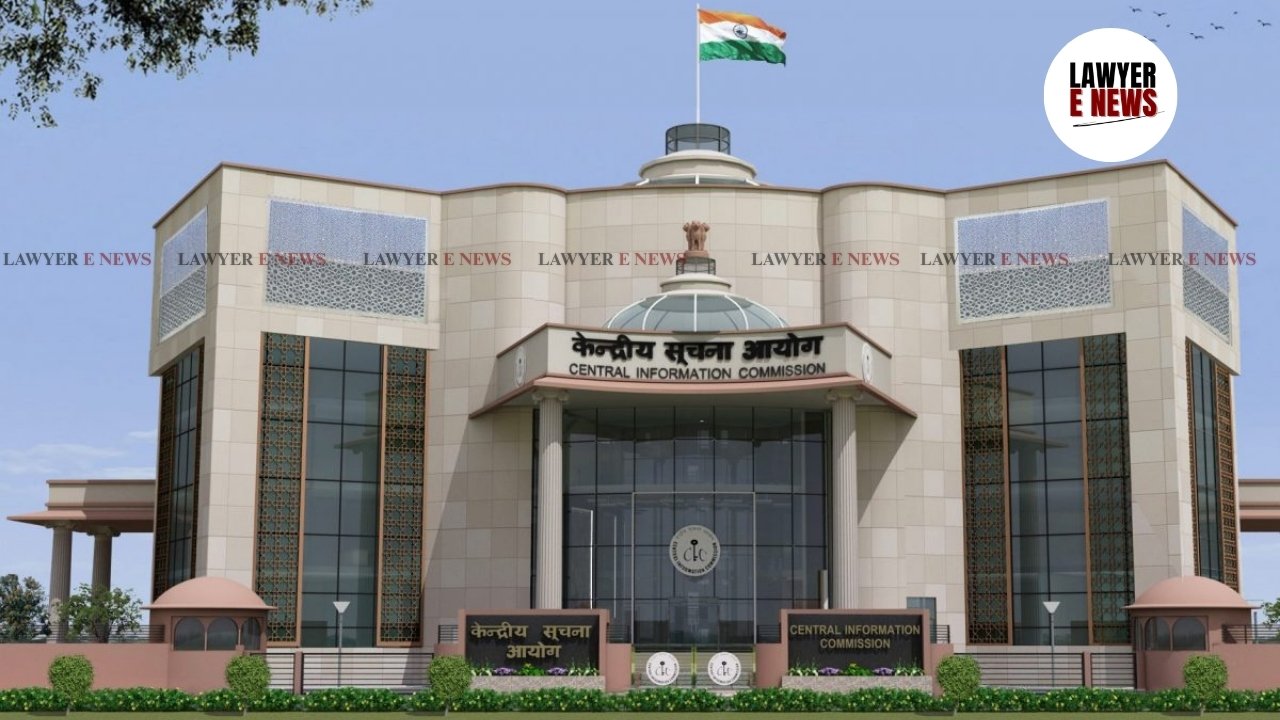
"RTI Act Cannot Be Permitted To Be Used As A Mechanism To Obtain Personal Information For Pursuing Private Disputes", In a significant ruling at the intersection of privacy, transparency, and matrimonial litigation, the Central Information Commission has held that asset and liability declarations filed by a public servant under the CCS (Conduct) Rules and the Lokpal and Lokayuktas Act are "intrinsically personal in nature" and cannot be disclosed under the Right to Information Act merely because the applicant claims an anti-corruption purpose — particularly when the applicant is the estranged wife of the very employee whose records are sought.
Information Commissioner Vinod Kumar Tiwari, deciding the Second Appeal on March 3, 2026, dismissed the appeal filed by Vijay Laxmi Mandraila, who had sought certified copies of her husband's asset declarations from 2018 to 2024, holding that the disclosure of such information to a third party would amount to an "unwarranted invasion of privacy" attracting exemption under Section 8(1)(j) of the RTI Act, 2005.
Vijay Laxmi Mandraila filed an RTI application in February 2024 seeking certified copies of all asset and liability declarations filed by her husband, Ankit Mandraila, an Inspector in the Income Tax Department (Exemption), since the date of his joining in 2018. The information sought was sweeping in scope — covering annual statements of assets and liabilities, movable and immovable property declarations, statements of debt and other liabilities, and the declaration made by him in relation to his spouse, all filed under Rule 18 of the Central Civil Services (Conduct) Rules, 1964 and Sections 44 and 45 of the Lokpal and Lokayuktas Act, 2013.
The CPIO denied the information under Section 8(1)(j) of the RTI Act, finding it to be personal information whose disclosure would cause an unwarranted invasion of the individual's privacy. The First Appellate Authority (FAA) upheld the denial, additionally noting that the appellant was the wife of the employee whose records were sought and that matrimonial litigation between the two was pending before various courts. Aggrieved, the appellant approached the Central Information Commission by way of the present Second Appeal.
On Whether Asset Declarations Are "Personal Information"
The Commission squarely addressed the central legal question and held against the appellant. Examining the nature of the information sought, the Commission observed that "the information sought by the Appellant pertains to detailed asset and liability declarations of a public servant filed under the CCS (Conduct) Rules and the Lokpal and Lokayuktas Act. Such declarations contain personal financial details including movable and immovable properties and liabilities, which are intrinsically personal in nature. The disclosure of these details to a third-party would amount to an unwarranted invasion of the privacy of the concerned individual and therefore attract the exemption under Section 8(1)(j) of the RTI Act."
The Commission thus declined to accept the appellant's argument that the statutory origin of these declarations — mandated by anti-corruption legislation — automatically strips them of their personal character. The mere fact that a public servant is required by law to file such declarations does not convert those declarations into public documents freely accessible to any RTI applicant on demand.
On the Role of Third-Party Consent Under Section 11
The Commission addressed the procedural argument about third-party consultation with notable nuance. It acknowledged that "third-party objection alone cannot be the sole ground for denial" — a significant concession to the appellant's legal position. However, it proceeded to hold that an independent assessment of the nature of the information confirmed that it squarely fell within the personal information exemption. The employee's express refusal of consent was therefore treated as a corroborating circumstance rather than the decisive ground.
The Commission relied on the Supreme Court's pronouncement in Girish Ramchandra Deshpande vs. Central Information Commission, where the Apex Court held that "details relating to assets, liabilities and service records of an employee constitute personal information and are exempt from disclosure unless a demonstrable larger public interest is established." The Commission found that precedent directly applicable to the facts at hand.
On the Appellant's Claim of Anti-Corruption Public Interest
"The Mere Assertion That Information Is Sought In The Interest Of Transparency Or To Fight Corruption, Without Any Cogent Material Substantiating Such Claim, Cannot Outweigh The Privacy Rights Of The Individual"
This observation from the Commission goes to the heart of what advocates frequently encounter in RTI litigation — the tension between claimed public interest and genuine privacy. The Commission held that a bare assertion of anti-corruption purpose, unsupported by any cogent material, cannot automatically override the privacy protections under Section 8(1)(j). The burden of demonstrating a specific, overriding, and larger public interest rests on the appellant — and that burden, the Commission found, had not been discharged.
On the Misuse of RTI in Matrimonial Disputes
The Commission took particular note of the matrimonial context of the dispute. The FAA had already flagged that matrimonial litigation between the parties was pending before various courts — a fact that cast a long shadow over the genuineness of the claimed public interest purpose. The Commission endorsed this reasoning, holding: "In such circumstances, the RTI Act cannot be permitted to be used as a mechanism to obtain personal information for pursuing private disputes." This is a significant and practically important observation, as it recognises a category of RTI misuse that courts and quasi-judicial bodies are increasingly confronting — where the RTI mechanism is deployed not in genuine public interest but as a discovery tool in private litigation.
The Commission, however, did not leave the appellant without a remedy. It directed that she is at liberty to file and pursue a petition for disproportionate assets against her husband before the appropriate forum — a forum better suited to examine such allegations with proper procedural safeguards and evidentiary standards.
The Central Information Commission's order draws a clear and important line: the RTI Act is a tool for public accountability, not a backdoor route to private litigation advantage. Asset declarations filed by public servants — though statutorily mandated — remain personal information whose disclosure requires the demonstration of a genuine and specific larger public interest, not merely a rhetorical invocation of anti-corruption ideals. Where matrimonial litigation provides the evident subtext of an RTI application, authorities are entitled to look beyond the stated purpose and decline to permit the statute's misuse.
Date of Decision: March 3, 2026