-
by sayum
27 August 2026 3:32 PM







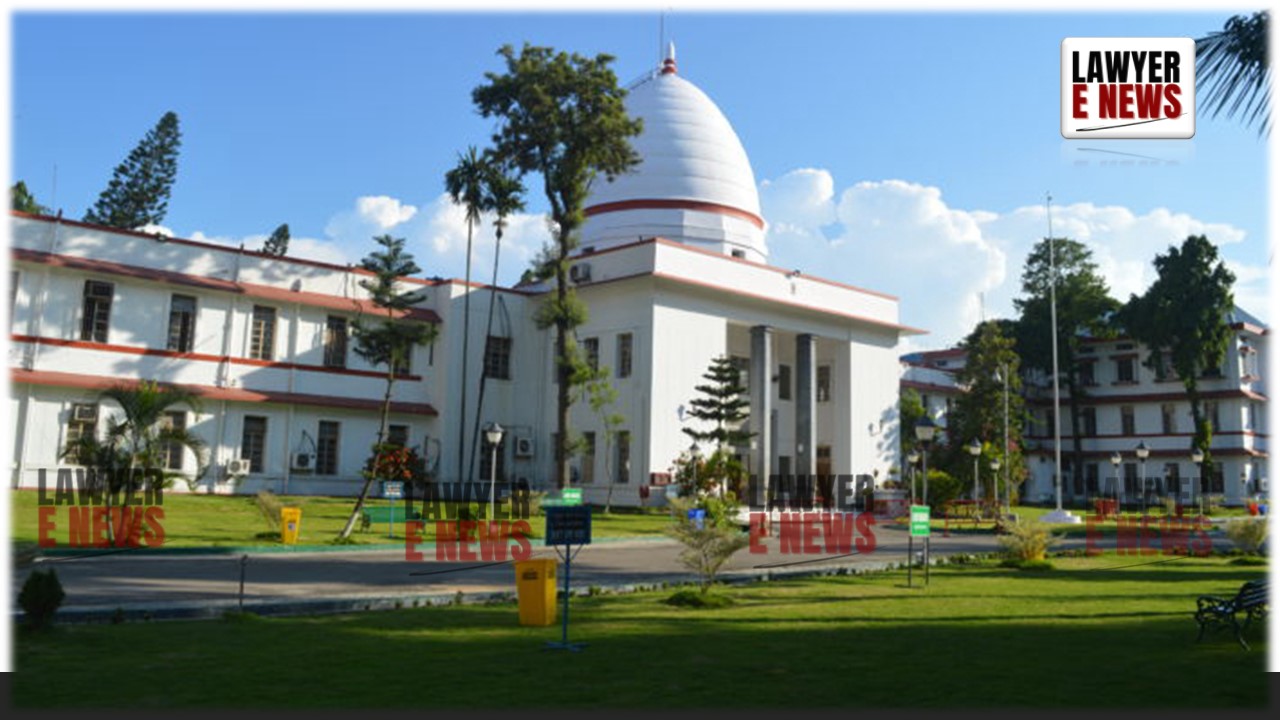
"Though the words confiscation, confiscating and confiscated have been used in Regulation 49, those are really a misnomer inasmuch as Regulation 49 provides for a stage prior to confiscation", Gauhati High Court, in a significant ruling, held that the administrative confiscation of a vehicle by forest authorities under Section 49 of the Assam Forest Regulation, 1891, is merely a temporary measure and not a final appropriation.
A single-judge bench of Justice Pranjal Das observed that a final and irrevocable confiscation can only be ordered by a Criminal Court under Section 51 of the Regulation upon the conviction of the accused. The Court further quashed criminal proceedings that had been languishing for over seven years, citing a violation of the right to a speedy investigation under Article 21 of the Constitution of India.
The case originated in August 2018 when forest personnel intercepted a truck transporting teak logs from Mizoram. The Divisional Forest Officer (DFO), Cachar, ordered the administrative confiscation of the vehicle in 2020 under Section 49(4) of the Regulation due to discrepancies in the transit pass and unmarked logs. While the petitioner unsuccessfully challenged this administrative order up to the Supreme Court, the actual criminal investigation into the forest offence remained incomplete for over seven years without the filing of a charge sheet.
The primary question before the court was whether administrative confiscation under Section 49 is independent and final or whether it remains a temporary stage pending the outcome of a criminal trial. The court was also called upon to determine if an unexplained delay of seven years in completing a forest offence investigation warrants the quashing of proceedings under Section 528 of the Bharatiya Nagarik Suraksha Sanhita (BNSS) and Article 21 of the Constitution.
Distinction Between Administrative And Judicial Confiscation
The Court analyzed the dual mechanism of confiscation provided under the Assam Forest Regulation, noting that Section 49(4) allows for administrative seizure by forest officials, while Section 51 empowers a Criminal Court to order confiscation upon conviction. Justice Das clarified that Section 51 only comes into play when a person is convicted of a forest offence, at which point the convicting Court may direct the confiscation of the produce and the tools used.
Section 49 Confiscation Is A Temporary Measure
The Court rejected the Forest Department's contention that Section 49 provides a parallel and entirely independent process of final confiscation. Relying on the precedent in Jogeshwar Borah v. State of Assam, the Court noted that the confiscation ordered by an Authorized Officer under Section 49 must be understood as a temporary stage.
Word 'Confiscation' In Section 49 Is A Misnomer
Citing Sambhu Saha v. State of Assam, the bench emphasized that the terminology used in the statute can be misleading. The Court observed that although the words 'confiscation' and 'confiscated' are used in Sub-Regulations (4) and (5) of Regulation 49, they are "really a misnomer" because the provision only deals with the stage of seizing property "liable to confiscation" rather than the final act of appropriation.
"The confiscation is visualized only in Section 51 upon conviction of a person of a forest offence."
Precedents From Other States Not Applicable
While the Forest Department relied on Supreme Court decisions involving the Forest Laws of Madhya Pradesh and Andhra Pradesh, which view administrative and judicial processes as independent, the High Court held these were not applicable. The bench noted that coordinate benches of the Gauhati High Court had already established a specific interpretation of the Assam Forest Regulation that remains binding.
Right To Speedy Investigation Under Article 21
Addressing the seven-year delay in investigation, the Court invoked the settled principle that the right to a speedy investigation is a fundamental facet of Article 21 of the Constitution. Referring to the Supreme Court's ruling in Robert Lalchungnunga Chongthu v. State of Bihar, the bench noted that investigations cannot continue endlessly, and an accused has the right to seek quashing if the delay is unduly long and lack justification.
"If investigation into a particular offence has continued for a period that appears to be unduly long, that too without adequate justification... the accused shall be at liberty to approach the High Court under Section 528 BNSS/482 Cr.P.C seeking quashing."
Applicability Of Government Withdrawal Policy
The Court also took note of the Government of Assam's notifications dated October 21, 2022, and September 20, 2024, regarding the withdrawal of petty and minor criminal cases to reduce judicial pendency. It observed that forest offences were not excluded from this policy and that the Department had not provided any reasons for the non-completion of the investigation despite the lapse of a considerable period.
Final Directions and Quashing of Proceedings
The Court concluded that since the investigation remained incomplete for seven years and the administrative confiscation was only temporary, the continued detention of the vehicle was unjustified. It held that quashing the proceedings would not prejudice the department as the petitioner had already been deprived of his vehicle for seven years. The Court quashed the criminal proceedings and directed the DFO, Cachar, to release the truck to the petitioner after usual verification formalities.
The Gauhati High Court reaffirmed that administrative seizure under the Assam Forest Regulation is a provisional measure that necessitates a subsequent conviction for finality. By quashing the 2018 proceedings, the Court emphasized that statutory powers of confiscation do not override the constitutional mandate of a speedy trial and investigation.
Date of Decision: 27 April 2026