-
by sayum
27 August 2026 3:32 PM







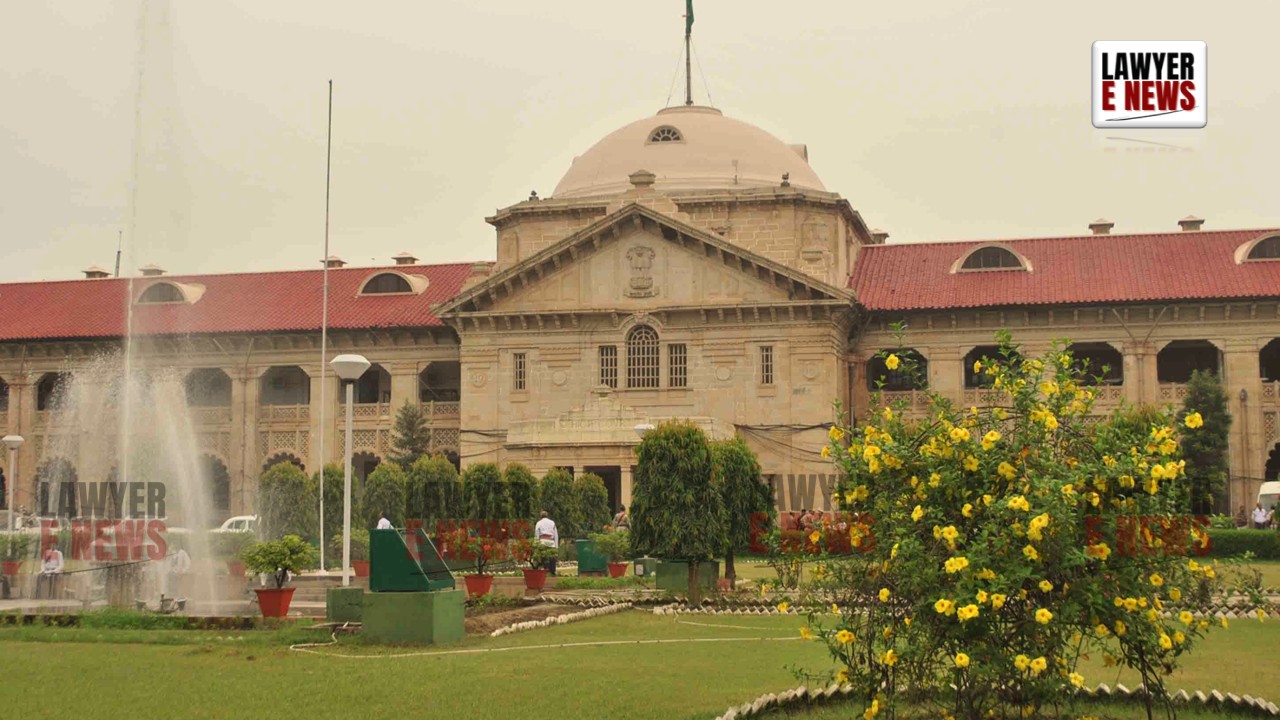
"An appointment of a minor to a public post is per se illegal, void, and non est in the eyes of law. Such an appointment lacks legal sanctity from its very inception and is liable to be treated as nullity," Allahabad High Court, in a significant ruling dated April 28, 2026, held that the appointment of a minor to any post within a recognized institution is inherently illegal and cannot be recognized in the eyes of law.
A bench of Justice Manju Rani Chauhan observed that such appointments are void ab initio and do not create any legal or equitable rights in favor of the appointee. The Court emphasized that "no right can accrue from an illegal appointment, and the Courts cannot be called upon to recognize or legitimize acts which are void ab initio."
The petitioners, Luxmi Shankar Tiwari and another, claimed to be working as a Peon (Class IV) and a Clerk (Class III) respectively at Shiv Durgeshwar Mahabir Poorva Madhyamik Vidyalaya, Varanasi. The dispute arose after the institution was brought onto the grant-in-aid list in 2006. The petitioners alleged that the school management had manipulated records to project them as Assistant Teachers instead of non-teaching staff to benefit the Manager's relatives, leading to the rejection of their salary claims by the Director of Education (Basic).
The primary question before the Court was whether a person who was a minor at the time of their alleged appointment can claim any legal right to a post or salary. The Court was also called upon to determine the effect of contradictory pleadings on a petitioner’s right to seek discretionary relief under Article 226 of the Constitution of India. Additionally, the Court examined whether the mandatory recruitment procedures under the relevant Service Rules of 1978 and 1984 were followed.
Petitioners Failed To Approach Court With Clean Hands
The Court expressed strong disapproval of the petitioners' conduct, noting significant inconsistencies in their pleadings. While in a previous writ petition they claimed to have been appointed in 1977, they shifted the date to 1980 in the present proceedings. The Bench observed that this was not a trivial discrepancy but a calculated attempt to mislead the Court.
The Court held that a litigant invoking extraordinary jurisdiction is under a solemn obligation to disclose full and correct facts. "Any suppression, concealment, or distortion of material particulars disentitles such a litigant from seeking discretionary relief under Article 226 of the Constitution of India," the Bench remarked. The Court concluded that the petitioners' mutually destructive stands rendered them undeserving of any judicial indulgence.
Minor’s Appointment To Public Post Is Non-Est In Law
On the merits of the appointment, the Court found that Petitioner No. 2 was admittedly a minor at the time of the alleged appointment. Even taking the improved date of 1980, the petitioner was only 13 years old, and according to earlier records, he would have been only 10 years old in 1977. The Court ruled that such an appointment lacks any legal foundation.
"It is a settled principle of law that any appointment of a minor to a post in an institution is impermissible and void ab initio."
The Bench placed heavy reliance on the Division Bench judgment in Ram Ashish Chaudhary and others vs. State of U.P. and others (2003), which settled the position that appointments of minors are per se illegal. The Court reiterated that no right, whether legal or equitable, can flow from an act that is void from its inception.
Non-Compliance With Statutory Recruitment Rules Vitiates Selection
The Court further observed that the appointments were in flagrant violation of the U.P. Recognized Basic Schools (Junior High School) (Recruitment and Conditions of Service of Ministerial Staff and Group ‘D’ Employees) Rules, 1984. These rules prescribe a mandatory minimum age of 18 years and specific educational qualifications, which a minor could not have possessed.
The Bench noted that there was no evidence of any advertisement, constitution of a proper selection committee, or participation of a nominee from the Basic Shiksha Adhikari. "Non-compliance with such mandatory requirements vitiates the entire selection process and renders the appointments wholly illegal and unsustainable in the eyes of law," the Court held.
No Claim For Salary From State Exchequer Without Valid Appointment
Regarding the claim for arrears of salary, the Court clarified that the State is not liable to pay salary unless the appointment is lawful and duly approved. In this case, the managerial return had been rejected by the competent authority, and the documents produced by the petitioners were found to be of doubtful authenticity.
The Court emphasized that equitable considerations cannot override statutory mandates. Since the petitioners failed to establish the legality of their appointments, their claim for salary from the State exchequer was deemed "wholly misconceived and legally untenable."
The Court concluded that the impugned order passed by the Director of Education (Basic) did not suffer from any perversity or illegality. Finding the writ petition to be devoid of merit and based on contradictory facts, the Court dismissed the plea, affirming that void appointments cannot be regularized or recognized for financial benefits.
Date of Decision: April 28, 2026