-
by sayum
27 August 2026 3:32 PM







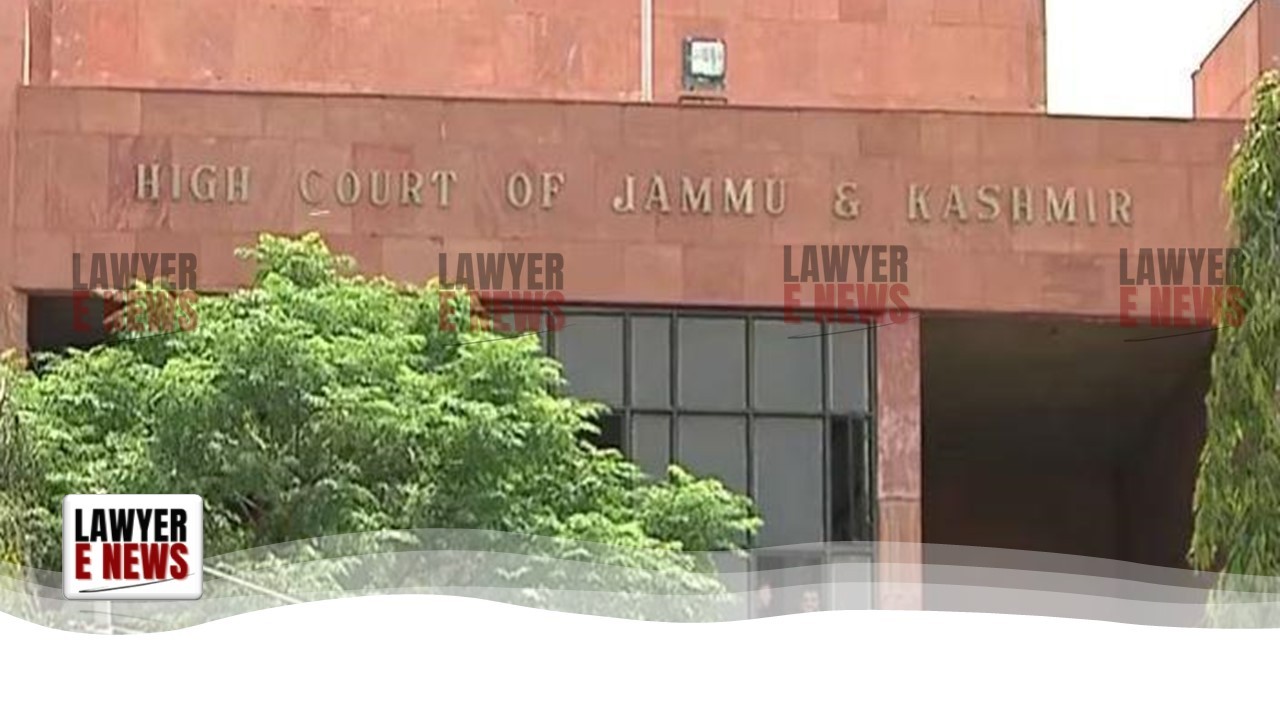
"Ring is closed to all except the petitioner and the candidates at the election. The concept of 'proper parties' is and must remain alien to an election dispute under the Representation of the People Act, 1951," High Court of Jammu & Kashmir and Ladakh, in a significant ruling, held that under the Representation of the People Act, 1951 (RPA), only contesting or returned candidates can be impleaded as respondents in an election petition.
A bench of Justice Sanjay Dhar observed that the concept of "proper parties" as defined under the Code of Civil Procedure (CPC) is "alien" to election disputes, which are strictly governed by special statutory provisions that exclude all non-candidates from the array of parties.
The Court emphasized that even if allegations of corrupt practices or impropriety are leveled against government officials or third parties, they cannot be made regular respondents at the commencement of the trial. The bench noted that the statutory design of the RPA ensures that the contest remains confined to those who actually participated in the electoral process, thereby preventing unnecessary harassment of public officials through vexatious litigation.
The petitioner, Harsh Dev Singh, filed an election petition challenging an election and impleaded not only the contesting candidates but also several government officers and officials (Respondents No. 1 to 9) against whom he leveled allegations of impropriety. Respondent No. 10 raised a preliminary objection regarding the misjoinder of parties, contending that Section 82 of the RPA only permits candidates to be parties to such disputes.
The primary question before the court was whether officers and officials against whom allegations of impropriety are made can be impleaded as respondents in an election petition along with contesting candidates. The court was also called upon to determine whether the procedural flexibility of the CPC could be invoked to join "proper parties" in an election dispute despite the restrictive language of Section 82 of the RPA.
Statutory Mandate Of Section 82 RPA On Joinder Of Parties
The Court began by analyzing Section 82 of the Act of 1951, which explicitly defines who "shall" be joined as respondents. The Court noted that the provision is divided into two categories: where a further declaration is claimed (all contesting candidates) and where no such declaration is claimed (all returned candidates). Additionally, any candidate against whom allegations of corrupt practice are made must be joined.
The bench observed that the provision is exhaustive and does not contemplate the impleadment of any individual who was not a candidate in the election. Justice Dhar emphasized that the legislative intent was to keep the "ring" of the election contest closed to outsiders to ensure the trial remains focused on the validity of the election result among the contestants.
"The concept of 'proper parties' is and must remain alien to an election dispute under the Representation of the People Act, 1951."
CPC Procedures Cannot Override Specific Provisions Of RPA
Addressing the petitioner’s argument that Section 87 of the RPA makes the CPC applicable to election trials, the Court clarified that such application is "subject to the provisions of this Act." The bench held that while the CPC generally allows for the joinder of "necessary" and "proper" parties to effectively adjudicate a suit, this power cannot be used to introduce a class of respondents that the RPA specifically excludes.
The Court held that anything in the CPC that is contrary to the RPA cannot be invoked. Since Section 82 specifically restricts the array of respondents to candidates, the Court cannot use its powers under the CPC to implead government officials or other non-candidates, regardless of how "proper" their presence might seem for the adjudication of the dispute.
"Anything contained in the Code of Civil Procedure which is contrary to the provisions of the Act of 1951 cannot be made applicable to trial of election petitions."
Section 99 Does Not Justify Impleadment At The Initial Stage
The petitioner had further argued that under Section 99 of the RPA, persons proved guilty of corrupt practices must be "named" by the Court, justifying their impleadment. However, the Court rejected this, clarifying that Section 99 operates at the conclusion of the trial. A non-candidate can only be given notice to show cause after evidence has been recorded and the Court finds sufficient material to hold them guilty.
The Court observed that the right given to such persons under Section 99 is limited to showing cause against being "named" in the final order and does not entitle them to participate in all stages of the trial as a regular party. The bench warned that allowing non-candidates to be joined at the filing stage could lead to the harassment of public personages and prevent the effective discharge of their public duties based on mere plausible allegations.
"The legislative provision contained in Sec. 99... is sufficient clarification of the legislative intent that such person may not be permitted to be joined as a party to the election petition [at the outset]."
Misjoinder Of Parties Established But Not Fatal To Petition
Applying these principles to the facts, the Court found that Respondents No. 1 to 9, being government officials and not candidates, were improperly joined. The bench ruled that their inclusion constituted a clear misjoinder of parties. However, the Court clarified that such a defect is not fatal to the maintainability of the election petition itself.
Citing Supreme Court precedents, the bench held that while a petition must be dismissed for non-joinder of necessary parties under Section 82, the misjoinder of unnecessary parties can be cured. The Court held that the appropriate remedy is not dismissal, but the striking off of the improperly impleaded parties from the array of respondents.
The Court decided the preliminary issue in favor of the respondents, establishing that there was indeed a misjoinder of parties. Consequently, the bench directed that Respondents No. 1 to 9 be struck off from the array of parties. The petitioner was directed to file an amended memo of parties by the next date of hearing, and the matter was listed for further proceedings on May 11, 2026.
Date of Decision: 20 April 2026