-
by sayum
27 August 2026 7:40 AM







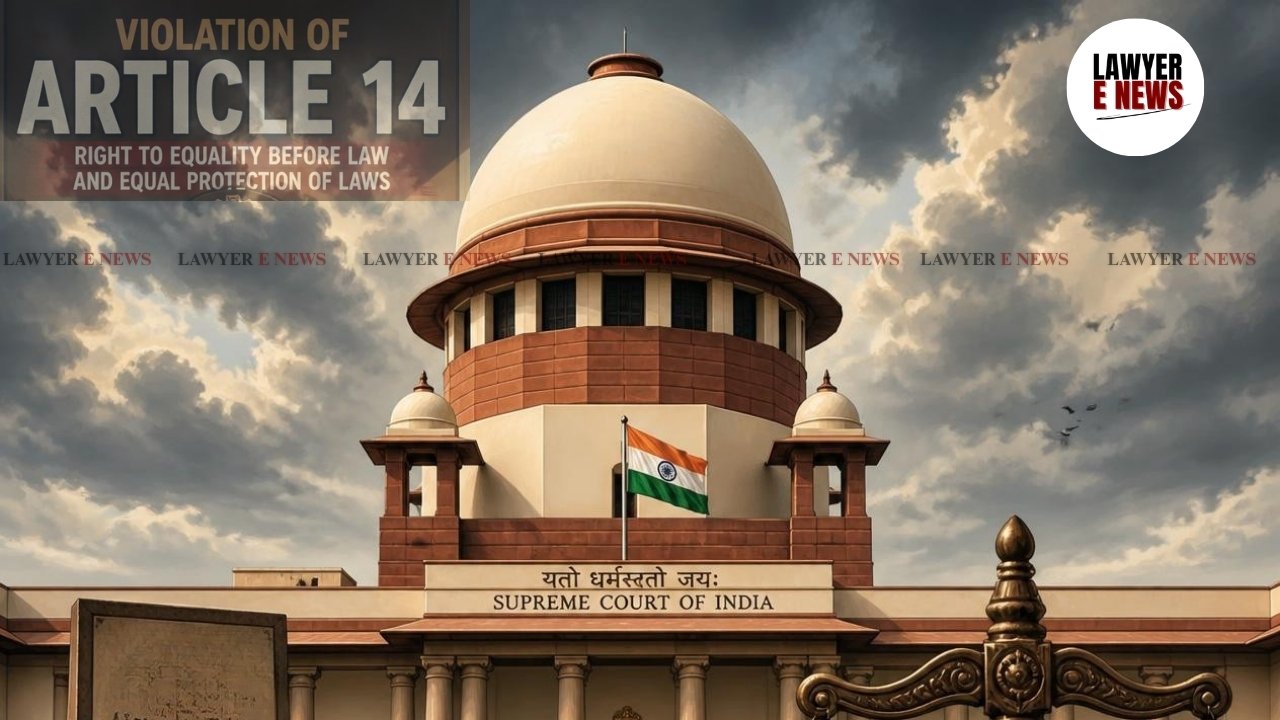
"On the face of it, Article 14 would be violated since it is specifically intended for securing the rights of indigenous communities but is being applied to people not amongst them." Supreme Court of India, in a significant ruling delivered on August 06, 2026, held that Civil Courts possess the requisite jurisdiction to entertain civil disputes of succession and partition between exclusively non-tribal parties, even when the property is situated within Scheduled Areas.
A bench comprising Justices Sanjay Karol and Nongmeikapam Kotiswar Singh observed that applying special procedures meant for tribal protection to non-tribals would violate Article 14 of the Constitution of India.
The dispute originated from a civil suit filed by the appellants for partition and separate possession of property. The Civil Court dismissed the suit, concluding that partition had already taken place, no joint family property existed, and the suit was barred by limitation.
The First Appellate Court, however, allowed the appeal, holding that the properties were joint family properties and that the Civil Court had jurisdiction over disputes in Scheduled Areas. This decision was then challenged in a second appeal before the High Court for the State of Telangana.
The High Court, relying on the judgment in Nagarjuna Gramin Bank v. Medi Narayana, set aside the First Appellate Court's decision, erroneously concluding that Civil Courts lacked jurisdiction over properties situated in Scheduled Areas. This prompted the aggrieved parties to file the present Civil Appeal before the Supreme Court.
The primary legal question before the Supreme Court was whether Civil Courts have jurisdiction to adjudicate property disputes between non-tribal parties in Scheduled Areas. A pivotal aspect of this inquiry involved determining the binding nature of the Nagarjuna Gramin Bank judgment.
Nagarjuna Gramin Bank Not a Binding Precedent
The Supreme Court commenced its analysis by addressing whether Nagarjuna Gramin Bank v. Medi Narayana (CA 5037-5038 of 2004, and (2013) 11 SCC 367) constituted a binding precedent. It concluded that the Nagarjuna judgment did not lay down any proposition of law that would bind the present case.
Judicial Deference, Not Legal Adjudication
The bench clarified that the Nagarjuna decision was a case of judicial deference to the executive and legislature. It was based on a high-powered committee's decision regarding the retention of the existing system in Scheduled Areas, rather than a legal analysis of the Andhra Pradesh Civil Courts Act, 1972.
Identifying Ratio Decidendi: The "Inversion Test"
The Court reiterated established principles for identifying the ratio decidendi of a judgment, referring to cases like Read and others v. The Bishop Of Lincoln Respondent [1892 A.C. 644] and Abdul Kayoom v. CIT (1961 SCC OnLine SC 244). It specifically cited the "Inversion Test" propounded by Professor Eugene Wambaugh, endorsed in State of Gujarat v. Utility Users' Welfare Assn. [(2018) 6 SCC 21].
Conclusion Over Legal Principle
It was emphasized, drawing from Career Institute Educational Society v. Om Shree Thakurji Educational Society [(2023) 16 SCC 458], that only statements of legal principles applicable to the facts constitute a precedent, not mere findings of material facts or conclusions. The Nagarjuna case, being a conclusion based on an executive decision, thus did not establish a binding legal principle.
Historical Context of Tribal Protection
The judgment meticulously traced the history of constitutional protection for tribals and Scheduled Areas, referencing the Scheduled Districts Act, 1874, and the Andhra Pradesh Agency Rules, 1924. It also relied on the comprehensive overview in Samatha v. State of A.P. [(1997) 8 SCC 191] regarding legislative interventions for tribal welfare.
Protecting Tribals from Exploitation
The Court noted the consistent governmental policy, right from colonial administration, to treat Agency areas distinctly to protect tribals from exploitation by moneylenders and other migrants. The aim was to preserve their rights, title to land, autonomy, and culture.
Constitutional Safeguards under Fifth Schedule
Part X of the Constitution, dealing with "Scheduled Tribes and Tribal Areas," along with Article 244(1) and the Fifth Schedule, grants powers to the Governor to make regulations for the peace and good government of Scheduled Areas. These powers include restricting land transfers and regulating moneylending, reflecting the framers' intent to safeguard tribal land.
Purpose of Scheduled Area Exclusion
The Court underlined that the primary objective of notifying an area as a Scheduled Area is to protect its tribal population. The exclusion of "modern" rules and regulations in latent disregard for age-old customs serves to maintain their sense of community and prevent exploitation.
Andhra Pradesh Civil Courts Act, 1972 and Scheduled Areas
The Andhra Pradesh Civil Courts Act, 1972, which came into effect on November 1, 1972, explicitly excluded its application to Scheduled Areas via a government notification. This exclusion was a cornerstone of the High Court's impugned judgment.
Lack of Rational Nexus for Non-Tribals Violates Article 14
The Supreme Court held that while the protection of tribal people and their property is paramount, extending these special procedures to non-tribal parties in Scheduled Areas lacks any rational nexus. Such an application serves no purpose relevant to the protective intent of the law.
"When the object sought to be achieved by agency courts continuing in the Scheduled Areas is to protect the tribal people, the tribal property, their customs and practices, what is achieved by subjecting non-tribal people in that area to such special procedure? There is only one answer. Nothing."
Equality Before Law and Reasonable Classification
The bench underscored that applying laws specifically intended for indigenous communities to non-tribals, who do not share the same vulnerabilities, would violate Article 14 of the Constitution. This article demands equality before the law and equal protection of the law, necessitating a rational classification that bears nexus to the object sought to be achieved.
Tests for Permissible Classification
Referring to principles articulated in State of Madras v. V.G. Row [(1952) 1 SCC 410], Chitra Ghosh v. Union of India [(1969) 2 SCC 228], and State of Punjab v. Davinder Singh [(2025) 1 SCC 1], the Court reiterated that any classification must be founded on an intelligible differentia and have a rational relation to the object of the statute. Applying tribal protection measures to non-tribals failed this test.
Civil Courts' Jurisdiction Restored for Non-Tribal Disputes
Consequently, the Supreme Court held that the Civil Court had the requisite jurisdiction to entertain the dispute between exclusively non-tribal parties, even though the land was situated within Scheduled Areas. The High Court's erroneous finding on jurisdiction was therefore set aside.
Caveat: Agency Courts Retain Jurisdiction if One Party is Tribal
The Court clarified that its conclusion on civil court jurisdiction applies only to disputes involving exclusively non-tribal parties. If even one party to the dispute is a tribal residing in the Scheduled Areas, the Agency Courts would retain their jurisdiction.
The appeal was allowed, and the impugned judgment of the High Court was set aside. The second appeal was restored to the file of the High Court for a decision on merits, consistent with the present judgment. Parties were directed to appear before the High Court on August 24, 2026, with hearing expedited. No costs were imposed.
This landmark judgment by the Supreme Court provides crucial clarity on the jurisdictional limits of Civil Courts in Scheduled Areas. By distinguishing between disputes involving tribal and non-tribal parties, the Court has affirmed the protective intent behind laws for Scheduled Areas while simultaneously upholding the constitutional guarantee of equality under Article 14 for non-tribals. The ruling emphasizes that the application of special laws must align with their intended purpose and rational nexus.
Date of Decision: August 06, 2026