-
by sayum
27 August 2026 7:40 AM







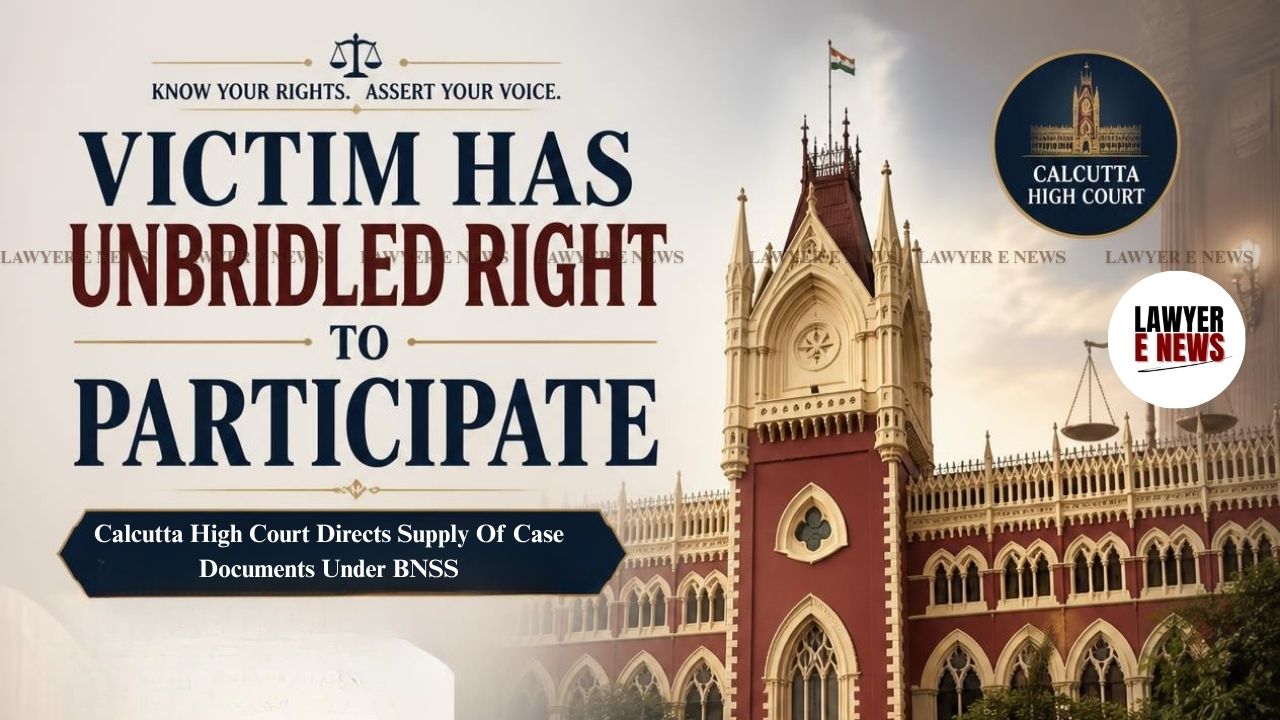
"The prayer always has to be considered in substance and not merely in its form. It is the business of the court to know the law... there is no obligation on the litigant to inform the court under which statute or section she is entitled to claim the remedy." Calcutta High Court, in a significant ruling, held that a victim’s right to obtain documents under the Bharatiya Nagarik Suraksha Sanhita (BNSS) cannot be defeated merely by a technical error in citing the repealed Code of Criminal Procedure (CrPC).
Justice Dr. Ajoy Kumar Mukherjee observed that the victim possesses an "unbridled participatory right" from the stage of investigation until the culmination of the criminal proceedings.
The case arose after a trial court rejected the victim’s plea for copies of investigation documents, reasoning that the proceedings were instituted under the CrPC and that the CrPC contained no provision for supplying such copies to a victim. The trial court maintained that the victim could not claim rights under the newly enacted BNSS, which mandates the supply of documents to both the accused and the victim.
Court Rejects Mechanical Application of Law
The primary question before the court was whether a victim’s application for documents should be dismissed for citing the repealed CrPC instead of the applicable BNSS. Additionally, the court had to determine if the victim’s right to receive investigation documents is legally substantive or merely procedural.
"Wrong Section Citation Not Fatal To Relief"
The High Court clarified that the invocation of the BNSS was mandatory for all applications filed on or after July 1, 2024. Addressing the trial court's technical approach, Justice Mukherjee emphasized that the law empowers, and indeed mandates, the court to apply the correct provision regardless of the section cited by the litigant.
"Court Below Is Not Supposed To Reframe The Legislation"
The bench held that since the application was filed after the BNSS came into force, the trial court was bound by Section 230 of the BNSS. This section explicitly mandates that the Magistrate must, without delay, furnish copies of documents to the victim, provided they are represented by an advocate. The court noted that refusing these documents amounts to a "perversity" that ignores the legislative intent behind the new Sanhita.
"Victim Entitled To Evaluate The Investigation"
The court further observed that a victim has a right to assess whether an investigation was conducted in the proper direction. By enabling the victim to access investigation papers, the law ensures that their participation is not just symbolic but effective. The court drew heavily upon the Supreme Court’s ratio in Jagjeet Singh vs. Ashish Mishra, which established that a victim has a legally vested right to be heard at every step of the criminal proceeding.
"Victim Has Unbridled Participatory Right From Stage Of Investigation Till Culmination"
The Court underscored that the right to participate in the proceedings is not contingent upon the commencement of the trial. By denying the documents, the trial court had effectively hindered the victim's ability to potentially file a protest petition or effectively challenge an improper investigation. The Calcutta High Court’s ruling reinforces the modern legal shift toward victim-centric criminal jurisprudence.
Direction To Provide Documents Within Ten Days
Allowing the petition, the High Court set aside the trial court’s order and directed the magistrate to supply the requested documents to the victim within ten days. This judgment serves as a vital precedent for lower courts, asserting that procedural technicalities regarding the transition from CrPC to BNSS must not be used to strip victims of their statutory rights to information and participation.
Date of Decision: 20 August 2026