-
by sayum
27 August 2026 7:40 AM







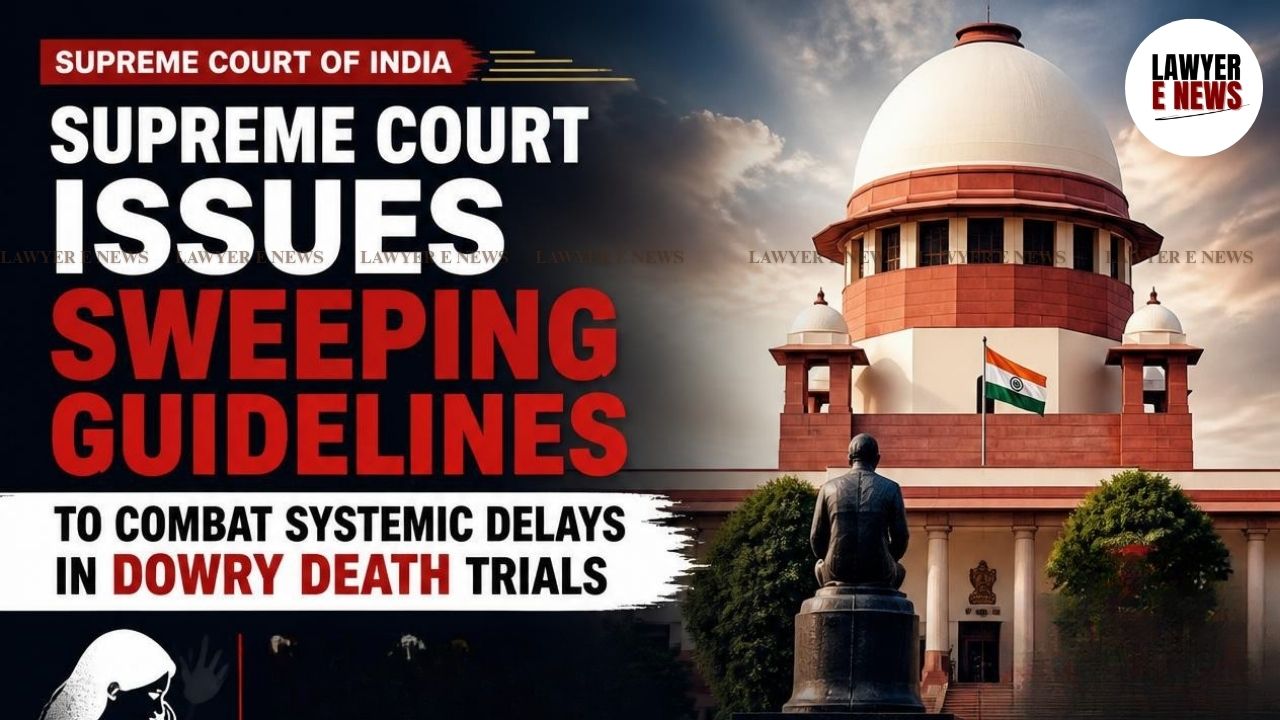
"The practice of dowry unfortunately has deep roots in society, hence, it being not a matter of swift change, a concentrated effort is needed on the part of all the involved parties" Supreme Court, in a significant order, has mandated a comprehensive structural overhaul for the trial and prosecution of cases under Section 304-B and 498-A of the IPC (corresponding to Sections 80 and 85 of the Bharatiya Nyaya Sanhita, 2023).
A bench of Justices Sanjay Karol and Augustine George Masih observed that while legal recourse exists, the implementation of the Dowry Prohibition Act, 1961, remains fraught with systemic inefficiencies, leading to inordinate delays that ultimately defeat the cause of justice. The Court emphasized that a multi-stakeholder approach involving the legislature, judiciary, and civil society is the only viable path to eradicating this deep-seated social malice.
Need for Multi-Dimensional Reform
The Court underscored that the fight against dowry-related violence cannot be confined to the courtroom alone. Recognizing that legislative tools have often been ineffective due to poor enforcement, the bench directed the Union and State Governments to integrate awareness into educational curricula. The objective is to dismantle the patriarchal notion that marriage partners are subservient to one another, a fallacy reinforced by the exchange of money or articles during matrimony.
Strengthening Institutional Support
Beyond awareness, the Court issued specific directives to operationalize the dormant mechanisms of the Dowry Prohibition Act. States are now required to ensure the effective appointment and visibility of Dowry Prohibition Officers, whose contact details must be disseminated to the public. Furthermore, the judiciary and law enforcement agencies are to be periodically sensitized to the psychological and social nuances of these cases to distinguish between genuine grievances and the abuse of legal processes.
Priority Classification of Pending Cases
Highlighting a specific instance where a trial took 24 years to conclude, the Court ordered High Courts to conduct an immediate stock-taking of all pending matters under Section 304-B and 498-A. Courts have been directed to identify cases pending for over three years, particularly those stuck at the charge-framing or evidence-recording stages, and to implement a mandatory monthly or quarterly review mechanism to ensure their expeditious disposal.
"It is not lost on us that the instant case began in 2001 and could only be concluded 24 years later by way of this judgment"
Strict Timelines for Trial Progression
To curb the culture of endless adjournments, the bench directed that trial courts should, as far as practicable, adhere to structured timelines. Charges should be framed within 60 to 90 days of the charge-sheet filing, and trials must proceed on a day-to-day basis as envisaged under Section 309 CrPC and Section 346 of the Bharatiya Nagarik Suraksha Sanhita (BNSS), 2023. The Court also mandated the preparation of a "witness calendar" immediately after the framing of charges to ensure the presence of material witnesses.
Mandatory Witness Management
The Supreme Court stressed that the transfer or retirement of an investigating officer should no longer serve as a pretext for deferring proceedings. A substitute officer must be nominated in advance to maintain the continuity of the trial. Furthermore, to discourage unnecessary delays, the Court observed that where defense counsel repeatedly remains absent without sufficient cause, the trial courts are empowered to appoint Legal Aid Counsel or Amicus Curiae to ensure the process remains unhindered.
Technological Integration in Case Monitoring
High Courts are now tasked with integrating digital dashboards into their existing Case Information System infrastructure to provide real-time updates on stage-wise pendency. This digital oversight is expected to trigger automated alerts for older cases. Additionally, the Supreme Court has ordered that periodic status reports, including statistics on disposals, awareness initiatives, and the functioning of institutional support mechanisms like One Stop Centres and Family Counselling Centres, be filed by the States and High Courts.
Final Accountability and Compliance
The Court explicitly directed that these compliance-cum-periodic reports be submitted by the 15th of January, May, and September each year. This is to remain in effect until the pendency of dowry-related cases is substantially reduced. The matter is next listed for hearing on October 15, 2026, to monitor the initial phase of compliance with these far-reaching administrative and judicial directives.
Date of Decision: 20 August 2026