-
by sayum
24 August 2026 3:22 PM







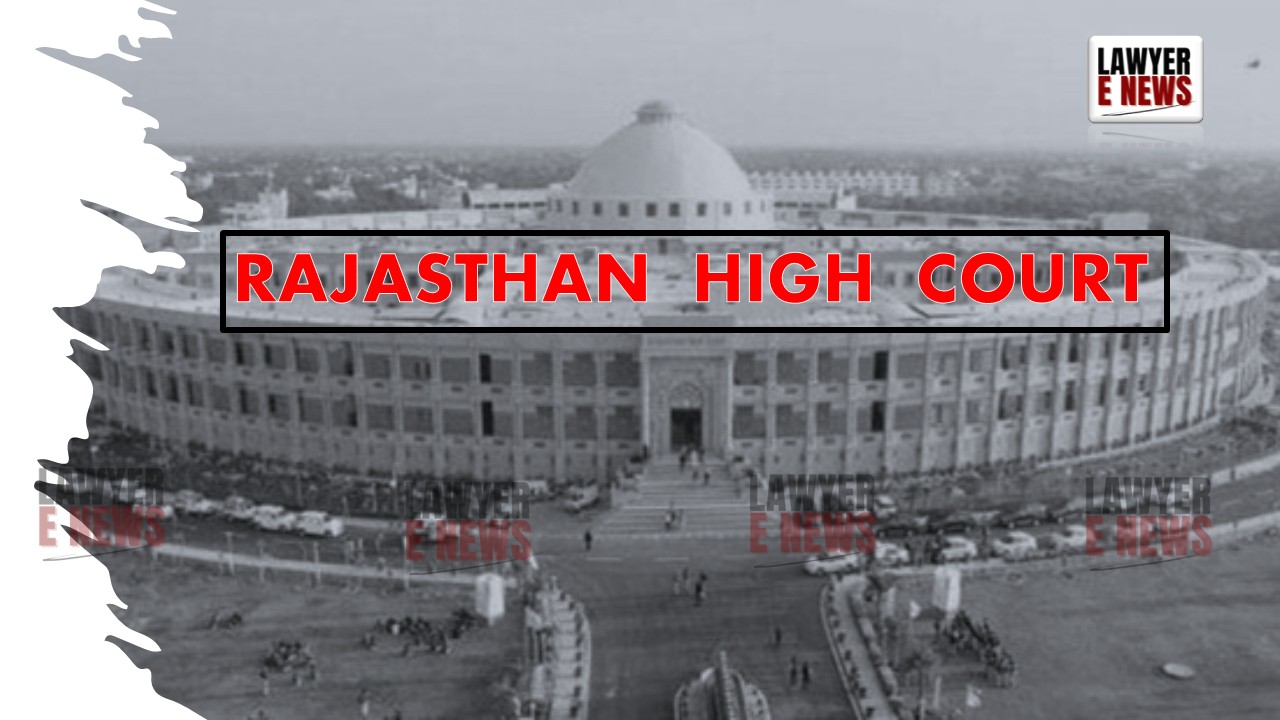
“Once you accept an order and act upon it, you cannot go back and challenge it later—law does not allow such flip-flops”: In a significant ruling Rajasthan High Court at Jodhpur, through Justice Rekha Borana, dismissed a writ petition filed by the Urban Improvement Trust (UIT), now Jodhpur Development Authority, challenging the grant of khatedari rights to a cultivator over land which the UIT had already regularised and allotted to multiple allottees nearly two decades ago.
The case arose from S.B. Civil Writ Petition No. 10317 of 2009, where UIT attempted to reopen proceedings relating to Khasra Nos. 83, 104 and 108 in Village Chopasani Jagir, Jodhpur, land which it claimed vested in it since the area had been notified as an urban region under Section 3 of the Rajasthan Urban Improvement Act, 1959, as early as 1977.
However, the Court noted that the UIT had, after losing before the Revenue Appellate Authority (RAA) and Board of Revenue (BOR) in 2003, gone ahead and issued pattas to private purchasers in 2005 under Section 90-B of the same Act. Not only that, the UIT had also granted construction permissions on those lands.
The Court made it clear that UIT, after having accepted and acted upon the revenue orders, could not be permitted to challenge them years later. Calling out the belated writ petition filed in 2009, the Court said:
“The present petition in the year 2009 is clearly a malafide attempt on the part of the UIT.”
The High Court said this was a classic case where the doctrines of waiver, estoppel and acquiescence applied in full force. Citing binding Supreme Court precedents such as Rajasthan State Industrial Development & Investment Corporation v. Diamond & Gem Development Corporation, the Court observed:
“No party can be allowed to approbate and reprobate. A person cannot at one time say a transaction is valid to gain advantage and later turn around to say it is void for another benefit.”
The Court also reminded UIT that State authorities cannot behave like private litigants, nor can they act in contradiction to their earlier positions. It held:
“UIT being a State instrumentality cannot be permitted to act irrationally, arbitrarily and malafidely.”
It was further noted that the UIT had even contested other cases before the High Court in 2008, in which it had not raised any dispute about the khatedari rights of Girdhari—the original cultivator—whose claim the 2003 orders had upheld. Observing this, the Court remarked:
“Interestingly, no objection regarding the khatedari rights of Girdhari was raised by the UIT in the said writ petition. The dispute was only as to who should receive the pattas.”
Justice Borana also dismissed the UIT's technical arguments that the land was “urban land” and therefore outside the jurisdiction of the revenue courts, stating that such arguments could no longer be entertained after UIT voluntarily implemented the revenue orders by issuing pattas.
Coming to the challenge raised by Smt. Koyali, widow of Bhera Ram (Girdhari’s brother), the Court upheld the principle of estoppel in her case too. While she initially claimed rights over all three khasras, she later gave written statements and No Objection Certificates in 2003, expressly waiving her rights over Khasra Nos. 83 and 104 after entering into a private settlement. The Court held:
“Even if it is held that Koyali was entitled to claim khatedari rights, by her acts and conduct she clearly waived them and cannot be permitted to raise her claim de novo.”
The High Court, however, protected her rights in Khasra No. 108, holding that:
“There is no reason why Koyali could have been deprived of her share when she was admittedly the sole legal heir of the joint cultivator Bhera Ram.”
The Court affirmed an earlier order of the RAA dated 22.02.2005, which had granted 50% khatedari rights in Khasra No. 108 to Koyali, while rejecting her claims to the other two khasras.
In another twist, one Hanuman Ram, son of Girdhari, had claimed exclusive rights on the basis of an alleged Will executed by Bhera Ram in 1980. The Court found that the Will had never been proved in any civil proceedings, and Hanuman had earlier acquiesced to his father's rights, even acting as a witness to sale deeds executed by Girdhari. Justice Borana observed:
“Once having accepted the khatedari rights conferred on his father, Hanuman Ram cannot now assert exclusive rights on the basis of an unproven Will.”
The Court thus rejected the Board of Revenue’s 2018 order which had allowed Hanuman Ram’s application under Order 41 Rule 21 CPC, calling it unsustainable and based on an erroneous assumption that Hanuman was denied a fair hearing.
The Court’s ruling also clarified that the Divisional Commissioner’s order from 2007 cancelling the pattas was already set aside in 2008 by a single judge bench in W.P. No. 42/2008, and that such a ruling was a judgment in rem, thereby benefitting all patta holders and not just the petitioner in that case.
In conclusion, the Court dismissed the UIT’s writ petition, holding that its conduct was malafide, inconsistent and legally untenable. It ruled:
“UIT’s conscious decision to act upon the orders of the RAA and BOR by issuing pattas and granting construction permissions amounted to an intentional abandonment of its right to challenge them.”
The Court also partly allowed the writ petitions filed by Koyali, restoring her rights only in Khasra No. 108 and dismissed all claims by Hanuman Ram. Other related writ petitions were disposed of, keeping in view the already existing binding rulings and pending special appeals.
Date of Decision: 27 October 2025