-
by sayum
19 August 2026 8:35 AM








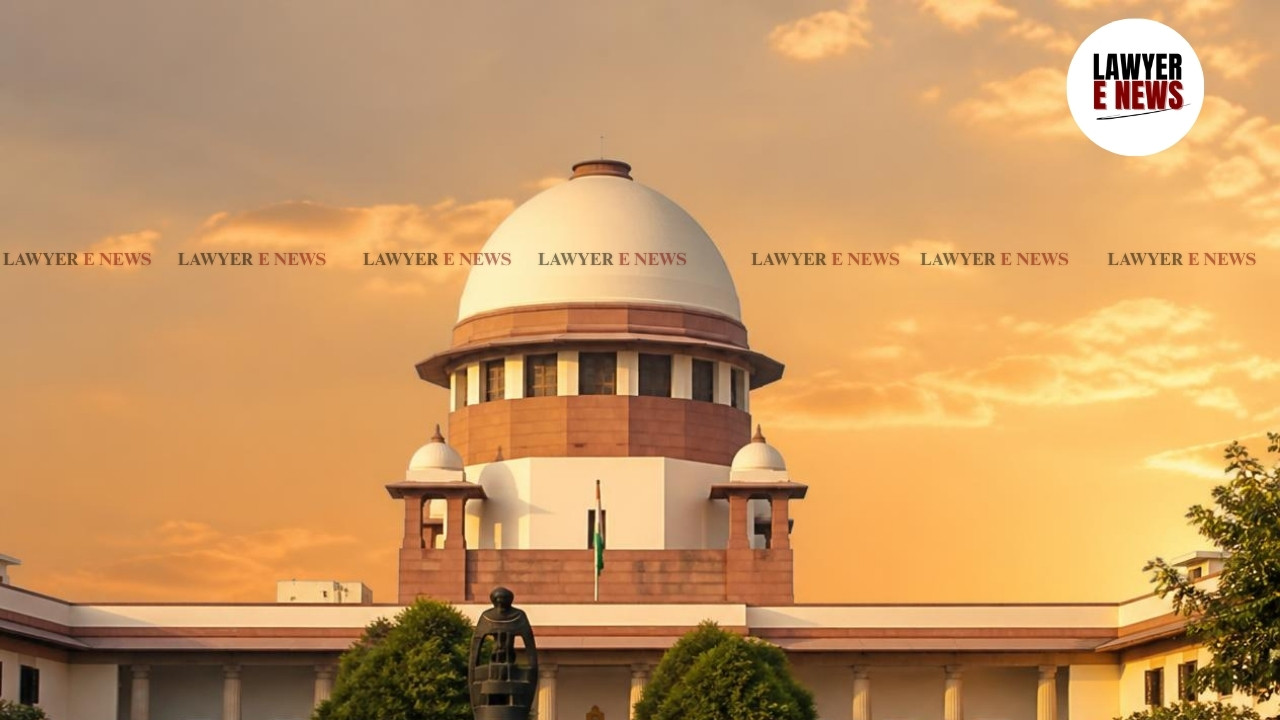
"[T]ime in public procurement, whether goods or services, is not just to be measured against the calendar for the purposes of limitation but as against the progression of the process." Supreme Court, in a significant ruling dated August 18, 2026, held that a challenge to tender eligibility conditions must be brought with due promptitude and cannot be entertained at an advanced stage of the procurement process where third-party rights have accrued.
A bench of Justice K.V. Viswanathan and Justice Arun Palli observed that judicial discretion must be exercised with extreme circumspection to ensure that fence-sitters and delayed litigants do not disrupt ongoing public projects involving vital public interest.
The Directorate of Education, Government of NCT of Delhi, had floated multiple tenders for the procurement of sports goods and outdoor gymnasium equipment for government schools. Several aggrieved entities collectively filed writ petitions before the High Court of Delhi challenging various tender conditions, including past performance criteria, mandatory physical sample submissions, and operational office-warehouse stipulations in Delhi. The High Court dismissed the petitions primarily on grounds of delay, laches, and non-participation, prompting the present civil appeals before the Apex Court.
The primary question before the court was whether a challenge to tender eligibility conditions could be entertained at an advanced stage when the procurement process had materially progressed and contracts stood awarded. The court was also called upon to examine whether the doctrine of delay and laches applies strictly to public procurement matters involving large-scale educational infrastructure.
Court Explains Compressed Timelines In Tenders
The Supreme Court emphasized that tender schedules operate within compressed and purpose-bound timelines where time is of the extreme essence. The bench noted that a delay of a few months in the life of a tender marks a critical distance between invitation, evaluation, selection, and the crystallization of competing commercial interests.
"Delay Is Not Assessed By Counting Days Alone"
The court held that delay in public procurement matters cannot be measured by merely counting calendar days. Instead, it must be assessed by reference to what has occurred during those intervening days, whose interests have arisen, and what adverse public consequences would follow from unsettling the process at a belated stage.
Challenge To Conditions Accrues Upon Publication [
The bench clarified that a challenge to a tender condition or eligibility criterion accrues on the very day the condition is published, unlike a challenge to the evaluation of a specific bid. An entity that finds itself excluded owing to a perceived arbitrary condition must at the earliest approach the court without conscious inaction.
"Nothing further is required to be discovered. Therefore, an entity which finds itself excluded or ineligible owing to a condition that is perceived to be arbitrary or unconstitutional, must at the earliest raise that grievance by approaching the Court."
Protection Of Participatory Rights
The court underscored that bidders who participated in the tendering process, met every eligibility criterion, and successfully underwent rigorous technical evaluations acquire substantial rights and interests as price bids near finalization. To stall the process and afford judicial indulgence to late-approaching litigants would be unfair and unjust to compliant participants.
Larger Public Interest And School Children
Highlighting the broader socioeconomic impact, the bench noted that the dispute was not merely a commercial contest between private actors. The procurement involved sports and gym equipment worth over thirty-four crores intended for approximately sixteen lakh school children, a vital delivery pipeline that cannot be brought to a standstill by belated litigation.
Distinguishing Precedents On Territorial Restrictions - Vinishma Technologies Distinguished
Addressing the appellants' reliance on the coordinate bench decision in Vinishma Technologies Pvt. Ltd. v. State of Chhattisgarh, the court examined whether territorial sourcing restrictions applied to the Delhi DoE tenders. The court noted that the Delhi stipulation requiring a functional office and warehouse in Delhi/NCR was operational rather than geographically exclusionary, designed specifically to ensure prompt installation, maintenance, and safety compliance for school equipment.
Concluding that the appellants' case suffered from a lack of bona fides and substantial delay, the court affirmed the High Court judgment and dismissed both civil appeals. However, the bench left the larger question regarding the constitutional validity of Clause 2.17 open to be examined in an appropriate, timely proceeding.
Date of Decision: 18 August 2026