-
by sayum
21 October 2026 5:27 PM







D.D: 21 JUNE 2022
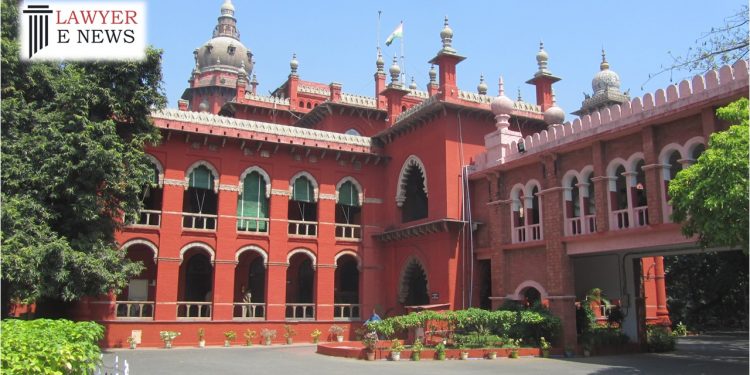
The Madras High Court, in dismissing the appeal of a retired sub-inspector challenging the order of punishment of a reduction in the pay scale by three stages for three years, expressed its concern over police officers taking bribes and thereby affecting the welfare of the public.
Justice SM Subramaniam believed that whenever police officials are discovered to have accepted bribes, criminal charges should be filed against them. These offences had to be punished without leniency or misplaced compassion.
It observed the following: "In all such instances where the receipt of mamool is discovered, criminal cases must be filed against the police officials who accepted it. Effective monitoring of these offences is necessary and imminent. Thus, respondents 1 and 2 are obligated to take all necessary steps to ensure that the receipt of mamool by police officials, specifically in jurisdictional police stations, is effectively controlled and that violations in this regard are dealt with according to the law, without leniency or misplaced compassion."
The public servant is expected to carry out his or her duties and responsibilities with the utmost integrity and honesty. There should be no room or room for such allegations of corruption. Examining the entire investigation officer's report, it is evident that the allegations that police officials received mamool are proven. However, the sanction imposed is a three-step reduction in pay.
Even further, the court concluded that the police department had not taken the matter seriously. Even after the corruption allegations were proven, no criminal complaint was filed against the police official for accepting mamool. This demonstrated the authorities' insensitivity towards corruption.
"It is painful to write that, for the implementation of beneficial schemes and government orders, public servants and, in some cases, higher officials demand various forms of corruption, and that the responsible higher officials are completely insensitive to controlling corruption. In addition to the demand and acceptance of money, corruption manifests itself in numerous other ways "the judge added.
In the present case, the writ petitioner was hired in 1977 as a Gr-II Police Constable, was promoted to the rank of Special Sub Inspector of Police, and retired in 2010 upon reaching the age of retirement. While he was in service, a charge memo was issued alleging that he received Rs. 50/- twice a week from Mr. Ravi, who ran a bunk shop near the TASMAC Shop. An inquiry officer was appointed, who, after conducting an investigation, concluded that the petitioner's accusation was proven. The disciplinary authority accepted the investigation officer's findings and imposed a punishment of a three-stage reduction in pay for three years, with the period of reduction serving to postpone future increments for three years. The petitioner's preferred appeals were denied. Therefore, he approached the Supreme Court.
The petitioner's primary argument was that he had approximately 35 years of impeccable service and that the charges are based on a false complaint. He also argued that the investigation was not conducted properly and that the documents relied upon were not provided. In addition, he argued that the punishment was imposed near the end of his retirement, so it cannot be implemented. He cited a circular issued by the Director-General of Police on May 27, 2010, in which it was stated that the disciplinary authorities must ensure that the punishment imposed can be carried out during the period of service.
The respondents, who were represented by a Special Government Pleading, opposed this argument by stating that the sanction imposed was a three-step reduction in the petitioner's pay scale while he was in service. Therefore, it is executable, and the monetary value corresponding to the time reduction must be recovered for the punishment. Consequently, the relevant circular was not applicable to the case's facts and circumstances.
In addition, he argued that the punishment was imposed after a thorough investigation, so there was no error. Consequently, the petition was susceptible to being denied.
The court stated, in dismissing the petition, that the power of judicial review under Article 226 of the Constitution was to ensure that the process by which a decision was made was in accordance with the applicable rules, and not the decision itself.
In the current case, the court did not find any flaws in the severity of the punishment imposed.
The court then elaborated on the negative effects of bribery in the current context. It was discovered that police officers receiving mamool permitted encroachments and other violations. This violates the rights of the general public by causing a great deal of disruption and inconvenience.
The court added that even if higher-ranking officials were aware of these violations, they did little to mitigate them. In the majority of instances, only departmental actions were taken, and on occasion, minor punishments were administered.
In addition, the court recommended that the Anti-Corruption Wings be strengthened and that periodic surprise raids/inspections be conducted at government offices. Additionally, the authorities' assets and liabilities could be periodically audited, and disproportional wealth could be monitored. The court added that the appropriate instructions and/or guidelines could be issued to government offices. Competent authorities could solicit suggestions/expert opinions in the field of anti-corruption and issue guidelines for addressing corrupt practises in public agencies.
K Kumaradoss versus The Principal Secretary to Government and others