-
by sayum
21 October 2026 1:30 PM








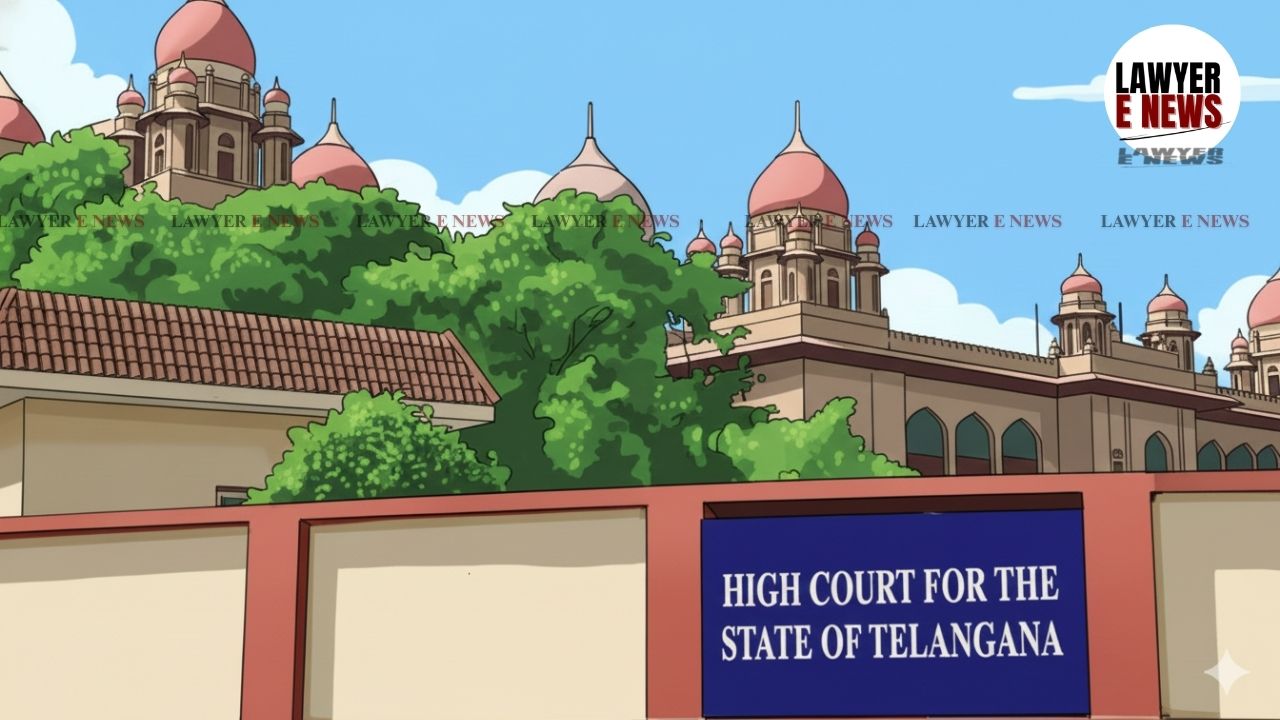
"Once the statutory remedy under Section 64 has been invoked and the competent Authority has adjudicated the compensation dispute, this Court, in exercise of jurisdiction under Article 226, would not ordinarily undertake a parallel adjudication of the same dispute." Telangana High Court, in a significant ruling, held that once a land acquisition compensation dispute has been adjudicated by the Land Acquisition, Rehabilitation and Resettlement (LARR) Authority under Section 64 of the Right to Fair Compensation and Transparency in Land Acquisition, Rehabilitation and Resettlement Act, 2013 (RFCTLARR Act), the High Court will not entertain writ petitions under Article 226 of the Constitution seeking a parallel re-valuation of structures or questioning the award on grounds of compensation inadequacy.
A bench presided by Justice Vakiti Ramakrishna Reddy observed that the existence of a statutory adjudicatory mechanism renders the plea for a fresh technical valuation via writ jurisdiction unsustainable.
The batch of five writ petitions challenged the validity of Award No. 1/2016, passed by the Special Deputy Collector, Land Acquisition, for the expansion of Singareni Collieries Company Limited (SCCL) mining operations in Peddapalli District. The petitioners alleged that the Land Acquisition Officer (LAO) relied on revised structural estimates prepared just one day before the award, arbitrarily omitted certain structures and electrical fittings, and failed to follow mandatory procedural norms under the RFCTLARR Act. During the pendency of these petitions, the petitioners’ claims were referred to the LARR Authority (LAOP No. 220 of 2018), which passed an award on October 7, 2024, granting a 100% enhancement on structural values and determining land compensation at Rs. 450 per square yard.
The primary questions before the Court were whether the transition from the Land Acquisition Act, 1894, to the RFCTLARR Act, 2013, was handled legally regarding the issuance of the Section 19 declaration; whether the court should intervene in the valuation of structures based on alleged discrepancies between initial and revised estimates; and whether the petitioners could pursue writ relief for compensation enhancement despite having invoked and obtained an order under the Section 64 statutory reference mechanism.
Nature Of Valuation Disputes In Writ Jurisdiction
The Court emphasized that structural valuation—involving assessments of whether a structure is permanent or semi-permanent, physical measurements, and depreciation—is a technical exercise. Justice Reddy noted that while the petitioners pointed to differences between initial and revised estimates prepared by the R&B Department, such discrepancies do not inherently establish mala fides or perversity. The Court clarified that it cannot act as a substitute for technical experts in Article 226 jurisdiction unless a clear violation of a mandatory statutory requirement is demonstrated.
"This Court, while exercising jurisdiction under Article 226 of the Constitution of India, cannot, merely because two different estimates exist, substitute one technical valuation for another."
Impact Of Section 64 Adjudication
The Court placed immense weight on the fact that the LARR Authority had already adjudicated the compensation grievances. The bench held that since the petitioners had already availed the statutory remedy under Section 64, which resulted in a comprehensive Award and Decree in October 2024, the primary grievances regarding compensation had moved beyond the stage of original award-making. Allowing a parallel challenge in the High Court would undermine the statutory scheme designed to address such disputes.
"Once the statutory remedy under Section 64 has been invoked and the competent Authority has adjudicated the compensation dispute, this Court, in exercise of jurisdiction under Article 226, would not ordinarily undertake a parallel adjudication of the same dispute."
Inapplicability Of Section 33 For Re-opening Valuations
The Court rejected the petitioners' prayer for a "supplementary award," noting that Section 33 of the RFCTLARR Act is strictly confined to the correction of clerical or arithmetical mistakes. It cannot be used as a gateway to reopen a concluded technical valuation or to force the LAO to perform a fresh assessment of structures that were allegedly omitted or misclassified. The Court concluded that the petitioners' remedy lies in challenging the LARR Authority’s order if they are dissatisfied with the quantum of enhancement granted by it.
The High Court dismissed the writ petitions, holding that no ground was established for interfering with the original award under Article 226. However, it explicitly reserved the liberty of the petitioners to pursue further remedies against the LARR Authority’s award dated October 7, 2024, in accordance with the law. The Court clarified that it expressed no opinion on the correctness of the LARR Authority’s findings, keeping all contentions in that regard open for the parties.
Date of Decision: 01 October 2026