-
by sayum
21 October 2026 1:30 PM







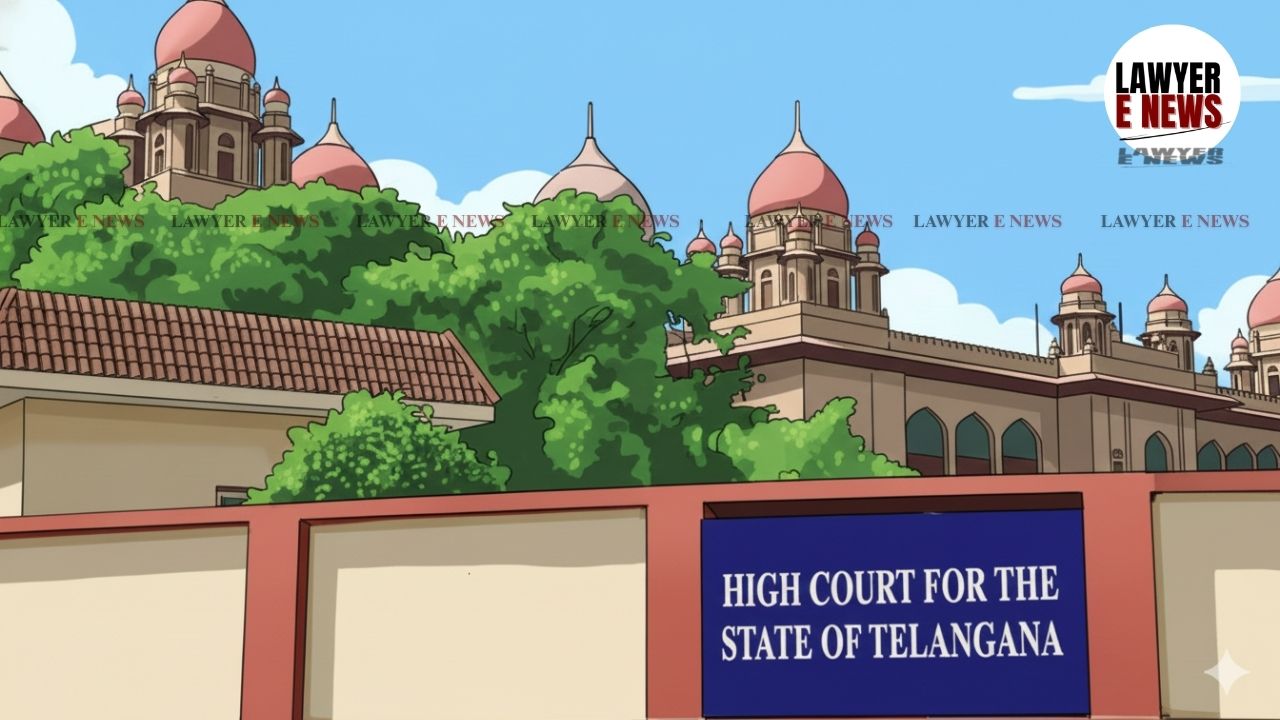
"Once a document is registered under the Registration Act, 1908, the forum competent to cancel such instrument is a Civil Court of appropriate jurisdiction, and hence, the present writ petition is not maintainable." Telangana High Court, in a significant ruling, held that a writ petition under Article 226 of the Constitution of India is not the appropriate remedy for seeking the cancellation of a registered sale deed or for adjudicating complex disputes regarding title and testamentary succession.
A bench presided by Justice Pulla Karthik observed that once a registering officer discharges their statutory duty and registers a document, they become functus officio, and any challenge to the document’s validity—or the executant’s title—must be ventilated before a competent Civil Court.
The petitioner, M/s. Janachaitanya Housing Pvt. Ltd., challenged the registration of a sale deed executed by the sixth respondent in favour of the seventh respondent, concerning land in Nanakramguda Village. The petitioner claimed that the sixth respondent lacked valid title as the underlying Codicil to the Will of the previous owner, M. Shakuntala, was disputed and currently the subject of a pending civil suit in O.S. No. 7 of 2025. Furthermore, the petitioner alleged that the registration was conducted in violation of statutory provisions, specifically contending that the land was in a "prohibitory list" and that the registering authority lacked jurisdiction as the land conversion proceedings (NALA) were finalized only on the date of presentation.
The primary question before the court was whether a writ petition under Article 226 is maintainable for the cancellation of a registered sale deed and for resolving conflicting claims of title. The court was also called upon to determine if a Registering Officer has the jurisdiction to refuse or cancel a registration based on private representations or pending litigation, and whether the inclusion of land in a prohibitory list without a specific court order is legally sustainable.
Scope of Writ Jurisdiction in Title Disputes
The court emphasized that the determination of lawful possession and superior title involves the appreciation of oral and documentary evidence, which falls outside the scope of writ jurisdiction. Referring to the precedent in Satya Pal Anand v. State of Madhya Pradesh, the bench clarified that the High Court cannot be expected to adjudicate upon the validity of Wills, Codicils, or competing claims of ownership.
Court Defines Role of Registering Authority
The court underscored that the registration process is a statutory duty comprising three distinct steps: execution, presentation, and registration. While the High Court may examine whether a registering authority performed its duties according to law, it cannot substitute for a Civil Court in declaring a document "null and void." The bench held that where a party questions the very execution of a document or the title of the executant, the remedy lies exclusively with the Civil Court.
Validity of Prohibitory Lists
The court scrutinized the inclusion of the property in the prohibitory list under Section 22-A of the Registration Act, 1908. Relying on Standing Order 219(b), the court observed that a property cannot be unilaterally included in a prohibitory list based on a mere representation by a private party. A valid prohibition requires a specific order or direction from a competent Court. The court termed the entry in the prohibitory list as "void-ab-initio" in the absence of a binding judicial restraint order against the registration.
"If a party questions the very execution of a document or the right and title of a person to execute a document and present it for registration, his remedy will only be to go to the civil court and certainly not before the writ court."
No Jurisdictional Infirmity in Registration
Regarding the contention that the registering officer lacked jurisdiction because the land was agricultural at the time of fee payment, the court clarified that the status of the property is to be determined at the date of presentation. Since valid NALA proceedings existed at the time of presentation, the registration was found to be in accordance with the law. The court rejected the allegations of collusion and fraud as "bald and unsupported" by documentary evidence.
"Once the document is registered, it is not open to the Registering Officer to cancel that registration even if his attention is invited to some irregularity committed during the registration of the document."
The High Court dismissed the writ petition, concluding that the petitioner failed to establish a legally enforceable right that would warrant the invocation of extraordinary jurisdiction. The court granted the petitioner liberty to pursue appropriate remedies before the Civil Court, where the foundational dispute regarding the validity of the testamentary documents is already sub judice.
Date of Decision: 03 September 2026