-
by sayum
30 July 2026 6:56 AM







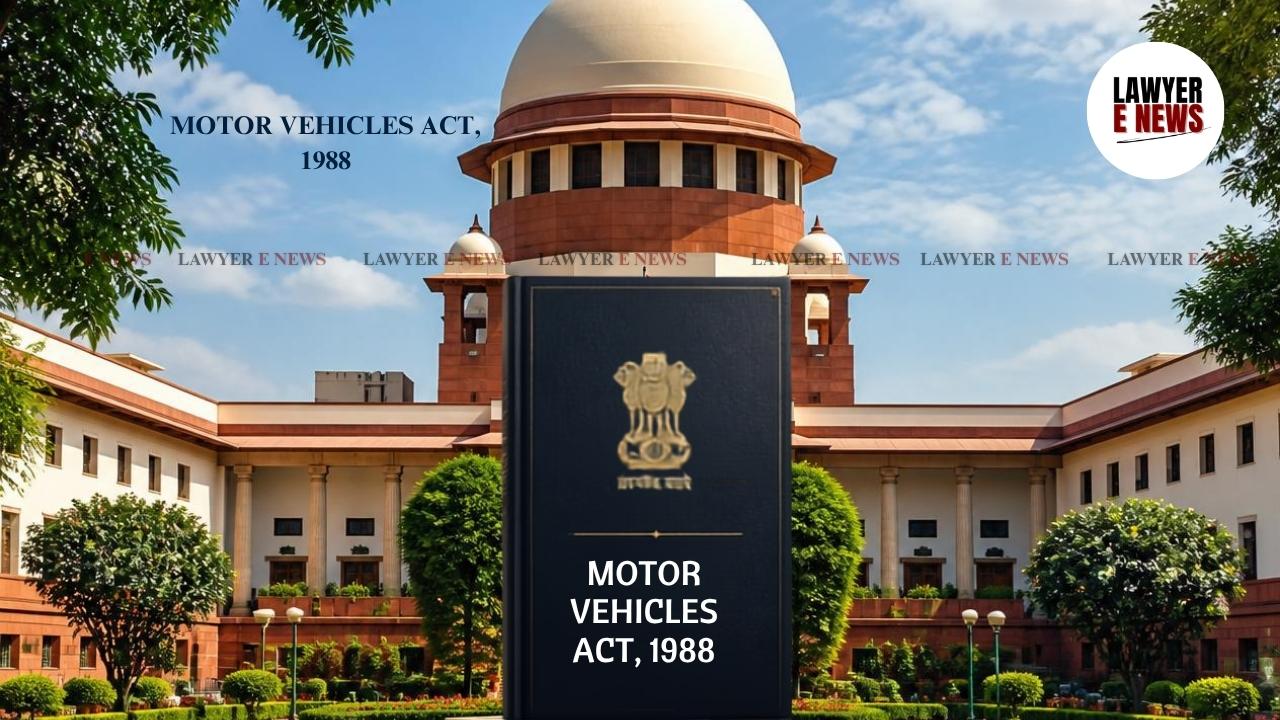
"The second part provides for the exclusion of certain vehicles from the definition of the motor vehicle... though the term motor vehicle is wide enough but it expressly excludes some of the motor vehicles which are of special type and have been adapted for use only in factory or in any other enclosed premises from its ambit." Supreme Court, in a significant ruling dated July 29, 2026, held that a Reach Stacker operating within an enclosed, custom-bonded Inland Container Depot does not qualify as a "motor vehicle" under Section 2(28) of the Motor Vehicles Act, 1988, thereby barring accident compensation claims under Section 166 of the statute.
A bench of Justices Sanjay Karol and Nongmeikapam Kotiswar Singh observed that despite possessing mechanical propulsion, heavy machinery designed for restricted industrial use and operating exclusively within non-public, enclosed premises falls squarely within the statutory exclusion clause.
The litigation arose from an unfortunate accident on September 5, 2013, when respondent no.1 visited the Inland Container Depot at Tughlakabad, New Delhi, where a heavy Reach Stacker ran over his pelvic region, causing 90 percent physical disability and leading to the amputation of his right leg. The Motor Accidents Claims Tribunal dismissed the compensation petition under Section 166 of the MVA, holding that the machine was not a motor vehicle. However, the Delhi High Court reversed this finding and allowed the claim, prompting the appellant Container Corporation of India Limited to approach the Apex Court.
The primary question before the court was whether a Reach Stacker constitutes a motor vehicle within the meaning of Section 2(28) of the MVA. The court was also called upon to determine whether the roads inside a custom-bonded Inland Container Depot constitute a "public place" under Section 2(34) of the enactment.
"Statutory Framework of Motor Vehicles"
The bench examined the anatomy of Section 2(28) of the MVA, noting that the provision contains both a positive inclusion and a specific exclusionary limb. While the first part encompasses mechanically propelled vehicles adapted for road use, the second limb explicitly excludes vehicles of a special type adapted for use only in a factory or any other enclosed premises. The court emphasized that the legislature consciously insulated specialized industrial machinery from the regulatory and compensatory regime of the Act.
"ICD Is Not a Public Place"
Analyzing the spatial context of the accident, the court held that the Inland Container Depot, being a custom-bonded area under Section 7 of the Indian Customs Act, 1962, restricts entry strictly to authorized personnel. Citing the principles laid down in Tarachand Logistic Solutions Ltd. v. State of A.P., the bench observed that where access is guarded, regulated, and denied to the general public as a matter of right, the premises cannot be characterized as a "public place" under Section 2(34) of the MVA.
"Utility and Weight Parameters"
Addressing the technical specifications of the machinery, the court noted that a Reach Stacker weighs approximately 71.8 metric tonnes unladen and exceeds 102 metric tonnes at full capacity, far surpassing the maximum permissible gross vehicle weights notified under Section 58(1) of the MV Act. The bench underscored that such heavy apparatus requires specially engineered surfaces and cannot be equated to ordinary vehicles plying on public highways.
"Distinction Between Adaptation and Suitability"
Relying on the doctrinal interpretations established in Bolani Ores Ltd. v. State of Orissa and Goodyear India Ltd. v. Union of India, the court reiterated that adaptation for road use denotes dominant, principal utility rather than incidental movement. The bench affirmed the reasoning in Ultratech Cement Ltd. v. State of Gujarat, holding that specialized off-road industrial equipment stands excluded from the statutory definition by virtue of its operational environment and design purpose.
"Though the vehicles used by the appellant are ‘motor vehicles’ within the first part of the definition under Section 2(28) of the Act but they stand excluded from the definition of ‘motor vehicles’ on account of their very nature of use and the place of the use by virtue of the second part of the definition."
Rejection of Precedents Cited by Claimants
"Distinguishing Road Rollers and Industrial Stackers"
Addressing the respondent's reliance on rulings concerning road rollers and tractor-trailers, such as Bose Abraham v. State of Kerala and Natwar Parikh & Co. Ltd. v. State of Karnataka, the bench distinguished those judgments on facts. The court noted that road rollers may occasionally ply on public roads during construction or repairs, whereas a Reach Stacker is permanently confined within the four walls of a non-public industrial terminal, dismantled for transportation, and structurally incapable of normal road operation.
"Validity of Regulatory Non-Registration"
The court took note of an official notification issued by the Joint Transport Commissioner and Secretary, Regional Transport Authority, Hyderabad, confirming that Reach Stackers are not motor vehicles and require no registration under Section 39 of the MVA. The bench rejected the amicus curiae's contention that un-registration invalidates the statutory exclusion, observing that non-registration is a consequence of a machine not being a motor vehicle in the first place.
"Important Statutory Caveat"
Before concluding, the bench issued a significant caveat clarifying that while the ICD is not a public place for specialized industrial machinery, this finding does not restrict a claimant's right to seek compensation under the MVA if an accident occurs within the ICD involving a regular, ordinary vehicle that usually plies on public roads and was brought inside the restricted premises by departmental officials or authorized persons.
Final Orders of the Court
The Supreme Court allowed the appeal, setting aside the judgment of the Delhi High Court dated September 5, 2019, and restoring the order of the Motor Accidents Claims Tribunal. The bench directed that any interim compensation or money already paid to respondent no.1 shall not be subject to recovery, and ordered that there shall be no order as to costs.
Date of Decision: 29 July 2026