-
by sayum
30 July 2026 6:56 AM







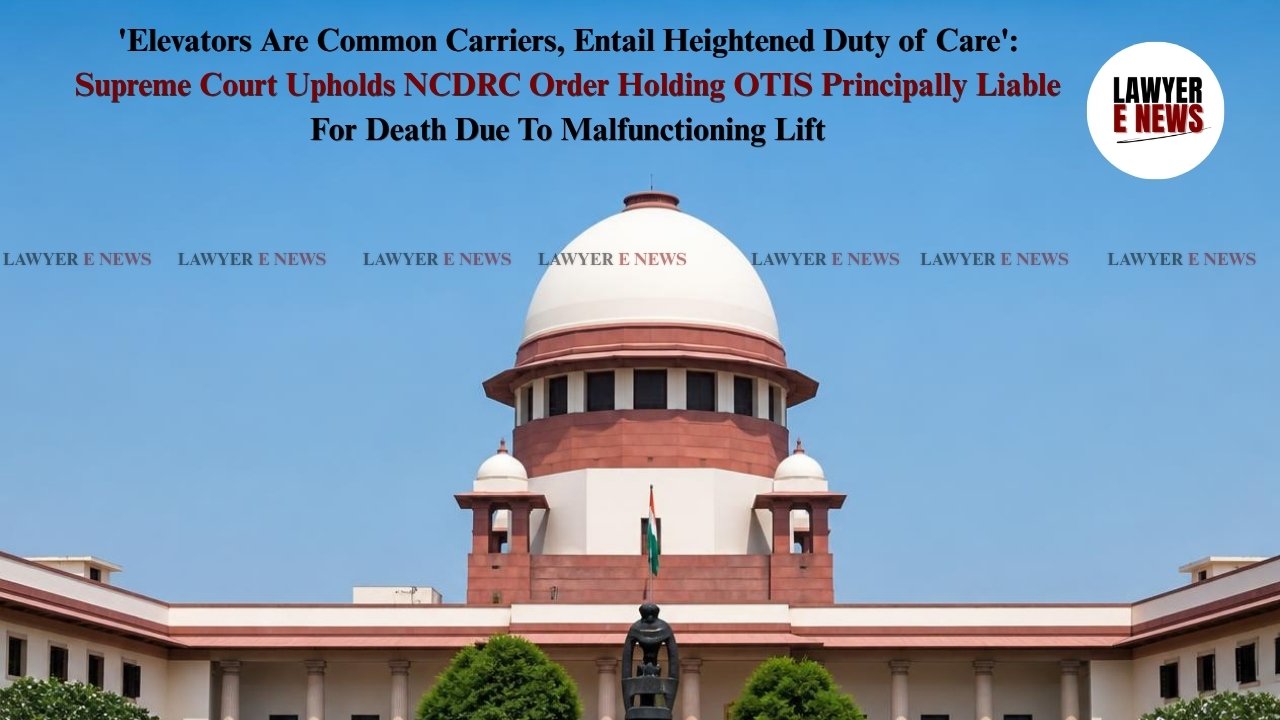
"It is not merely reasonable, but a legal necessity to impose a heightened duty to care, akin to that of common carriers in view of the intrinsic passenger vulnerability. An elevator must be construed and deemed to be a common carrier and the operator, in the wider sense must undertake greater responsibility to transport passengers from floor to floor and exit safely." Supreme Court of India, in a significant ruling dated July 29, 2026, unequivocally held that elevators must be construed as common carriers, thereby imposing a heightened duty of care on their manufacturers, operators, and owners.
A bench of Justices Pamidighantam Sri Narasimha and Alok Aradhe dismissed an appeal by M/s Otis Elevator Co. (India) Ltd. (OTIS), affirming its principal liability for the death of an officer due to a malfunctioning elevator.
The case stemmed from a fatal accident on March 20, 2003, where a senior officer of the Research and Analysis Wing (RAW) was crushed to death by a lift in the RAW office complex. The lift, installed by OTIS and maintained under contract with the Military Engineering Service (MES), abruptly stopped, and during a rescue attempt, suddenly moved downwards. The deceased's family approached the National Consumer Disputes Redressal Commission (NCDRC) seeking compensation, which eventually held OTIS, RAW, and MES jointly and severally liable, apportioning 70% of the liability to OTIS.
The primary question before the Supreme Court was the correct apportionment of liability among OTIS, RAW, and MES for the fatal accident, given that the appeals of RAW and MES had already been dismissed at the admission stage. The Court also had to consider the nature of responsibility owed by elevator service providers.
Elevators Deemed Common Carriers; Heightened Duty of Care
The Supreme Court emphasized the indispensable role of elevators in modern vertical cities, noting the intrinsic vulnerability of passengers who have no control over the conveyance. The Court underscored that safety in an elevator is not merely expected but is a fundamental assurance.
The bench stated that it is a legal necessity to impose a heightened duty of care, akin to that of common carriers, due to this inherent passenger vulnerability. An elevator must be considered a common carrier, obligating the operator to undertake greater responsibility for safe transportation.
Manufacturer, Operator, Owner are Jointly Liable
The Court clarified that in the context of public places, the term "carrier" for elevators encompasses the manufacturer, the operator, and the owner of the premises. These entities are identified as joint duty bearers, jointly and severally liable to safeguard the user.
"The burden of identifying the inter se liabilities of joint tortfeasors should not rest on the shoulders of the consumers seeking compensation for injury caused due to transportation through an elevator."
The principle of composite negligence, the Court noted, entitles a claimant to sue joint tortfeasors and recover damages. The immediate focus of courts should be on recognizing injury and assessing compensation, with inter-se apportionment among tortfeasors determined based on contractual relationships and circumstances.
NCDRC Findings on Deficiency of Service
The NCDRC had found OTIS deficient in service for installing and operating the lift without a voltage stabilizer despite awareness of the risk, and for failing to depute site personnel or provide emergency training. RAW and MES were also held deficient for failing to install the recommended stabilizer and monitor OTIS's compliance.
OTIS's Comprehensive Contractual Obligations
The Court meticulously examined the Repair and Maintenance Contract between MES and OTIS, noting that Clause 1.1 covered comprehensive maintenance, including regular examination, adjustment, lubrication, and replacement of parts for smooth and efficient functioning.
Clause 3.1 clearly stipulated OTIS's responsibility for electrical and mechanical fittings and their maintenance "to keep them in sound condition to avoid risk of accident." Clause 3.2 mandated the deployment of a qualified mechanic daily during fixed hours for maintenance and complaint attendance.
Mandatory Record Keeping by OTIS
Under Clauses 3.3 to 3.5, OTIS was obligated to maintain attendance registers for each shift and a complaint register for each lift, to be certified daily. These records were crucial to verify the discharge of OTIS's contractual duties.
OTIS Liable for Accidents Under Contract
The contract's Clause 6.1 explicitly stated that "In case of accident during operation of lift, the contractor is liable to pay compensation as applicable," reinforcing OTIS's primary responsibility.
Persistent Malfunctioning of Lift No. 6 Notified to OTIS
The Court noted a series of communications between OTIS and MES from April to August 2002, detailing persistent malfunctioning of Lift No. 6. Telegrams repeatedly highlighted the lift being "off road," "heavy criticism from users," and "frequent break down." These communications underscored OTIS's continuous notice of the lift's defects.
OTIS Aware of Voltage Fluctuation, Recommended Stabiliser
Crucially, OTIS itself, through a letter dated July 4, 2002, informed MES that voltage unbalance caused "frequent breakdown on new lifts" and formally requested the installation of a "Service Line Voltage Corrector Stabilizer of 50 KVA on each phase for the protection & safe operation of our equipments." This demonstrated OTIS's awareness of a critical underlying issue.
OTIS Failed to Act on Own Recommendation or Ensure Safety
Despite identifying the remedy, the Court found that OTIS failed to follow up on its recommendation, decline to certify the lift as safe for use, or escalate the matter, even as breakdowns continued unabated. The lift continued to operate daily without the safeguards OTIS itself deemed necessary.
Technical Report's Finding Not Absolute Absolution for OTIS
The Court addressed the Technical Report by Prof. C.M. Bhatia, which concluded that the accident's immediate cause was the manual release of mechanical brakes. While acknowledging this, the Supreme Court clarified that the report's conclusion on the "cause of accident" should be distinguished from the "cause of action" for deficiency of service.
"Though the Technical Report of Prof. Bhatia concludes that releasing the brake release key is the only cause of accident, we are of the opinion that the said conclusion must be seen in the context of the Report. For the purpose of determining deficiency of service and the consequential relief of compensation, it is necessary to take note of a number of incidents giving rise to the cause of action which is very different from cause of accident."
The persistent and well-documented malfunctioning of the lift, of which OTIS was repeatedly notified, formed the "cause of action" for deficiency of service.
OTIS's Specific Lapses Leading to Accident
The Court identified several specific lapses by OTIS: (i) absence of attendance records to prove the presence of its mechanic as contractually required, (ii) the initial electrical malfunction causing the lift to stop mid-operation, which necessitated manual intervention, and (iii) failure to train RAW and MES personnel in correct rescue procedures. The Court found no evidence that OTIS imparted such training, despite placing caution stickers.
OTIS Primarily Deficient in Service
The Supreme Court affirmed the NCDRC's finding that OTIS was principally deficient in service. As a manufacturer and comprehensive maintenance contractor of a critical vehicle like an elevator, OTIS owed a heightened duty of care. Its failure to implement a known remedy or ensure safety measures, despite being cognizant of the defects, constituted a clear deficiency.
Limited Liability for RAW and MES Affirmed
Regarding RAW and MES, the Court agreed that their liability was more limited. RAW, as the occupier and consumer, bore a residual duty of oversight. MES failed to maintain attendance registers and its machine room was left accessible, which was a lapse "of a different order from, and subordinate to, OTIS's primary responsibility."
Apportionment of 70:25:5 upheld
The Supreme Court found no reason to interfere with the NCDRC's apportionment of liability: 70% on OTIS, 25% on MES, and 5% on RAW. This division, the Court stated, properly reflected the differential degree of knowledge, control, and responsibility each party bore for the accident.
For the aforementioned reasons, the Supreme Court found no infirmity in the NCDRC's order apportioning liability. OTIS's Civil Appeal No. 4081 of 2014 was accordingly dismissed. Consequently, Civil Appeal No. 1602 of 2020, filed by the complainant against the NCDRC's order deferring execution, was allowed, and the NCDRC was directed to proceed with the execution petition in accordance with law. This judgment reinforces the high standards of safety and accountability expected from service providers in critical public utilities like elevators.
Date of Decision: July 29, 2026