-
by sayum
27 August 2026 3:32 PM







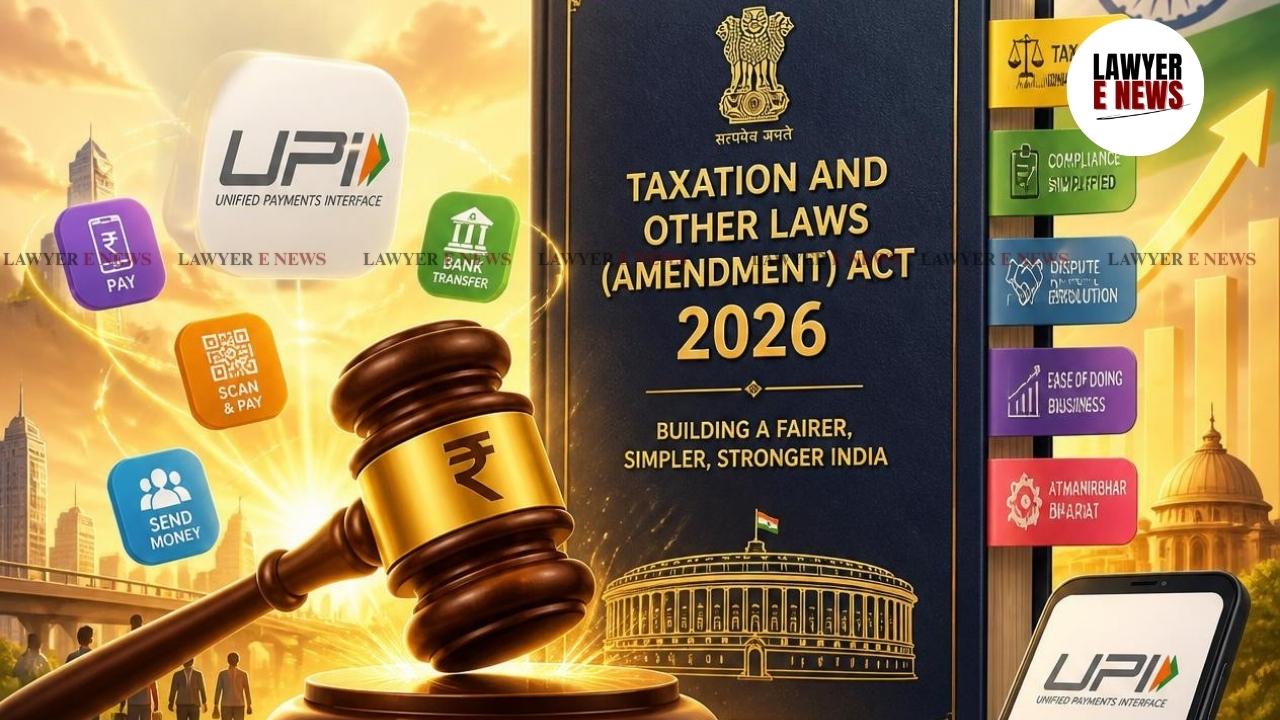
"Notwithstanding anything contained in this Act, no bank or system provider shall impose, whether directly or indirectly, any charge upon a person making or receiving a payment by using one or more electronic modes of payment as may be notified by the Central Government" Lok Sabha and Parliament of India, in a significant legislative move enacted in the Seventy-seventh Year of the Republic of India, formally codified a strict statutory prohibition against the imposition of direct or indirect charges by banks or system providers on electronic mode payments.
As reflected in the Taxation and Other Laws (Amendment) Act, 2026, the legislature reinforced the mandate of digital financial transactions by amending section 10A of the Payment and Settlement Systems Act, 2007. The enactment ensures that consumers and merchants utilising unified payments interface (UPI) and other specified digital modes remain completely insulated from transaction fees or MDR burdens imposed by banking institutions.
The enactment traces its lineage to the evolving economic landscape and the immediate need to provide tax certainty, ease of doing business, and robust consumer protections amid global supply chain disruptions. Initially promulgated as the Income-tax (Amendment) Ordinance, 2026 under Article 123 of the Constitution of India, the provisions were consolidated into the present parliamentary enactment to replace the Ordinance and amend key fiscal statutes including the Income-tax Act, 2025 and the Finance Act, 2026. The legislative intervention addresses both direct taxation frameworks and the foundational architecture of digital retail payments across the country.
Statutory Amendment To Payment And Settlement Systems Act - Legislative Overhaul Of Section 10A
The Amendment Act introduces a direct substitution in section 10A of the Payment and Settlement Systems Act, 2007, replacing previous cross-references to the Income-tax Act, 1961 with an independent, direct empowerment of the Central Government.
Prohibition On Direct Or Indirect Charges
The statute commands that no bank or system provider shall impose any charge, whether directly or indirectly, upon any person making or receiving a payment through notified electronic modes. This removes any discretionary leeway for financial institutions to claw back processing costs from end-users or merchants participating in the digital ecosystem.
Statutory Immunity For Digital Payers
By anchoring the prohibition directly within the primary payments legislation, the legislature has insulated digital transactions from contractual or regulatory subversion by commercial banks.
"No bank or system provider shall impose, whether directly or indirectly, any charge upon a person making or receiving a payment by using one or more electronic modes"
Broadening Electronic Payment Protections - Elimination Of Restrictive References
The amendment explicitly deletes references to section 269SU of the older Income-tax framework, broadening the protective umbrella to encompass any electronic mode of payment specified via notification by the Central Government.
Seamless Integration With Unified Payments
The statutory mechanism provides unhindered legal backing to zero-cost digital transactions, specifically safeguarding platforms like the Unified Payments Interface (UPI) from commercial monetization by acquiring or issuing banks.
Judicial And Legislative Consistency
The amendment harmonises subordinate financial regulations with overarching public policy goals, ensuring that the proliferation of digital public infrastructure is not encumbered by private banking fees.
Final Legislative Outcome And Repeal
The Taxation and Other Laws (Amendment) Act, 2026 successfully repeals the preceding Income-tax (Amendment) Ordinance, 2026 while saving all actions taken thereunder. Alongside the landmark prohibition on digital transaction charges under Chapter II, the Act introduces comprehensive tax exemptions for foreign companies in special zones, rationalises conditions for eligible investment funds under Schedule I, and adjusts taxation parameters for business trusts.
Taxation and Other Laws (Amendment) Act, 2026 | Bill No. 150 of 2026