-
by sayum
19 August 2026 7:06 AM







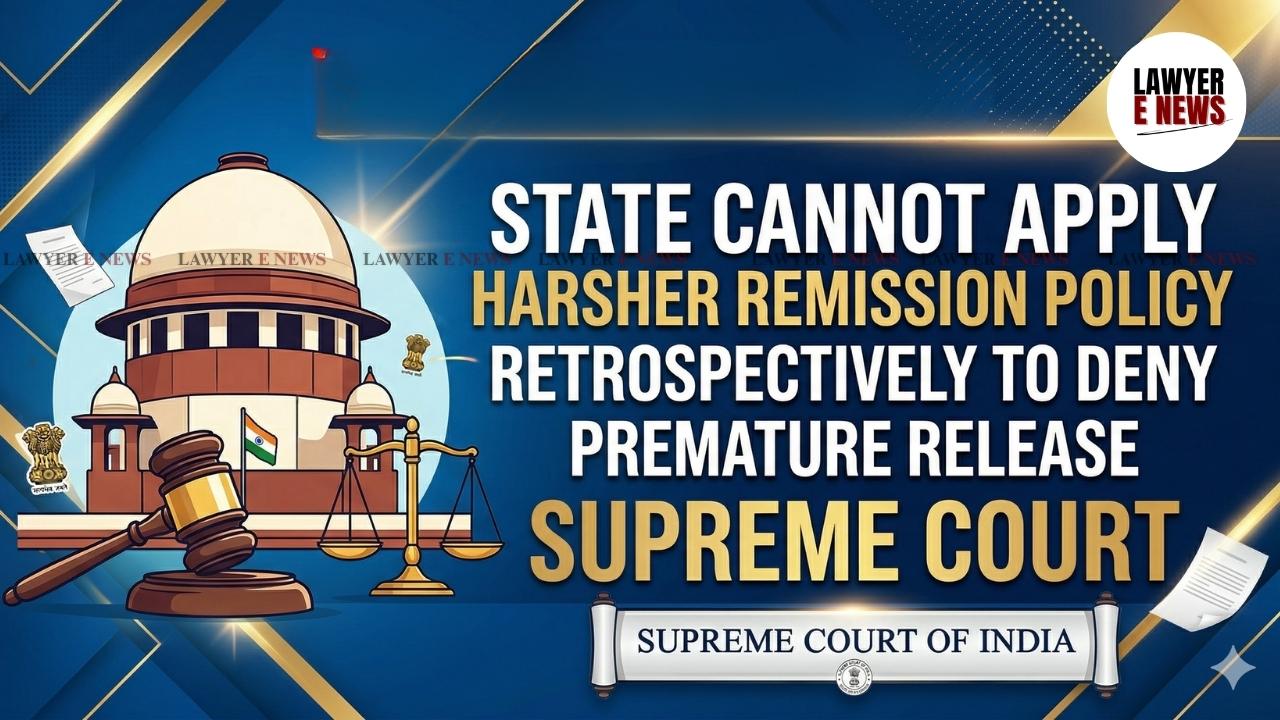
"When a convict prays for remission of sentence, the relevant date as regards the applicability of a particular policy would be the date on which the court holds him guilty of the alleged offence, subject to a more beneficial regime in a subsequent policy." Supreme Court of India, in a significant ruling dated March 18, 2026, held that a convict's plea for premature release must be governed by the remission policy existing on the date of conviction, and a harsher subsequent policy cannot be applied retrospectively to deny relief.
A bench of Justice J.B. Pardiwala and Justice K.V. Viswanathan observed that the State must strictly abide by the policy in force at the time of guilt adjudication unless a newer policy provides a more beneficial regime to the prisoner.
The petitioner, sentenced to life imprisonment for offences including murder under Section 302 and kidnapping under Section 364 of the Indian Penal Code, 1860, approached the apex court challenging the Andhra Pradesh government's rejection of his remission plea. The Trial Court had convicted him in 2005, a verdict that was ultimately restored by the Supreme Court in 2008. However, the State rejected his representation in October 2025 by relying on its new April 2025 remission guidelines, which permanently barred convicts involved in kidnapping and related offences from seeking premature release.
The primary question before the court was whether a remission policy introduced in 2025 could be retrospectively applied to deny premature release to a prisoner convicted in 2005. The court was also called upon to determine whether the State is strictly bound to apply the specific remission policy that was in force at the time the trial court held the accused guilty.
The bench clarified the established legal doctrine governing the premature release of prisoners, emphasising that the State's administrative orders cannot retrospectively extinguish the statutory expectations of a convict under Section 433-A of the Code of Criminal Procedure, 1973. The court categorically stated that the determination of remission must hinge on the policy operative when the guilt was adjudicated, preventing the State from arbitrarily moving the goalposts years after the conviction.
"When a convict prays for remission of sentence, the relevant date as regards the applicability of a particular policy would be the date on which the court holds him guilty of the alleged offence, subject to a more beneficial regime in a subsequent policy."
Examining the chronology of the petitioner's incarceration, the court noted that his guilt was established by the Trial Court in 2005, meaning the remission policy formulated by the Government of Andhra Pradesh on August 7, 2004, would legally govern his case. The State's attempt to invoke its revised 2013, 2015, or 2025 policies—which introduced specific bars against kidnapping-related convicts—was deemed legally untenable for this specific petitioner since the 2004 policy contained no such exclusionary clause for his category. "We are of the view that it is the 2004 policy of the State that should govern the plea for remission of sentence."
The court heavily relied on the three-judge bench precedent in Rajkumar v. State of Uttar Pradesh (2024), reaffirming that while the policy on the date of conviction is the baseline, any subsequent liberalised policy must be extended to the convict. The bench noted that the State must execute its statutory formulations uniformly and cannot adopt arbitrary yardsticks to deny relief to similarly situated prisoners.
"It must strictly abide by the terms of its policies bearing in mind the fundamental principle of law that each case for premature release has to be decided on the basis of the legal position as it stands on the date of the conviction subject to a more beneficial regime being provided in terms of a subsequent policy determination."
In a compassionate interim directive, the court also addressed an urgent plea made by the petitioner's counsel for a temporary release citing the upcoming Ramadan Eid festival. Acknowledging the petitioner's unblemished incarceration record and his trusted engagement at a petrol pump outside the prison walls authorised by jail officials, the bench directed the competent authorities to act immediately upon receiving his application.
"If any such application is preferred, the authority concerned shall pass an appropriate order, releasing the petitioner on parole on the very same day, subject to the terms and conditions that the authority may deem fit to impose."
The Supreme Court kept the writ petition pending and directed the State Government to reconsider the petitioner's remission representation strictly in light of the 2004 policy. The court instructed the State to place its fresh decision on record by April 6, 2026, while permitting the petitioner to forthwith seek temporary release on parole.
Date of Decision: 18 March 2026