-
by sayum
28 August 2026 10:07 AM







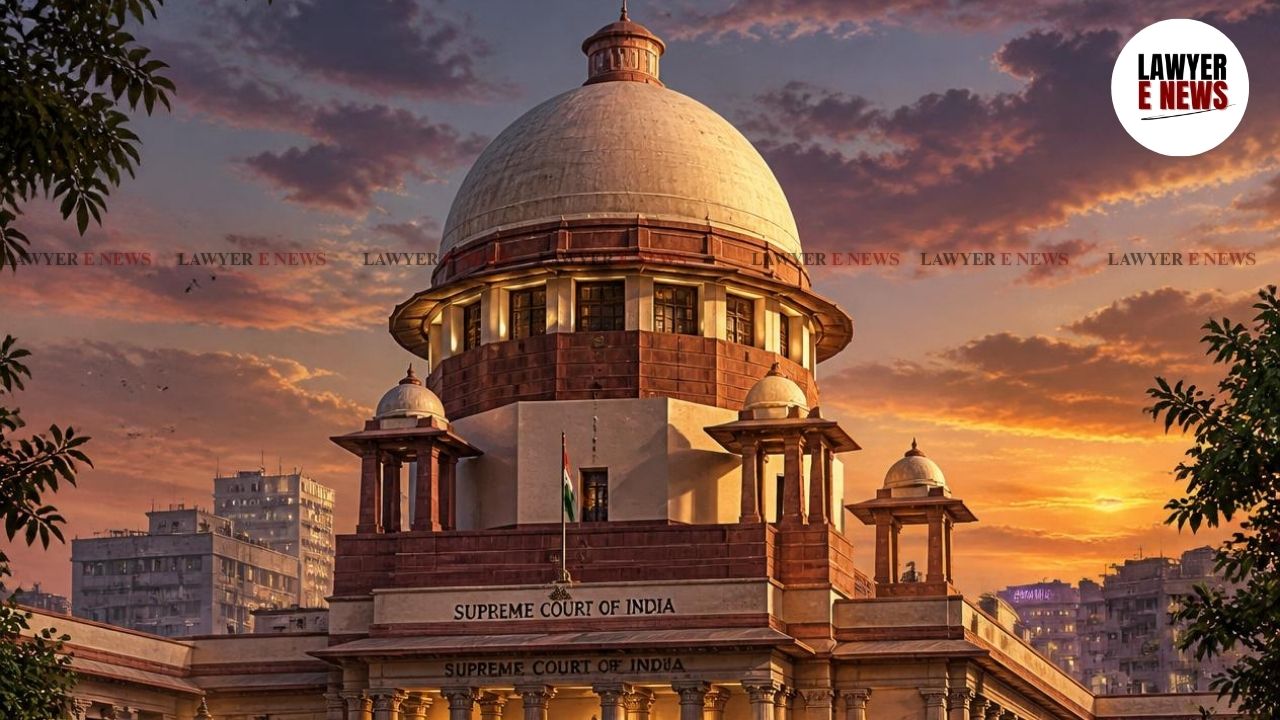
"A strict reliance upon the Vivaad se Vishwaas II (Contractual Disputes) scheme would result into loss of crores of rupees to the public exchequer without examination of the court under the statutory process." Supreme Court, in a significant ruling, directed the Paradip Port Trust (PPT) to extend the benefit of the 'Vivaad Se Vishwaas II' (Contractual Disputes) scheme to M/s Modi Projects Limited, despite the Trust's strong contention that the underlying arbitral award was "manifestly perverse" and its settlement would lead to "loss of crores of rupees to the public exchequer."
A bench of Justice J.B. Pardiwala and Justice K.V. Viswanathan emphasised that in view of the Union of India's clear stance on the scheme's applicability, it was unnecessary to delve into the merits of the arbitral award.
The dispute arose from an arbitral award of Rs. 13,66,01,820/- plus interest in favour of M/s Modi Projects Limited against the Paradip Port Trust. The Trust's challenges to this award under Section 34 and subsequently Section 37 of the Arbitration and Conciliation Act, 1996, were dismissed by the Commercial Court and the Orissa High Court respectively. The High Court further permitted M/s Modi Projects Limited to avail the benefits of the 'Vivaad Se Vishwaas II' scheme, leading the PPT to appeal to the Supreme Court.
The primary question before the court was whether M/s Modi Projects Limited was entitled to the benefits of the 'Vivaad Se Vishwaas II' scheme despite the serious objections raised by the Paradip Port Trust regarding the alleged perversity of the arbitral award. The court also considered whether it should independently examine the merits of the arbitral award when a government settlement scheme was invoked.
Initial Directions to Union of India on Scheme Applicability
In its earlier orders dated January 28, 2026, and March 19, 2026, the Supreme Court had noted the Paradip Port Trust's objections concerning the lower courts' "non-speaking orders" and the potential "effect in terms of revenue" due to the scheme. The Court had specifically directed the Union of India's Ministry of Ports, Shipping & Waterways to clarify its stance on the respondent's eligibility for the 'Vivaad Se Vishwaas II' scheme.
Paradip Port Trust's Vehement Opposition and Warning of Public Exchequer Loss
During the proceedings, the Paradip Port Trust, through its letter dated February 19, 2026, communicated its strong objections to the Ministry, arguing against a settlement under the scheme. The Trust explicitly stated, "This is one of the rare and shocking cases wherein a manifestly perverse award is not examined either by the First Court under Section 34 of the Arbitration and Conciliation Act, 1996 or by the Appellate court under Section 37 of the Arbitration and Conciliation Act. Both the judgements are completely without any reasons."
Detailed Grounds for Alleged Perversity of Arbitral Award
The Trust meticulously detailed the grounds on which it considered the arbitral award to be perverse. It highlighted the allowance of Claim 5 (loss of overheads) to the tune of Rs. 2,20,23,800/- "without any evidence in support thereof by applying the Hudson formula." The Trust cited the Supreme Court judgment in Batliboi Environment Engineers Ltd. v. Hindustan Petroleum Corporation Ltd., (2024) 2 SCC 375, arguing that the application of the Hudson formula in isolation was erroneous.
Unsubstantiated Loss of Profit Claim
Furthermore, the PPT pointed out the erroneous award of Claim No. 6 – Loss of Profit of Rs. 6,31,94,400/-, stating it was "without assigning any reasoning or referring to supporting evidence" and based solely on an "arbitrary assumption of 10% of the unexecuted work value." The Trust contended that the respondent-claimant produced no proof of actual loss or inability to undertake other contracts, which was contrary to the Supreme Court's ruling in Unibros v. All India Radio, 2023 SCC OnLine SC 1366, requiring cogent evidence for loss of profit.
Failure to Appreciate Material Evidence and Contract Clauses
The Trust also submitted that the Arbitral Tribunal failed to appreciate material evidence, including the respondent's own letter dated March 29, 2016, admitting no work during the seven-month monsoon period. It further noted the Tribunal's failure to consider relevant contract clauses, such as Clause 10 of the Special Conditions of Contract, which mandated work during monsoon and maintenance of sufficient labour.
Union of India Confirms Scheme Applicability
In response to the Supreme Court's directive, the Union of India, through an affidavit dated May 6, 2026, affirmed that "the Scheme applies to the present case and requires due consideration of the claim in accordance with its parameters." It further clarified that "the final determination must be undertaken by the procuring entity (i.e., the petitioner) in accordance with the Scheme."
Court Declines to Examine Merits, Directs Scheme Implementation
Despite the "manifold contentions" raised by the petitioner regarding the "legality and validity" of the lower court orders, the Supreme Court ultimately deemed it unnecessary to delve into the merits of the case. The bench stated that "in view of the specific stance of the Union of India as regards the entitlement of the Respondent No.1 to avail the benefit of the scheme, it would not be necessary for us to go into the merits of the matter."
The Court observed, "All that the Respondent No.1 wants is to seek the benefit of the Scheme by an appropriate direction to the petitioner to disburse the requisite amount in their favour that may be determined by petitioner."
The Supreme Court disposed of the petitions, directing the Paradip Port Trust to extend the benefits of the 'Vivaad Se Vishwaas II' scheme to M/s Modi Projects Limited. The Trust is now mandated to determine and disburse the requisite amount as per the scheme within two months. This ruling underscores the government's strong policy impetus towards resolving contractual disputes through the 'Vivaad Se Vishwaas II' scheme, even in cases where public sector entities allege significant financial implications and "perverse" arbitral awards.
Date of Decision: 27 July 2026