-
by sayum
28 August 2026 2:11 PM







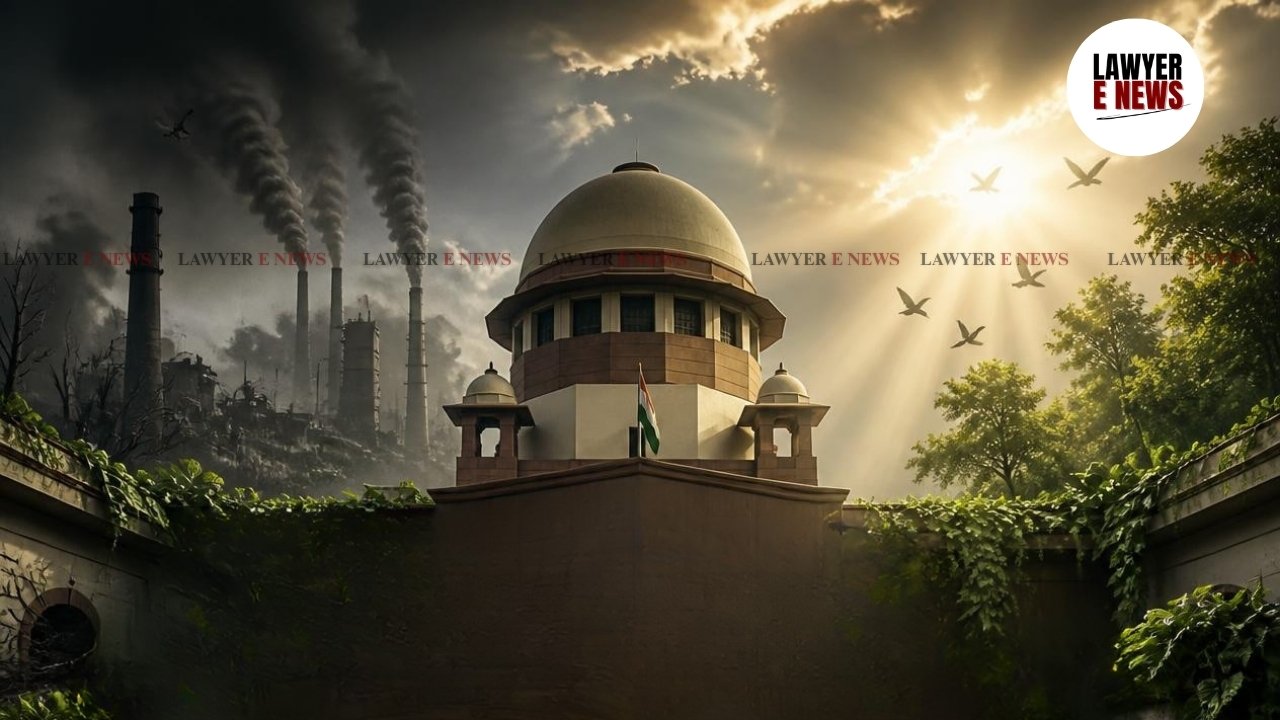
"Until the completion of the aforesaid exercise, no fresh permissions facilitating industrial, commercial or residential development within the identified river corridors shall be granted by any Department, statutory authority or local body of the State of Rajasthan." Supreme Court, in a sweeping and significant ruling dated August 07, 2026, mandated the immediate constitution of an "Integrated Coordination Group" and an independent "River Commission" for Rajasthan to tackle "grave environmental concerns," including widespread river contamination and the unchecked discharge of industrial effluents.
A bench of Justice Vikram Nath and Justice Sandeep Mehta simultaneously imposed an interim ban on new industrial, commercial, or residential development within identified river corridors across the State, emphasizing the urgent need for a cohesive, institutional response to systemic failures.
The matter originated from Suo Moto Writ Petition (Civil) No. 8 of 2025, titled 'In Re: 2 Million Lives at Risk, Contamination in Jojari River, Rajasthan,' initiated following alarming reports of widespread environmental degradation. The Court had previously constituted a High-Level Ecosystem Oversight Committee and a Special Investigation Team (SIT), issuing interim directions based on their initial reports and concerning newspaper articles. The present order follows the submission of detailed compliance and progress reports by both the SIT and the State of Rajasthan.
The primary legal issues before the Supreme Court involved addressing systemic environmental degradation, widespread contamination of water bodies by industrial effluents, ensuring accountability for environmental offenses including the connivance of officials, and establishing a robust institutional framework for river basin management and ecological restoration in Rajasthan.
SIT's Investigation Under Scrutiny, Deeper Probe Ordered
The Court meticulously perused the Report submitted by the Special Investigation Team, which indicated a review of 16 criminal cases related to riverine pollution in Jodhpur, Pali, and Balotra districts, with four new FIRs registered post-SIT constitution. The SIT stated that relevant provisions of the Bhartiya Nyaya Sanhita, 2023, and the Prevention of Damage to Public Property Act, 1984, were invoked where prima facie cases existed, leading to some arrests and ongoing investigations.
Connivance of CETP Officials and Industrial Units Evident
The SIT's report highlighted that material collected indicated "connivance amongst officials of the Common Effluent Treatment Plants and their member industrial units in facilitating the discharge of untreated industrial effluents by deliberately bypassing the prescribed treatment process." The investigation is stated to be tracing financial and institutional trails and independently examining the role of public servants.
SC Raps SIT for Delayed Action, Demands Independence
Despite noting substantial steps, the Court questioned the sincerity of the SIT's actions. It observed that the invocation of graver offences and subsequent arrests only occurred when the matter approached the fixed hearing date, casting a shadow on the team's bona fides.
"This puts a question mark on the bona fides of the SIT’s actions. The officials concerned are thus, advised to act with due promptness and efficacy."
The bench mandated a "more deeper probe" by the SIT, directing it to act "without fear or favour and uninfluenced by the position or status of any person." The investigation must extend beyond immediate effluent discharge, tracing the complete chain of events, decision-making, financial mechanisms, and the involvement of all persons, including private individuals, industrial entities, and public officials.
State's Response to Grave Environmental Concerns
The State of Rajasthan presented a comprehensive response to the Court's previous directions and the environmental concerns highlighted in various newspaper reports. Regarding the pink coloration of a pond near the Jojari River at Tanawada, the District Administration undertook drone surveys, inspections, and scientific sampling. The Indian Institute of Technology, Jodhpur, provided a preliminary opinion, attributing the coloration to saline and organic contamination combined with evaporation and microbial activity, recommending further scientific investigation, which the State committed to implementing expeditiously.
Stringent Action Against Polluting Textile Units in Sanganer-Dravyavati-Nevta
In the Sanganer-Dravyavati-Nevta region, the State identified 1,767 textile processing units, with 875 operating outside the Common Effluent Treatment Plant (CETP) network. The CETP is operating below capacity. Stringent regulatory actions have been taken, including closure directions under Section 33A of the Water (Prevention and Control of Pollution) Act, 1974 against 814 industrial units, initiation of prosecutions, imposition of environmental compensation, and sealing of 65 industrial units. Efforts are underway to integrate all units into the statutory regime and operationalize the CETP at full capacity.
Addressing Contamination of Morel Dam
Concerning the Morel Dam, the RSPCB conducted an inspection, noting algal bloom but no foul odour or aquatic mortality. While recent sample reports are awaited, earlier analyses indicated the presence of Biochemical Oxygen Demand (BOD) and Chemical Oxygen Demand (COD), suggesting sewage and/or industrial effluents. The State assured appropriate action upon receiving the analytical reports.
HRTS Facilities at Ambey Valley and Khed to be Dismantled
The Court noted the State's acceptance of recommendations for the removal and treatment of accumulated wastewater at Ambey Valley and Khed HRTS sites. An action plan has been prepared, pipelines dismantled, and desludging operations have commenced. All RCC storage tanks and associated infrastructure at these temporary sites are to be dismantled, and the land ecologically restored as a "green ecological zone/urban forest" under the Committee’s supervision.
In-Situ Remediation for Nehda Dam Reservoir
The State also accepted the recommendation for in-situ treatment of accumulated wastewater in the Nehda Dam reservoir, with technical assistance from IIT Madras confirming feasibility, subject to preventing further polluted water inflow. The State informed that IIT Madras's recommendations have been forwarded for implementation.
River Restoration Blueprints and Land Transfer
Comprehensive river restoration blueprints for the Luni, Jojari, and Bandi rivers are underway, including scientific determination of High Flood Lines and buffer zones. Steps have been initiated to transfer ecologically significant lands near Dhawa and Doli villages to the Forest Department for preservation as forest and grassland ecosystems.
CETP Sangariya Undergoing Scientific Treatment
For the accumulated effluent at CETP, Sangariya, RSPCB has engaged IIT Jodhpur to recommend and implement time-bound, controlled chemical treatment under scientific supervision, strictly prohibiting recommencement of industrial operations without Court permission.
> "All these issues involve the functioning of multiple Departments and statutory authorities of the State and cannot be effectively addressed through fragmented departmental interventions. The nature and complexity of these issues necessitate a coordinated, multidisciplinary and institutional response extending across different administrative levels of the State Government."
Integrated Coordination Group Mandated for Systemic Overhaul
Recognizing "severe degradation of the riverine ecosystem" and "systemic failures in regulatory enforcement," the Court deemed fragmented departmental interventions insufficient. It ordered the constitution of an "Integrated Coordination Group" headed by the Chief Secretary of Rajasthan within seven days. This group, including senior officers from various departments, will ensure inter-departmental coordination, monitor ecological restoration, and resolve policy-level issues, formulating a Comprehensive Resolution Plan within three weeks.
Independent River Commission to Oversee Conservation
To further strengthen river basin governance, the Supreme Court directed the State to constitute an "independent and adequately empowered River Commission/River Rejuvenation Authority for the State of Rajasthan." This authority, for now chaired by the Chief Secretary, will oversee the conservation, rejuvenation, and integrated management of rivers, including the scientific determination of High Flood Lines and protection of riverine ecosystems throughout the State.
Promoting Decentralized Effluent Treatment and Incentives
The Court observed that excessive dependence on CETPs led to operational overload and environmental risks. It directed the State to examine the feasibility of promoting decentralized Captive Effluent Treatment Plants (ETPs) for industrial units generating 100 Kilo Litres per Day (KLD) or more, with RSPCB expediting permissions. For smaller units, a policy to encourage Captive ETPs is to be formulated, aiming for zero liquid discharge while also maximizing existing CETP capacity.
Concerns Over RIICO Industrial Area, Kakani and Ambey Valley Industrial Park
The Court expressed serious concerns over the proposed RIICO Industrial Area, Kakani, located close to the Luni River, with parts falling within the High Flood Area and no scientific buffer. It directed a comprehensive review of its layout upon scientific demarcation of the High Flood Line, with corrective measures including relocation of plots if necessary. Similarly, the Chief Secretary was ordered to conduct an inquiry into irregularities concerning land-use conversions and plot allotments at Ambey Valley Industrial Park, situated near the Luni River, where industrial plots appeared to be within the riverbed.
Sustainable Groundwater Management and Ban in Dark Zones
Emphasizing the importance of groundwater resources, the Court directed the formulation of a comprehensive strategy for sustainable groundwater management. Crucially, it stated that "no industries which are water intensive shall be henceforth permitted in areas which have been identified as dark zones (over-exploited zones) with reference to the groundwater availability."
Integrated Public Reporting and Environmental Grievance Redressal Mechanism
To enhance public participation and accountability, the Court mandated the establishment of an "Integrated Public Reporting and Environmental Grievance Redressal Mechanism." This QR Code-based digital platform will allow confidential reporting of environmental violations (e.g., illegal discharge, groundwater extraction, encroachments) via photographs, videos, and geo-tagged information, ensuring immediate transmission to jurisdictional authorities and digital monitoring of action taken. The State will also examine incentives for credible information leading to detection of serious environmental violations.
Accountability for RSPCB Officials
The Court noted that the State Government's report was "totally silent regarding the action taken, if any, against the responsible officers of the RSPCB." It directed that details of action taken/proposed be placed before the Committee within three days. The Chief Secretary, Government of Rajasthan, is to personally monitor compliance with all directions.
The Supreme Court's far-reaching and detailed directions mark a decisive intervention to overhaul environmental governance in Rajasthan, shifting from fragmented departmental efforts to an integrated, institutional, and accountable response. By mandating a new River Commission, an Integrated Coordination Group, imposing a ban on industrial development in river corridors, and demanding accountability from officials, the Court has established a robust framework for urgent ecological restoration, pollution abatement, and ensuring public health in a state grappling with severe environmental degradation.
Date of Decision: August 07, 2026