-
by sayum
13 August 2026 1:48 PM







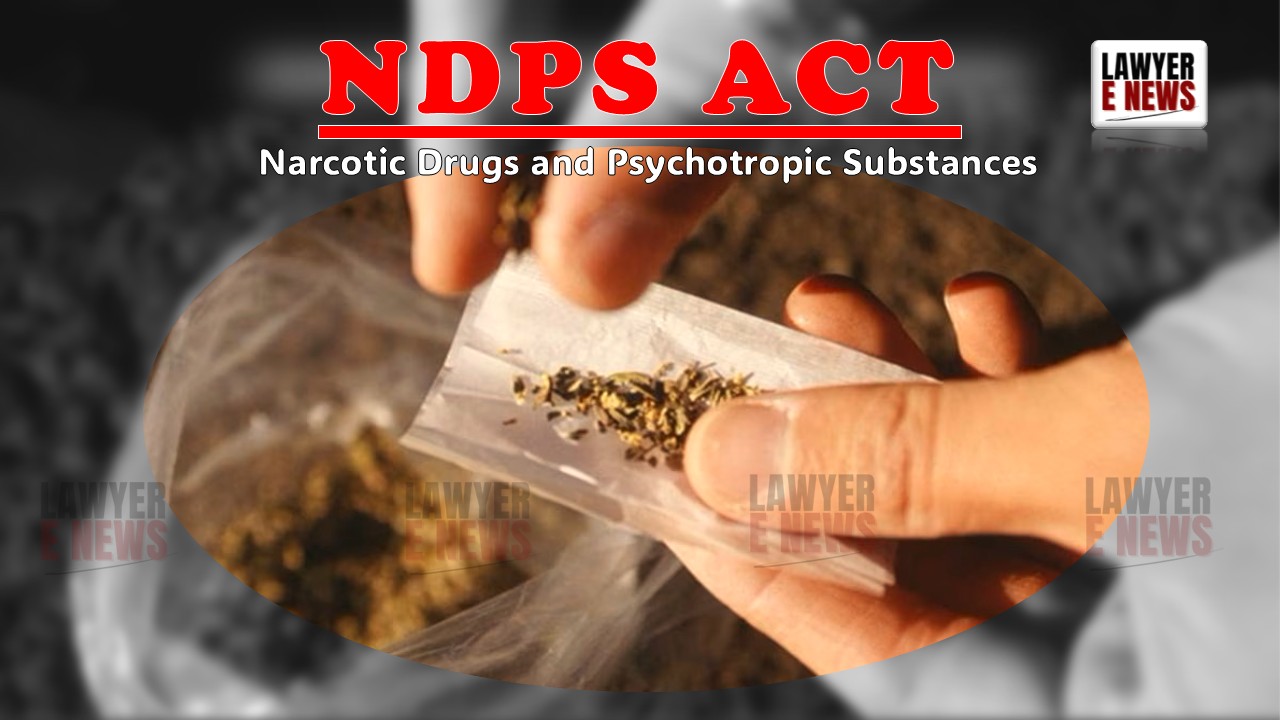
Himachal Pradesh High Court reversed the acquittal of two accused, Pardeep Kumar and Pradeep Saini, for possession of 1.88 kilograms of charas under Section 20(b)(ii)(C) of the Narcotic Drugs and Psychotropic Substances Act, 1985 (NDPS Act). The Court, however, upheld the acquittal of the third accused, Raman Kumar, citing insufficient evidence.
The case, stemming from the recovery of narcotics during routine patrolling near Manikaran, Kullu, raised significant questions about compliance with procedural safeguards, evidentiary thresholds, and statutory presumptions under the NDPS Act and Arms Act.
"Non-Compliance with Section 42 of NDPS Act Not Fatal in Chance Recovery Cases"
The defense argued that the prosecution's case was vitiated due to non-compliance with Section 42 of the NDPS Act, which mandates prior authorization for searches conducted based on specific information. The Court dismissed this contention, clarifying that the recovery in question was a "chance recovery" during routine patrolling and did not arise from prior information.
"Section 42 applies only when the police act on prior information about contraband. In cases of chance recovery, such as the present, compliance with Section 42 is not required," the Court held, referring to the Supreme Court's judgment in Union of India v. Mohd. Nawaz Khan (2021) 10 SCC 100.
The Court observed that the accused's vehicle was stopped on mere suspicion, and the contraband was discovered concealed beneath the mat in the vehicle's rear dickey. "The failure to comply with Section 42 does not invalidate the recovery in situations where no specific information regarding narcotics was available prior to the search," the Bench noted.
"Seal Integrity Verified Through NCB-1 Form and FSL Report"
The Trial Court had acquitted the accused, partly on the ground that the prosecution failed to produce the physical seal used to secure the case property during trial. The High Court rejected this reasoning, emphasizing that seal integrity can be verified through other means.
"The production of the physical seal in court is not mandatory where seal integrity is otherwise established," the Court noted, relying on Fredrick George v. State of Himachal Pradesh, 2002 SCC OnLine HP 73.
The High Court pointed to the NCB-1 Form and the Forensic Science Laboratory (FSL) Report, both of which confirmed that the seals on the case property were intact and matched the specimen seals.
"The report of the chemical analyst shows that the seals were intact and were compared with the specimen seals sent with the NCB-1 Form. This conclusively rules out any tampering with the case property," the Court observed. Referring to the Supreme Court’s judgment in Varinder Kumar v. State of Himachal Pradesh (2019), the Bench concluded that the Trial Court’s finding on seal production was "erroneous and unsustainable."
"Conscious Possession Presumed Unless Rebutted by Accused"
The High Court underscored the statutory presumption of conscious possession under Sections 35 and 54 of the NDPS Act, which places the burden on the accused to rebut the presumption once possession of contraband is established.
In the present case, the accused Pardeep Kumar and Pradeep Saini were traveling in the vehicle from which 1.88 kilograms of charas was recovered. The Court observed, "Both accused failed to rebut the presumption of conscious possession. Their mere denial of knowledge of the contraband is insufficient in the face of the statutory presumption."
Quoting the Supreme Court in Madan Lal v. State of H.P. (2003) 7 SCC 465, the Court observed, "Once possession is established, the person who claims that it was not a conscious possession has to establish it, because how he came to be in possession is within his special knowledge. Section 35 of the Act gives a statutory recognition of this position."
The Court further held that all occupants of a vehicle transporting contraband are deemed to be in possession unless proven otherwise. "Traveling together in a private vehicle with concealed contraband establishes sufficient nexus between the accused and the narcotics. The failure to provide any plausible explanation confirms their guilt," the judgment read.
"Independent Witnesses Not Always Essential in Chance Recoveries"
The defense argued that the prosecution’s case was weakened due to the absence of independent witnesses during the recovery operation. The High Court rejected this claim, noting that the recovery was made during routine patrolling in a remote area, where the presence of independent witnesses could not reasonably be expected.
Quoting the Supreme Court in Kripal Singh v. State of Rajasthan, (2019) 5 SCC 646, the Court stated, "The evidence of police officials cannot be discarded solely because they are police officers. In the absence of independent witnesses, the testimonies of police officials, if credible, are sufficient to establish guilt."
The Bench added, "There is no evidence to suggest that the police officials were motivated to falsely implicate the accused. Their testimonies are consistent, credible, and supported by documentary evidence."
"Chemical Analysis Report Sufficient to Prove Charas"
The Trial Court had cast doubt on the prosecution’s case, stating that the chemical analysis report did not specify the percentage of tetrahydrocannabinol (THC) in the substance recovered. The High Court dismissed this reasoning as legally untenable, citing the Full Bench decision in State of H.P. v. Mehboon Khan, 2013 SCC OnLine HP 4080.
"It is not essential to mention the percentage of THC to prove that a substance is charas under the NDPS Act. The presence of resin in the sample is sufficient to establish that the substance is charas," the Court held.
The Bench emphasized that the NDPS Act treats the entire mass containing resin as charas, irrespective of the THC percentage. "The learned Trial Court’s finding on this point is contrary to settled law and cannot be sustained," the judgment read.
Acquittal Under Arms Act Upheld: Pistol's Working Condition Not Proven
The Court upheld the acquittal of Raman Kumar under Section 25 of the Arms Act, holding that the prosecution failed to prove the working condition of the pistol allegedly recovered from his possession.
Quoting the Supreme Court in Jagjit Singh v. State of Punjab, (1994) 4 SCC 726, the Court stated, "It is necessary for the prosecution to prove that the weapon is in working condition, either through expert testing or by demonstration by police officials. Mere recovery of a pistol, without evidence of its operability, is insufficient for conviction under the Arms Act."
The Court also noted the absence of the mandatory sanction under Section 39 of the Arms Act, which renders the prosecution impermissible.
The High Court convicted Pardeep Kumar and Pradeep Saini for the possession of 1.88 kilograms of charas under Section 20(b)(ii)(C) of the NDPS Act, overturning their acquittal by the Trial Court. Both accused were directed to appear for sentencing on March 13, 2025. However, the Court upheld the acquittal of Raman Kumar, citing lack of evidence under the NDPS and Arms Act.
"This Court finds that the acquittal of Pardeep Kumar and Pradeep Saini was based on conjectures and misinterpretations of law, while the judgment regarding Raman Kumar is consistent with legal principles," the judgment concluded.
Date of Judgment: January 9, 2025