-
by sayum
28 August 2026 2:11 PM







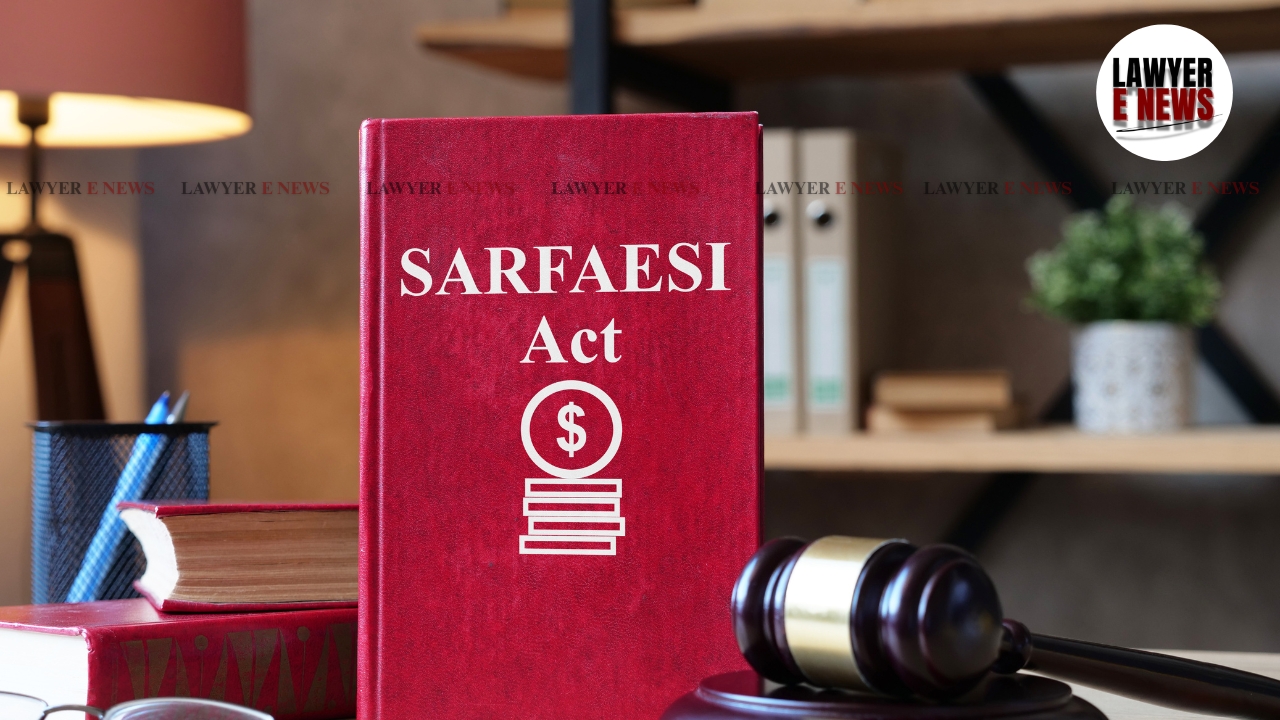
“Only One Composite Notice Required Under Rule 8(6); High Courts Erred In Requiring Two Separate Notices” — On 22nd September 2025, the Supreme Court of India delivered a definitive judgment laying to rest the long-standing confusion surrounding the borrower’s right of redemption under the amended Section 13(8) of the SARFAESI Act, 2002. The Court held that a borrower’s right to redeem the secured asset stands extinguished the moment the auction notice is published, and not at the point of sale or transfer of title. This landmark decision harmonises inconsistent interpretations adopted by various High Courts post the 2016 amendment to the statute.
This ruling carries immense significance for banks, financial institutions, auction purchasers, and borrowers, given the pervasive misuse of redemption rights to delay or obstruct recovery of dues through SARFAESI proceedings.
The case arose from a challenge by M. Rajendran and other borrowers against the auction sale of their mortgaged property by a secured creditor under the SARFAESI Act. The loan was obtained on 06.01.2016, and the account was classified as NPA on 31.12.2019. Pursuant to this, a notice for auction sale was published on 22.01.2021, and the auction was conducted on 26.02.2021. The sale certificate was issued on 22.03.2021.
The borrowers argued that their right of redemption survived beyond the date of auction notice, relying on precedents interpreting Section 60 of the Transfer of Property Act and the pre-amendment version of Section 13(8) of SARFAESI. The High Court accepted this contention. However, the auction purchaser and the secured creditor contended that with the amendment to Section 13(8) coming into effect from 01.09.2016, the borrower’s right to redeem ends upon publication of the sale notice, not upon sale.
Aggrieved by the High Court’s view, the auction purchaser approached the Supreme Court.
The Supreme Court focused on two crucial legal issues: when does the right of redemption of a borrower end under amended Section 13(8) and whether the SARFAESI Rules require issuance of two distinct sale notices.
The Court clarified that the legal regime underwent a material change post the 2016 amendment to Section 13(8). The unamended provision allowed borrowers to redeem the property any time before actual transfer. However, after the amendment, the language of the statute unambiguously curtailed this right:
“As per the plain language of the provision, the moment the notice for holding auction, obtaining quotation, inviting tender or conducting private treaty is ‘published’, the borrower’s right of redemption would be extinguished.”
Rejecting the application of Mathew Varghese and Narandas Karsondas, the Court emphasized that those decisions dealt with the unamended legal regime.
"Only One Sale Notice Required Under SARFAESI Rules; Two Notices Theory is a Misreading"
The most important procedural issue addressed by the Court was the conflicting interpretations by different High Courts on Rule 8(6), Rule 9(1), and Rule 8(7) of the SARFAESI Rules. Some High Courts had insisted that two separate sale notices — one to the borrower and another to the public — were mandatory, with a 30-day gap between them. The Supreme Court called this a misconception:
“Rule(s) 8(6), the Proviso thereto, Rule 8(7) and Rule 9(1) of the SARFAESI Rules do not speak of any separate or distinct notice of sale… all these rules are concerned with a single composite ‘notice of sale’.”
The Court pointed out that the statutory format prescribed in Appendix IV-A confirms this position. The standard notice is addressed both to the borrower and to the public:
“Notice is hereby given to the public in general and in particular to the Borrower(s) and Guarantor(s)...” — Appendix IV-A
This, the Court held, makes it clear that there is no requirement for two distinct notices under the Rules. The same notice serves the dual purpose of compliance with both borrower service and public advertisement.
“The public notice of sale in newspaper as-well the notice of sale served to the borrower are one and the same, for the purpose of Rule 9(1).”
The Court further ruled that publication and service of the sale notice may be done simultaneously, provided that 30 days lapse before the auction date, thereby overruling High Court judgments that insisted on a gap between the two:
“There is no rhyme or reason why the time [gap] be maintained. Both the notices can be issued simultaneously… any other view would defeat the object of enabling the expeditious recovery of loan.”
“The Word ‘Publication’ Under Section 13(8) Must Be Interpreted Holistically”
Addressing the ambiguity around the phrase “before the date of publication” in amended Section 13(8), the Court offered a harmonious construction:
“The word ‘publication’ used in Section 13(8) of the SARFAESI Act has to be understood to mean and include the service, publication in newspaper, and the affixation and uploading of the ‘notice of sale’, as may be required under the SARFAESI Rules.”
Accordingly, the right of redemption ends the day the composite sale notice is published, affixed, or served — whichever occurs last — and 30 days thereafter, the sale may legally proceed.
Amended Section 13(8) Applies Retrospectively to All “Live Claims”
Another key issue raised was whether the amended Section 13(8) applies only to loans disbursed after 01.09.2016. The borrowers contended that since their loan was obtained in January 2016, the pre-amendment provision should apply.
The Supreme Court emphatically rejected this:
“The SARFAESI Act intends to provide a remedy in respect of pre-existing loans… the interpretation that it would apply only to future debts would defeat the very purpose of that law.”
Relying on M.D. Frozen Foods, the Court noted that remedial statutes like SARFAESI are designed to apply to all subsisting causes of action:
“A remedial statute applies to pending proceedings and such application may not be taken to be retrospective if application is to be in future with reference to a pending cause of action.”
Accordingly, the Court held that the amended Section 13(8) applies to all cases where auction notices were published after 01.09.2016, regardless of the original loan date.
Strong Censure Against Attempts To Derail Auction Process
The Supreme Court noted with concern that the borrowers had attempted to create third-party rights over the mortgaged property after auction proceedings were initiated. The Court issued a stern warning:
“If any third-party rights have been created over the said secured asset, the same would be non-est in view of this judgment.”
It also directed that if there is any resistance to possession by the auction purchaser, the Court would “take the strictest of actions” against the responsible parties.
Legislative Gaps and a Call to the Finance Ministry
In a rare judicial appeal to the executive, the Court expressed serious concern about statutory ambiguity in the wording of Section 13(8) and the procedural rules under SARFAESI:
“We are… at our wit’s end to note how the ill-wording of Section 13(8) of the SARFAESI Act has resulted in a glaring inconsistency… the interpretative deadlock… has single handedly resulted in a huge mess insofar as enforcement of security interest is concerned.”
The Court urged the Ministry of Finance to examine and amend the provisions urgently:
“We humbly urge the Ministry of Finance to take a serious look at these provisions and bring about necessary changes, before it is too late in the day.”
Copies of the judgment were directed to be sent to all High Courts and the Principal Secretaries of Finance and Law & Justice.
This decision by the Supreme Court brings a long-awaited clarity on three central legal issues:
The right of redemption under SARFAESI ends with publication of auction notice, not at the point of sale.
Only one composite notice of sale is required under Rule 8(6) — not two, and not with a mandatory 30-day interval between them.
The amended Section 13(8) applies retrospectively to all pending claims and causes of action post-September 2016, regardless of when the loan was granted.
By settling these interpretational conflicts and warning against procedural misuse, the Court has fortified the SARFAESI framework as a tool for efficient debt recovery and curbed delay tactics by borrowers.
Date of Decision: 22 September 2025