-
by sayum
27 August 2026 7:40 AM







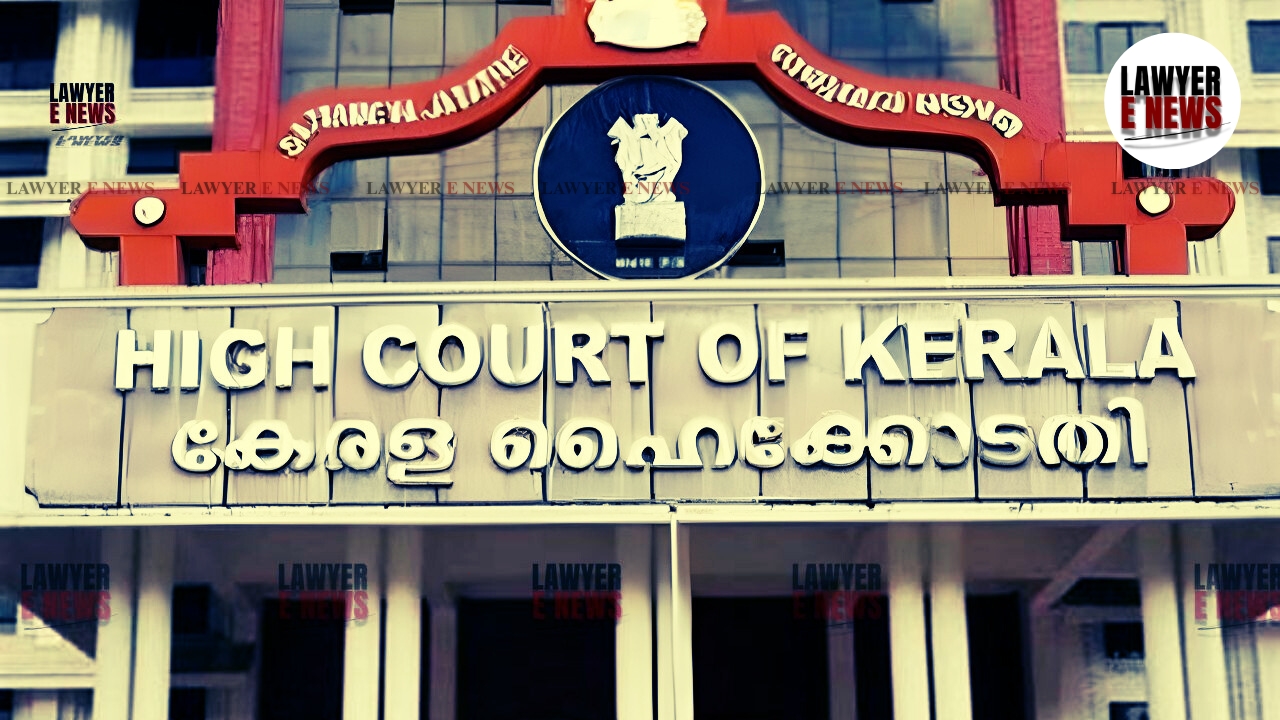
"The penalty proceeding under Section 20 of the RTI Act is purely a matter between the State Information Commission and the SPIO", Kerala High Court has ruled that an RTI complainant has no legal right to be heard before the State Information Commission decides whether to impose or drop penalty proceedings against a State Public Information Officer under Section 20(1) of the Right to Information Act, 2005 — holding that such proceedings are exclusively a matter between the Commission and the delinquent officer.
Justice Murali Purushothaman dismissed the writ petition filed by Raisa Eapen, who had challenged the Commission's order dropping penalty proceedings against the SPIO without furnishing her a copy of the officer's explanation or giving her an opportunity to rebut it.
Background of the Case
The petitioner had submitted a Form-6 application under the Kerala Conservation of Paddy Land and Wetland Act, 2008 seeking reclassification of her land. A circular dated December 24, 2023 issued by the Land Revenue Commissioner directed that all Form-6 applications received on or before December 31, 2023 be included and disposed of at a Revenue Adalat held on February 17, 2024. Despite claiming full eligibility, the petitioner's application was excluded from the Adalat without any satisfactory explanation.
She then filed an RTI application dated May 18, 2024 before the SPIO at the Revenue Divisional Office, Fort Kochi, seeking information on why her application was excluded. No reply was furnished within the statutory period of 30 days under the RTI Act. She accordingly preferred a second appeal under Section 19(3) of the RTI Act before the State Information Commission.
The Commission, finding that the SPIO had failed to furnish information within the prescribed time and had given false and misleading information, issued a show cause notice calling for an explanation as to why penalty proceedings under Section 20(1) should not be initiated. The SPIO responded claiming that the petitioner's Form-6 application was submitted only on January 8, 2024 — after the cutoff date of December 31, 2023 — and attributed the delay in providing information to election duty, staff transfers, and administrative delays. The Commission accepted this explanation and dropped further proceedings by its final order without hearing the petitioner or furnishing her a copy of the SPIO's reply.
Legal Issues
The central question before the Court was whether an RTI complainant or appellant possesses a right to be heard — and to receive a copy of the SPIO's explanation — in penalty proceedings initiated under Section 20(1) of the RTI Act before the State Information Commission decides to impose or drop the penalty.
Court's Observations
On the Statutory Scheme — Penalty Is Not for the Complainant
The Court undertook a careful reading of Sections 19 and 20 of the RTI Act, drawing a sharp distinction between the two. Section 19(8)(b) empowers the Commission to direct a public authority to compensate the complainant for any loss or detriment suffered — a provision that inherently requires the complainant's participation to adjudicate the quantum of loss. Section 20(1), by contrast, empowers the Commission to impose a monetary penalty on the SPIO that goes directly to the State exchequer — not to the complainant's pocket.
This distinction, the Court held, was decisive: "While the 'compensation' goes to the complainant, the 'penalty' goes to the State exchequer. The penalty proceeding under Section 20 of the RTI Act is purely a matter between the Central Information Commission or the State Information Commission and the CPIO or the SPIO, as the case may be."
The first proviso to Section 20(1) — the only express mandate in the provision regarding hearing — requires exclusively that the SPIO be given a reasonable opportunity of being heard before any penalty is imposed. Nowhere, the Court noted, does the RTI Act require the Commission to hear the appellant in Section 20 proceedings.
On the Kerala State Information Commission Rules
The Court further examined Rule 7 of the Kerala State Information Commission (Procedure for Appeal) Rules, 2006 governing the personal presence of the appellant. The Rule makes the appellant's appearance entirely optional — the appellant "may at his discretion be present in person... or may opt not to be present." Even if the appellant chooses not to appear, the Commission must dispose of the appeal. This structural optionality, the Court held, reinforces the position that the complainant has no right to participate in penalty proceedings as such.
"The petitioner has no right to be heard in the penalty proceedings under Section 20(1) of the RTI Act, unless permitted by the State Information Commission."
On the Show Cause Notice Being Prima Facie in Nature
The Court further clarified that a show cause notice issued by the Commission before imposing penalty is only prima facie in nature — a preliminary satisfaction, not a final finding. If the Commission, upon examining the SPIO's explanation, finds it satisfactory, it is fully within its jurisdiction to drop the proceedings without conducting any further inquiry.
"The opinion formed by the Central Information Commission or the State Information Commission at the stage of deciding the complaint or appeal and issuing a show cause notice is only prima facie in nature. If the Central Information Commission or the State Information Commission finds that the explanation of the SPIO is satisfactory, the Commission can drop the penalty proceedings."
The Commission's final order accepting the SPIO's explanation — that the delay was attributable to election duty, staff transfers, and administrative transitions — was therefore not erroneous or perverse, and did not call for interference under Article 226.
The writ petition was dismissed. The Court declined to quash the Commission's order or direct a fresh hearing, holding that the petitioner had no right to be heard in Section 20(1) proceedings unless specifically permitted by the Commission, and that the Commission's finding was neither perverse nor illegal.
Date of Decision: March 9, 2026