-
by sayum
24 October 2026 7:15 PM







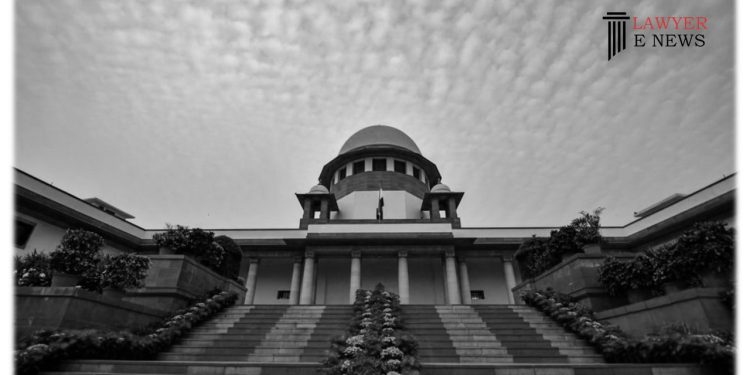
The Supreme Court bench, made up of Justices Dinesh Maheshwari and Bela M. Trivedi, ruled that the presiding judge must provide justification for his or her decision when granting remission under Section 432(2) of the Criminal Procedure Code, as established by the Supreme Court in the case of Laxman Naskar v. Union of India.
According to the Chhattisgarh High Court's ruling, the petitioners are convicted criminals serving a life term in jail. They were charged for the offences under Sections 147, 148, 302/149, and 307 of the IPC as well as Sections 3(2)(5) of the Scheduled Caste and Scheduled Tribes Act, along with other co-accused parties (Prevention of Corruption Act). They were all tried for the aforementioned offences and found guilty by Special Judge (SC, ST), Durg in Special Case No. 16/2006. They were each given a life sentence. They were accused of participating in an illegal assembly and killing two persons with dangerous weapons such swords, axes, wooden sticks, and other things. There were eight people charged in total.
The petitioners have cited Article 32 of the Indian Constitution in their request for the issuance of a suitable writ, order, or directive for the respondents to resubmit the petitioners' case to the sentencing court for review.
In this instance, the relevant authorities repeatedly refused the petitioners' requests for remission without providing any justification. They had each applied to the jail superintendent for early release under Section 432(2) of the Criminal Procedure Code after serving 16 years in prison (or 21 years without remission). The concerned Sessions Court, which had found the petitioners guilty, was consulted by the jail superintendent. In light of the case's facts and circumstances, the relevant Sessions Court refused their request. The Presiding Judge was supported by the Law Department as well. The petitioner's applications were turned down by the petitioner's director general of jail and correctional services as well.
Ram Chander, one of the co-accused, had earlier submitted a writ petition to the Supreme Court. The Supreme Court dismissed the petition, ordering the Special Judge to reissue an opinion with sufficient justification in light of the pertinent considerations outlined in the Laxman Naskar v. Union of India case. Thus, the Special Judge suggested that his sentence be commuted after taking into account the directives provided by the highest court in the relevant case.
The panel decided to make the same ruling in the current instance as it did in Ram Chander's plea.
"We propose to pass similar order as passed in the case of co-accused Ram Chander," the petitioners write. "Since the case of the present petitioners is also similar to the case of the co-accused Ram Chander, inasmuch as the Presiding Officer's opinions contained in the letters dated 02.07.2021, 10.08.2021, and 01.10.2021 do not contain reasons with regard to the factors to be taken into consideration as laid down in case of Laxman Naskar
The Court held that the Presiding Officer's opinions contained in the letters dated 02.07.2021, 10.08.2021 and 01.10.2021 do not contain reasons with regard to the factors to be taken into consideration when the Presiding Judge gives an opinion under Section 432(2) of the Criminal Procedure Code and the authority of the appropriate Government to suspend or remit sentences under Sections 432 and 433-A of the Cr.P.C.
As a result, we order the Special Judge in Durg to provide a new opinion on the petitioners' applications with sufficient justification after taking into account the pertinent criteria established in Laxman Naskar v. Union of India.
Importantly, the Supreme Court ruled in the case of Laxman Naskar that the presiding officer must take into account the following factors when exercising his or her authority under section 432(2): I whether the crime affects society as a whole; (ii) the likelihood that the crime will be repeated; (iii) the potential for the convict to commit crimes in the future; (iv) whether keeping the convict in prison is serving any useful purpose; and (v) the convict.
JASWANT SINGH & ORS. VS THE STATE OF CHHATTISGARH & ANR.