-
by sayum
15 August 2026 5:59 AM







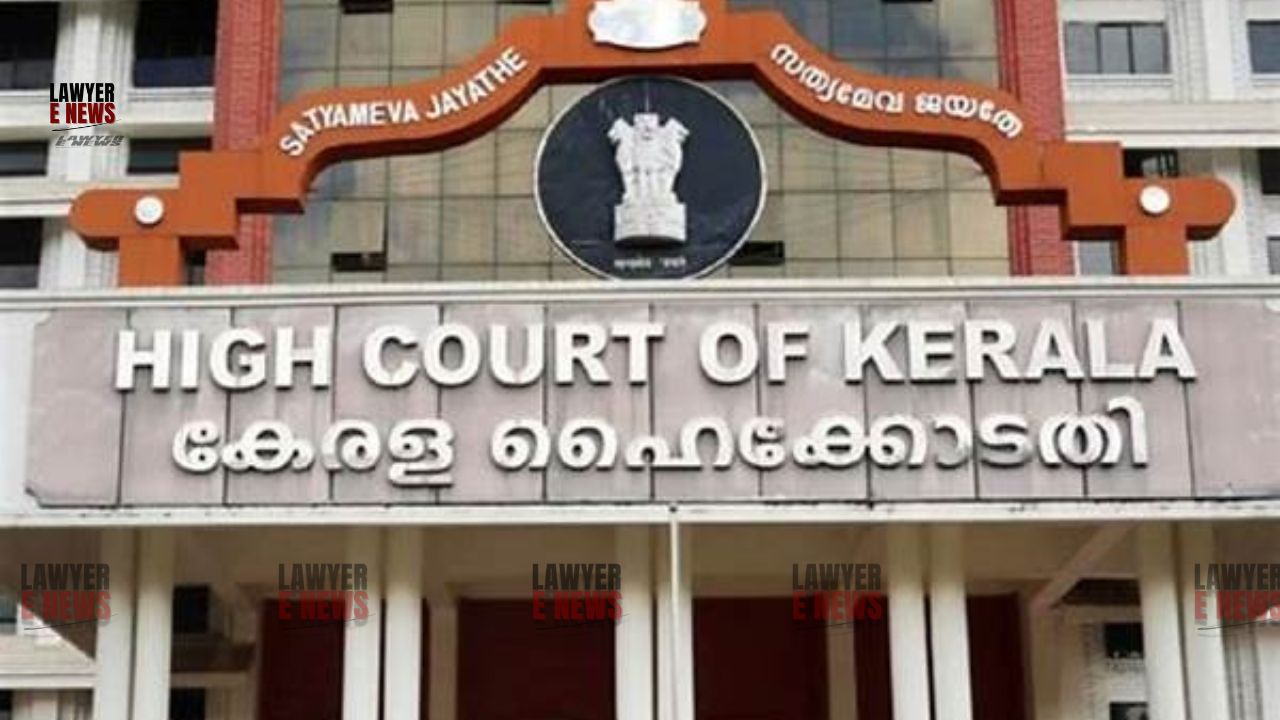
"There is no quarrel that, if after excluding the portions conveyed from Ext.B9, any portion of the property remains, that can be incorporated in the description of counter claim schedule item No.1 and can be partitioned equally between the plaintiff and the defendant." High Court of Kerala, in a significant ruling, held that any remaining portion of a bequeathed property, after excluding prior conveyances made from the parent title deed, is liable to be partitioned equally among the legal heirs.
A division bench of Justice Sathish Ninan and Justice P. Krishna Kumar observed that a claim for partition cannot be outrightly declined at the preliminary decree stage merely because exact remaining extents are yet to be precisely identified.
The dispute arose between two brothers over the properties bequeathed equally to them by their late father through a Will. The plaintiff filed a suit for partition of one specific item, while the defendant filed a counter-claim seeking the partition of two additional properties. The trial court granted a preliminary decree for the plaint schedule and one of the counter-claim items but declined to partition the first item in the counter-claim, holding that the defendant failed to prove the existence of such property. Aggrieved by this rejection, the defendant approached the High Court.
The primary question before the court was whether a preliminary decree for partition is liable to be passed in respect of a property from which various prior conveyances have already been made. The court was also called upon to determine if the exact remaining extent of the property must be strictly proved at the preliminary decree stage to sustain a claim for partition.
Identifying Remaining Extent From Parent Title Deeds
Delving into the merits of the counter-claim, the High Court examined the title deeds through which the late father acquired the properties. The bench noted that the contested item in the counter-claim was claimed to be a part of the property included in a parent title deed, marked as Exhibit B9. It was an admitted position between the parties that various conveyances had already taken place from the property covered under this deed over time.
No Bar On Partitioning Residual Property
Addressing the trial court's conclusion that the existence of the property was not proved, the High Court adopted a pragmatic approach regarding residual land. The bench observed that the mere fact that prior conveyances were executed does not extinguish the right to partition the leftover estate. The court emphasised that as the sole legal heirs of the deceased father, the brothers were entitled to whatever remained of the bequeathed property.
"The plaintiff and the defendant being the sole legal heirs of late Pankajakshan, we do not find any reason to decline such prayer."
Identification Relegated To Final Decree Proceedings
Crucially, the High Court held that the exact demarcation and identification of the remaining land need not act as a barrier to passing a preliminary decree. The bench directed that the actual assessment of the property covered under the parent deed and the subsequent conveyances could be practically ascertained at a later stage, ensuring that the substantive rights of the heirs are not defeated by initial evidentiary gaps.
"In the final decree proceedings, the property covered under Ext.B9 and the conveyances therefrom shall be identified."
Modification Of Trial Court Decree
Setting aside the lower court's refusal, the High Court clarified that if any extent is found available after the identification exercise, it must be included in the partition schedule. The bench modified the trial court's judgment to ensure that both parties receive their legitimate half-shares over any residual property discovered during the final decree proceedings.
Allowing the appeal, the High Court set aside the trial court's judgment to the extent that it declined partition with respect to the first item of the counter-claim. The bench directed that the remaining extent of the property, once identified in the final decree proceedings, shall be partitioned equally between the two brothers, thereby securing their complete rights over the bequeathed estate.
Date of Decision: 17 July 2026