-
by sayum
23 August 2026 2:56 PM







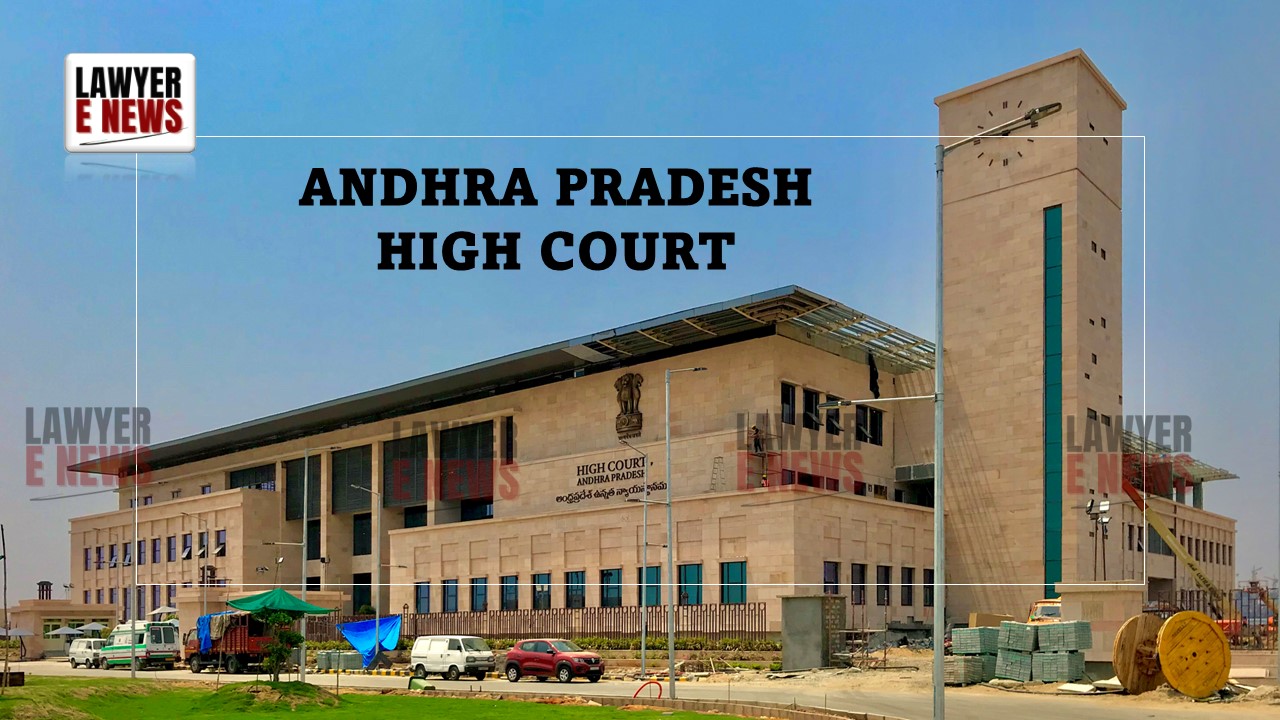
“In a suit for declaration of title, the burden always lies on the plaintiff to establish a clear case, and cannot rely on the weakness of the defendant’s case,” held the Andhra Pradesh High Court.
In a decisive judgment with far-reaching implications on civil title disputes involving religious institutions, the Andhra Pradesh High Court, dismissed a first appeal seeking declaration of title and injunction over agricultural lands claimed as ancestral property by two individuals. The Court held that mere possession or revenue entries such as pattadar passbooks or cist receipts do not establish ownership, especially when the property is already recorded in the name of a religious endowment.
Delivering its ruling in Matam Ashok Kumar and Another v. State of Andhra Pradesh and Another, a Division Bench of Justice Ravi Nath Tilhari and Justice Maheswara Rao Kuncheam upheld the findings of the III Additional District Judge, Kurnool, which had earlier dismissed the plaintiffs’ suit for want of title proof.
The core legal question revolved around whether the plaintiffs could succeed in a suit for declaration of ownership solely based on their possession and certain revenue records, without establishing their ancestor's title over the disputed land which was recorded as belonging to the Sri Pothuluri Veera Brahmendra Swamy Mutt, a religious institution.
“Plaintiffs Must Stand on Strength of Their Own Title” – High Court Reiterates Foundational Rule in Title Suits
At the very outset, the High Court framed the central issue in precise terms: “Whether the learned trial Court committed error of fact and law in dismissing the suit of the appellants for declaration of right and title over the plaint schedule property?”
The Court answered this with a categorical no, observing that the trial court had rightly held the plaintiffs failed to discharge the initial burden of proof. Referring to authoritative precedents including Union of India v. Vasavi Cooperative Housing Society Ltd. [(2014) 2 SCC 269] and Jagdish Prasad Patel v. Shivnath [(2020) 19 SCC 57], the Court reaffirmed that:
“In a suit for declaration of title, the burden always lies on the plaintiff to make out and establish a clear case for granting such a declaration and the weakness, if any, of the case set up by the defendants would not be a ground to grant relief.”
The plaintiffs had claimed title based on alleged ancestral inheritance from one Matam Veera Brahmam Swamy, asserting that their family had cultivated the lands and held pattadar passbooks and cist receipts as supporting evidence. They argued that the surname “Matam” and revenue documents proved their ancestral connection to the lands.
However, the High Court firmly rejected this argument, holding that no documentary evidence was produced to connect the plaintiffs’ ancestors with the ownership of the suit lands. The Court observed:
“Mere resemblance of the surname ‘Matam’ would not make the property recorded in the name of the Mutt the ancestral property of the plaintiffs.”
Revenue Records, Cist Receipts, and Pattadar Passbooks Are Not Proof of Title
Addressing the plaintiffs' heavy reliance on Exs.A1–A28 (cist receipts) and Exs.A29–A32 (pattadar passbooks), the Court ruled that such documents may raise a presumption of possession for fiscal purposes, but do not confer ownership.
Citing Suraj Bhan v. Financial Commissioner [(2007) 6 SCC 186] and Nagar Palika v. Jagat Singh [(1995) 3 SCC 426], the Court underscored:
“It is well settled that entries in the revenue records or jamabandi have only fiscal purpose i.e., payment of land revenue, and no ownership is conferred on the basis of such entries.”
The plaintiffs had also produced loan documents from Syndicate Bank, claiming they mortgaged the property using these records. The Court, however, dismissed the evidentiary value of such documents, especially those created during the pendency of the suit.
Presumption Under Section 110 Evidence Act (Now Section 113 of Bharatiya Sakshya Adhiniyam) Not Applicable
A major plank of the plaintiffs’ argument was invoking Section 110 of the Indian Evidence Act, 1872, now Section 113 of the Bharatiya Sakshya Adhiniyam, 2023, which provides that possession raises a rebuttable presumption of ownership.
But the Court clarified that this presumption only arises when no party has a clear title, or when possession is shown to be prima facie lawful. Referring to Nazir Mohamed v. J. Kamala [(2019) 6 SCC 82] and the recent Supreme Court judgment in Yerikala Sunkalamma v. State of Andhra Pradesh, 2025 SCC OnLine SC 630, the Bench noted:
“The presumption of title as a result of possession can arise only where facts disclose that no title vests in any party and the possession of the plaintiff is not prima facie wrongful.”
In the present case, since the lands were recorded in the name of the religious institution and the plaintiffs could not produce a single registered document or historical title deed in favour of their ancestors, the Court held the presumption inapplicable.
No Admission of Title or Possession by Defendant Through Pleadings
The plaintiffs had also contended that the Mutt, in its written statement, admitted their possession by stating it “was not aware” of certain land dealings and that the plaintiffs were “alleged” cultivators. The High Court dismissed this reading of the pleadings, holding that:
“Pleadings must be read as a whole. An expression of ignorance by the defendant regarding collateral facts does not amount to an admission of title or possession.”
The Court emphasized that the defendant Mutt had categorically denied ownership of the plaintiffs and asserted its own title through registered revenue documents and pattadar passbooks (Exs.B7, B8).
Religious Endowment’s Ownership Stands Validated
The High Court ultimately upheld the trial court’s finding that the Sri Pothuluri Veera Brahmendra Swamy Mutt was the rightful owner of the suit lands, as borne out by official land records and long-standing revenue entries.
The Court concluded: “The property being recorded in the name of the 2nd defendant (Endowment Commissioner), the presumption that possession follows title cannot be attracted in favour of the plaintiffs, nor can any declaration of title be granted in their favour in absence of any document of title.”
Accordingly, the appeal was dismissed, affirming the trial court’s decree.
This judgment serves as a clear caution against attempting to establish ownership solely on the basis of revenue documents, cist receipts, or mutation entries, especially when title is disputed. It reinforces the foundational rule in Indian civil jurisprudence that title must be proved by cogent, independent evidence—not on presumptions or the weaknesses in the opposing party’s case.
Date of Decision: January 7, 2026