-
by sayum
17 November 2026 9:07 PM







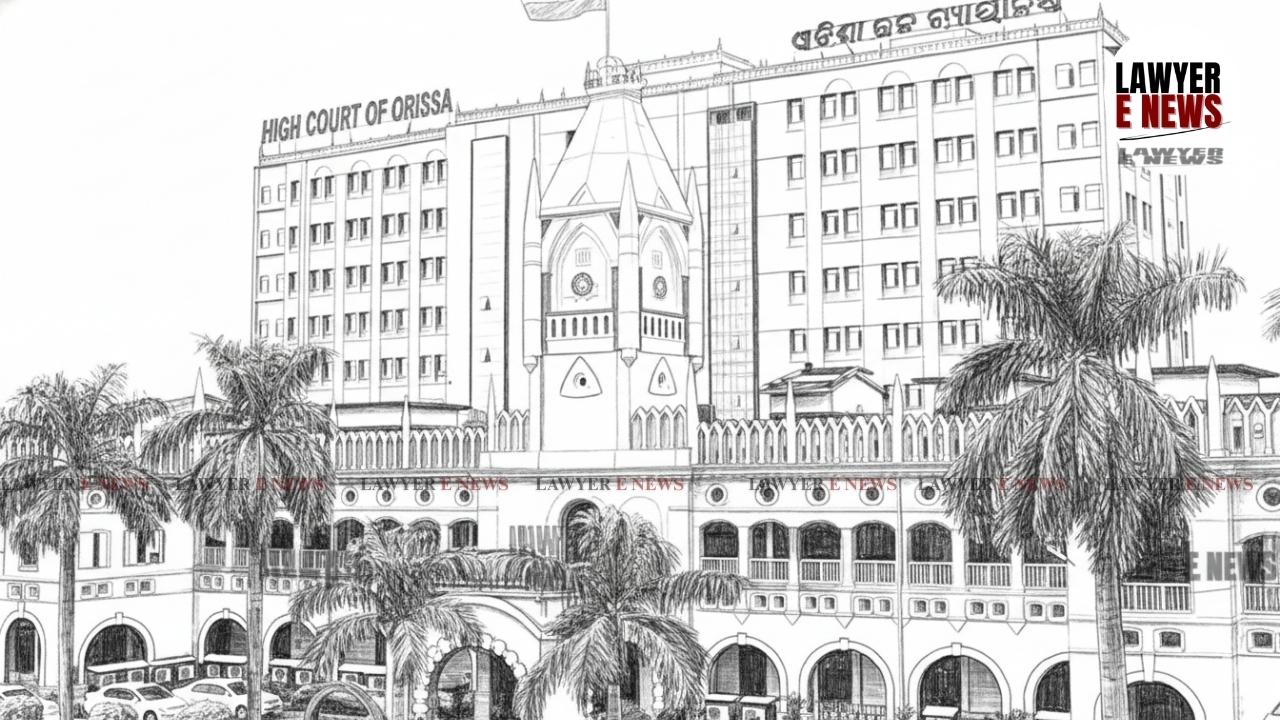
CUTTACK: The Orissa High Court has held that review proceedings cannot be equated with an appeal in disguise to rehear contentions previously urged and rejected, affirming that a review court cannot re-evaluate the applicability of the Insolvency and Bankruptcy Code, 2016 to pre-existing industrial awards.
A Division Bench comprising Chief Justice Harish Tandon and Justice Mruganka Sekhar Sahoo made these observations while dismissing a review petition preferred under Order 47 Rules 1 and 2 read with Section 114 of the Code of Civil Procedure, 1908.
The petitioner company had sought a review of the High Court's earlier judgment dated August 29, 2023, which dismissed its writ petition challenging an award passed under Section 33-C(2) of the Industrial Disputes Act, 1947 by the Labour Court, Bhubaneswar. The dispute originated from an industrial award passed in 1999 reinstating a workman with continuity of service and 50% back wages, which was affirmed by the High Court in 2019. The management contended that because it subsequently underwent Corporate Insolvency Resolution Process (CIRP) resulting in an approved resolution plan under Section 31 of the IBC, all prior unadmitted claims of the workman stood completely extinguished.
The primary legal issues before the Court were whether the petitioner established any mistake or error apparent on the face of the record under Order 47 Rule 1 of the CPC to warrant a review of the dismissal order, and whether a review petition can be entertained to re-agitate the interpretation of the IBC's clean slate doctrine after identical arguments were specifically considered and rejected in the writ proceedings.
Review jurisdiction is circumscribed by definitive statutory limits under Order 47 Rule 1 CPC
The Court observed that while the High Court enjoys plenary powers under Article 226 of the Constitution of India, the review of an order or decree must be strictly exercised within the circumscribed perimeter of Order 47 Rule 1 CPC. Referring to settled jurisprudence, the Bench emphasized that substantive review powers under Section 114 CPC do not grant unfettered authority to reopen concluded matters without satisfying the threshold requirement of a patent error.
A clear distinction exists between an erroneous decision and an error apparent on the record
Emphasizing the distinction between appellate and review jurisdictions, the Bench noted that an erroneous decision must be taken higher up in appeal rather than corrected under review. The Court relied on leading Supreme Court precedents, noting that an error apparent on the face of the record must be self-evident and striking at the root of the decision without requiring a long-drawn process of reasoning or lengthy debate.
The Bench reiterated the Supreme Court's pronouncement in Parsion Devi v. Sumitri Devi, observing that it is impermissible for an erroneous decision to be reheard and corrected under Order 47 Rule 1 CPC. The Court highlighted that a review petition serves a limited statutory purpose and cannot be allowed to function as an appeal in disguise.
Re-arguing the scope of the IBC's clean slate doctrine does not warrant review
Addressing the petitioner's argument regarding the landmark ruling in Ghanashyam Mishra and Sons Private Limited v. Edelweiss Asset Reconstruction Company Limited, the Bench observed that the Division Bench in the writ judgment had already considered the judgment threadbare. The writ court had specifically found that the company had conscious knowledge of the decades-old labour dispute but chose not to incorporate it into the resolution plan, thereby attempting to circumvent industrial adjudication under the guise of insolvency proceedings.
The Court noted that even if the interpretation suggested by the review petitioner could be viewed as an alternative interpretation, the mere possibility of two views on a subject does not constitute a ground for review. The repetition of overruled arguments through the medium of a review petition cannot be countenanced, as reconsideration cannot be equated with a rehearing of the writ petition.
Subsequent disputes on factual and legal findings cannot be reassessed under review
Examining the petitioner's assertions of supposed mistaken factual findings, the Bench observed that re-assessing these aspects would amount to a reappreciation of evidence, which is impermissible even in appellate scrutiny, let alone review jurisdiction. The Bench reiterated that where a point is already dealt with and answered by a coordinate Bench, parties are not entitled to challenge the outcome simply because they disagree with the conclusion reached.
The High Court affirmed that the grounds raised by the petitioner failed to point out any manifest error undermining the soundness of the writ court's judgment. The Court ruled that judicial finality cannot be disturbed when the petitioner is merely seeking a second trip over ineffectually covered ground.
The High Court concluded that the review petition was devoid of merit as no patent mistake or error apparent on the face of the record was established, and accordingly dismissed the review application with no order as to costs.
Date of Decision: November 5, 2026