-
by sayum
17 November 2026 9:07 PM







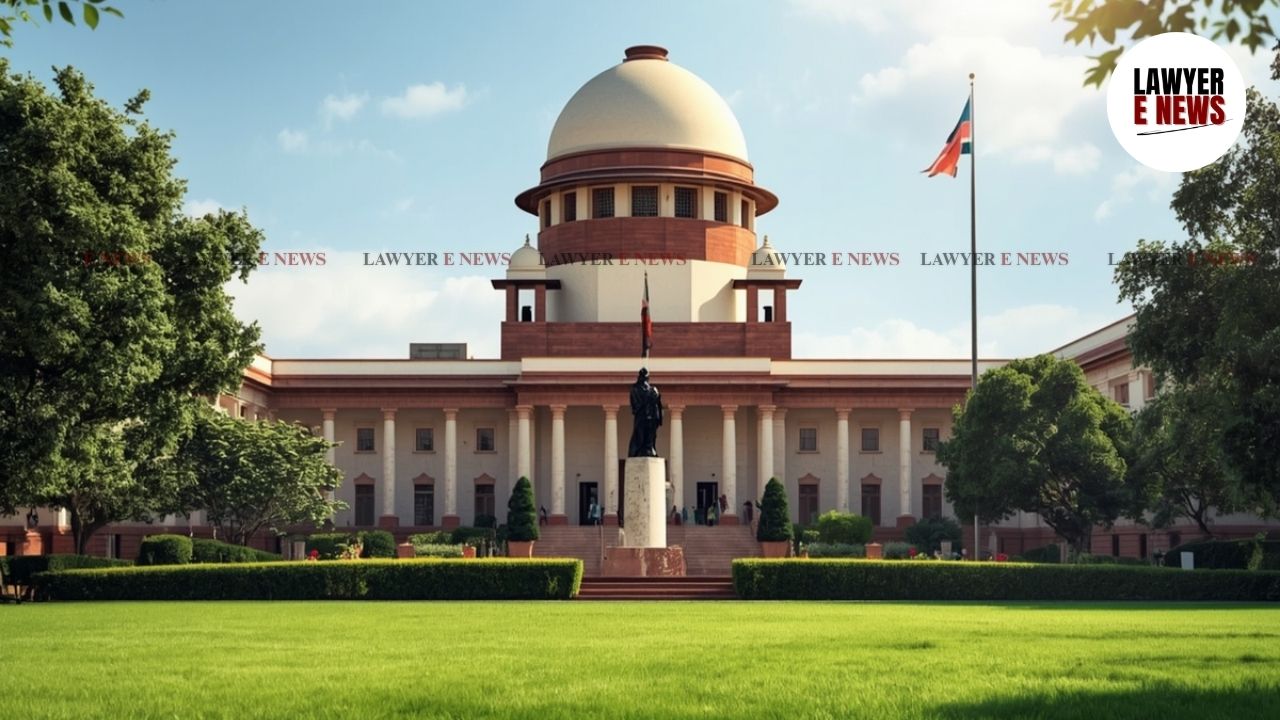
NEW DELHI: Clarifying the jurisprudence governing the discharge of probationers, the Supreme Court on November 16, 2026 observed that an order terminating probationary services without casting any aspersion or imputing moral turpitude remains a termination simpliciter and cannot be branded punitive merely because adverse perceptions or complaints prompted the employer's decision. A Bench comprising Justice Dipankar Datta and Justice Sheel Nagu held that unless a full-scale formal inquiry into allegations of misconduct culminated in a finding of guilt behind the employee's back, such complaints constitute mere motive and not the foundation of the discharge.
The appellant was appointed on probation as an Associate Professor at the Centre for Earth Sciences, Indian Institute of Science, Bangalore. After an initial extension of his probationary period, a review committee recommended the discontinuation of his engagement due to unsuitability and friction with colleagues. Acting under Regulation 13.5 of the Institute Regulations, which permitted termination on notice without assigning reasons, the Institute issued an office memorandum discharging him from service, which the High Court of Karnataka declined to interfere with.
Whether the termination of the appellant's probationary services was a termination simpliciter or a punitive discharge camouflaged in innocuous language, and whether the High Court erred in refusing to quash the order of discharge and Regulation 13.5 of the Institute Regulations.
Examining the historical evolution of probationary employment, the Bench reiterated that probation provides an employer a valuable opportunity to evaluate a recruit's efficiency, sincerity, and suitability before absorbing them into regular cadres. The Court highlighted that termination at the end of or during probation ordinarily carries no civil consequence or punishment because a probationer enjoys no vested right to hold the post.
Distinction between motive and foundation must turn on substance rather than mechanical inquiry
Addressing the foundational principles governing judicial review, the Bench observed that courts must separate the grain from the chaff by looking at the substance of the record rather than resting solely on the linguistic form of the order. Drawing upon settled precedents, the Court noted that if an employer chooses not to investigate the truth of allegations or conduct a departmental inquiry, but dispenses with the services of a probationer on an overall assessment of unsuitability, the allegations remain mere motive.
The Bench formulated a three-stage filter test to determine whether an ostensibly innocuous termination order is infected with stigma. First, the court must see if the order, on its face, carries any imputation against the probationer. Second, if innocuous on its face, the material on record must disclose that the foundation of the order is an established finding of misconduct rather than an administrative assessment of suitability. Third, such foundation must visit the probationer with civil consequences affecting future employment prospects.
Mere use of words like unsuitability or general dissatisfaction does not constitute stigma
The Court underscored that implicit unsuitability is an inherent component of every discharge during probation. In order to amount to a stigma, the order or the record must impute something over and above mere unsuitability for the job, such as moral turpitude or established misconduct.
Revisiting the three-pronged test laid down in Pavanendra Narayan Verma v. Sanjay Gandhi PGI of Medical Sciences, the Bench held that to render a discharge punitive in substance, there must be a full-scale formal enquiry into allegations involving moral turpitude or misconduct which culminated in a finding of guilt. If any one of these factors is missing, the termination must be upheld as termination simpliciter.
Lifting the corporate or administrative veil is impermissible to re-appreciate suitability
The Court placed strict boundaries on judicial scrutiny, stating that lifting the veil of an innocuous discharge order is permissible only within circumscribed limits to ascertain whether alleged unsuitability is a cloak for punitive action founded on specific misconduct. The writ court cannot lift the veil to substitute its own view on suitability for that of the appointing authority.
Rejecting the challenge to Regulation 13.5 of the Institute Regulations, the Court affirmed that a regulation permitting termination during probation without assigning reasons is neither arbitrary nor unconstitutional. A probationer cannot insist that formal reasons must be assigned in every discharge order, as doing so would negate the very object of probation.
Deliberations preceding non-confirmation do not transform administrative review into punitive condemnation
Applying these settled tests to the appellant's case, the Bench held that no inquiry was initiated or concluded against him, nor was any specific finding of misconduct recorded. The Institute merely exercised its prerogative not to retain an employee who failed to demonstrate institutional compatibility, choosing an innocuous discharge rather than initiating disciplinary proceedings.
Dismissing the appeal, the Supreme Court upheld the concurrent findings of the Single Judge and the Division Bench of the Karnataka High Court, ruling that the discharge of the appellant was a valid termination simpliciter that warranted no interference under Article 136 of the Constitution of India.
Date of Decision: November 16, 2026