-
by sayum
27 August 2026 3:32 PM







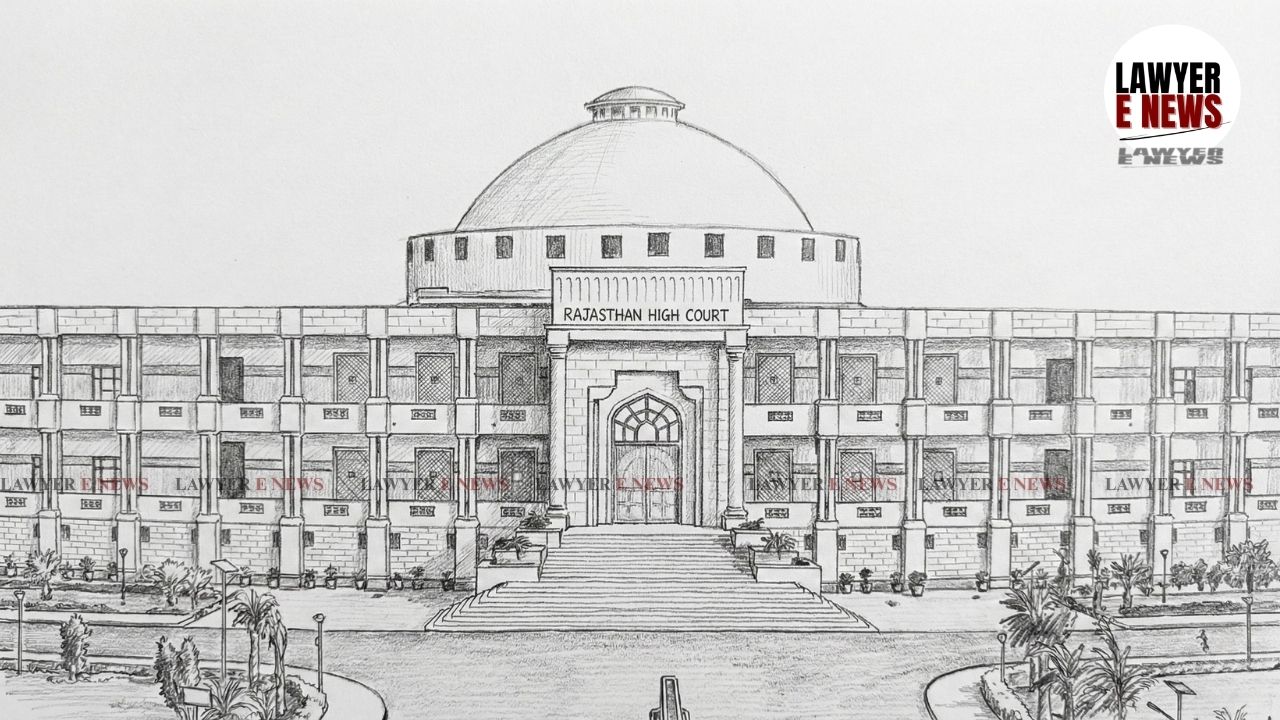
In a significant ruling that tightens the jurisdictional preconditions for income tax reassessment following third-party searches, the Rajasthan High Court has quashed a Rs. 18.63 crore income tax assessment against a company whose premises were never searched — holding that a satisfaction note merely listing a Partnership Deed and Dissolution Deed, without identifying any incriminating material, cannot form the foundation for proceedings under Section 153C of the Income Tax Act, 1961.
The Court simultaneously held that a single transaction of sale of rural agricultural land situated beyond 8 kilometres from municipal limits cannot be taxed either as business income or as capital gains.
A Division Bench of Acting Chief Justice Sanjeev Prakash Sharma and Justice Sangeeta Sharma, in its judgment dated April 13, 2026, allowed the appeal of Superb Infotech Pvt. Ltd. and set aside the orders of the Assessing Officer, CIT(Appeals), and the Income Tax Appellate Tribunal — all three.
Two substantial questions of law were framed when the appeal was admitted in August 2019. First, whether the ITAT erred in holding that block assessment proceedings could be completed under Section 153C on the basis of the nature and character of the documents seized. Second, whether the ITAT erred in holding that income from the sale of agricultural land could be subjected to tax, given that the land qualified for exemption under Section 2(14)(iii) as rural agricultural land.
The Satisfaction Note Fails the Jurisdictional Test
The Court examined the satisfaction note on which the entire edifice of reassessment was built. The note recorded that documents described as "Partnership Deed, Dissolution Deed and miscellaneous papers" belonging to Superb Infotech were found at the searched premises, and that "to find any tax implication on the basis of these documents it would be better to examine these documents by initiating assessment proceedings." The Court found this woefully insufficient to constitute valid satisfaction under Section 153C.
The Court laid down a clear standard for what "incriminating" must mean in this context: "The word 'incriminating' must necessarily be understood to mean of such a nature which creates a prima facie doubt of involvement of the assessee conduct in concealment of income with reference to the Act of 1961 and for the purpose of Section 153C of the Act."
The satisfaction note nowhere stated that the documents were relatable to Assessment Year 2007-08 or that they prima facie disclosed any concealment of income. Tellingly, the ITAT itself had noted in its own order that the AO had not referred to any material to indicate that the assessee was the owner of those documents. The Court also noted that in the eventual assessment order, the AO made no mention whatsoever of the Partnership Deed, Dissolution Deed or miscellaneous papers — the very documents cited as the basis for initiation of proceedings.
"Mere possession of documents relating to another person would not establish that they did not belong to the searched person and, therefore, the question of invoking Section 153C of the Act of 1961 on such premise without any satisfaction of the documents being of incriminating nature does not arise."
Re-examining Already-Known Facts Through Section 153C Is Impermissible
The Court further exposed a critical circumstance that rendered the invocation of Section 153C doubly impermissible. The agricultural land transaction which the AO sought to tax was a transaction already within the AO's knowledge at the time of the original assessment for AY 2007-08. The AO had effectively used Section 153C as a tool to reopen and re-examine facts that were already before him during the original assessment proceedings.
The Court rejected this approach unequivocally. Relying on the Supreme Court's landmark ruling in Principal Commissioner of Income Tax Central-3 v. Abhisar Buildwell Private Limited, the Court reaffirmed that for completed and unabated assessments, the Assessing Officer cannot assume jurisdiction under Section 153C in the absence of incriminating material unearthed during the search. "If in the earlier assessment, something escaped from notice, the remedy lies elsewhere. The recourse to Section 153C of the Act of 1961 is not available for correction of the assessment without any new incriminating material."
Where income has escaped assessment in a completed year, the prescribed remedy under the statute is under Sections 147 and 148 — not Section 153C.
The Entire Proceedings Fall With the Satisfaction
Placing reliance on the Punjab and Haryana High Court's decision in Misty Meadows Private Limited v. Union of India — authored by Acting Chief Justice Sanjeev Prakash Sharma himself while on that bench, and upheld by the Supreme Court when the Special Leave Petition against it was dismissed on January 15, 2025 — and on the Delhi High Court's ruling in Pepsi Foods P. Ltd. v. Assistant Commissioner of Income Tax (also upheld by the Supreme Court), the Court held that satisfaction is a jurisdictional precondition and where it is not properly arrived at, everything that follows is tainted.
"The satisfaction itself being vitiated, the entire proceedings initiated are also vitiated in law."
Single Sale of Agricultural Land Is Not an Adventure in Trade
Having quashed the proceedings on jurisdictional grounds, the Court proceeded to address the substantive tax question as well. The AO had treated the profit from the sale of agricultural land as business income on the ground that the company was in the business of purchase and sale of land and this transaction constituted an "adventure in the nature of trade."
The Court firmly rejected this characterisation. There was only a single transaction of sale of agricultural land — not a series of frequent purchases and sales that could bear the hallmark of trade. "It is not that the land was frequently sold and purchased and there is only a single transaction of agriculture land, out of which, certain profits have been received." Frequency of dealing is what distinguishes trading from investment, and a solitary transaction cannot be elevated into a trading venture.
Rural Agricultural Land Beyond 8 Km Is Exempt — Purchaser's Subsequent Use Irrelevant
On the Section 2(14)(iii) question, the Court noted that the land was situated beyond 8 kilometres from municipal limits and was being used for agricultural operations at the time of sale. Such land qualifies as rural agricultural land, expressly excluded from the definition of "capital asset" under the Income Tax Act. A transaction involving rural agricultural land therefore generates neither taxable business income nor taxable capital gains in the hands of the seller.
The Court also dismissed any attempt to drag in the subsequent conduct of the purchaser, holding definitively that "subsequent uses of land for non-agriculture purposes would not in any manner be a reason to include capital gains for the seller."
Drawing on the Bombay High Court's ruling in Pr. Commissioner of Income Tax-19 v. M/s. Jogani & Dialani Land Developers — affirmed by the Supreme Court — the Court also reiterated that there is no bar in law for an assessee to hold the same class of assets both as investment and as stock-in-trade. A company that deals in land can simultaneously hold certain land parcels as investment, and each asset must be assessed on its own character.
Both questions of law were answered in favour of the appellant. The Income Tax Appeal was allowed. The orders of the Assessing Officer dated July 21, 2010, of the CIT(Appeals) dated February 27, 2013, and of the ITAT dated December 6, 2018 were quashed and set aside in their entirety.
Date of Decision: April 13, 2026