-
by sayum
28 August 2026 2:11 PM







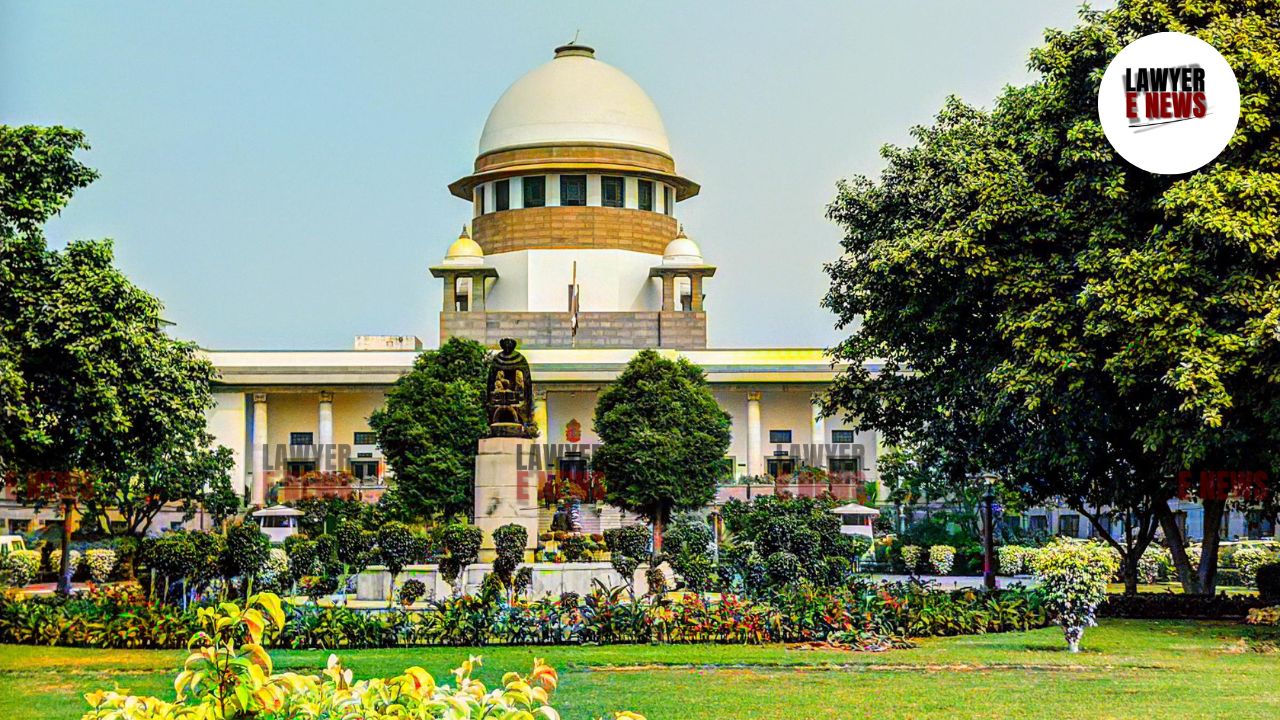
“The Act is intended to protect tenants, not to enable their eviction on trivial grounds — minor pruning of trees cannot be construed as injury to land under Section 3(2)(b)” – Supreme Court In a crucial judgment that reasserts tenant protection under welfare legislation, the Supreme Court of India held that cultivating tenants cannot be evicted on the mere ground of cutting branches or digging pits unless there is cogent proof of substantial damage to the land. The bench comprising Justice J.B. Pardiwala and Justice Sandeep Mehta quashing both the eviction order passed by the Revenue Court and the affirming judgment of the Madras High Court.
“A Welfare Statute Meant to Protect Cultivating Tenants Must Be Liberally Construed”
The Court, while interpreting the Tamil Nadu Cultivating Tenants Protection Act, 1955, observed:
“The Act was enacted solely to protect the interests of cultivating tenants. The provisions should be interpreted in such a manner that the tenants are ultimately protected and are not thrown out at the instance of landlords.”
The case involved litigation between the heirs of Govindappa Gounder, a cultivating tenant in Coimbatore district, and the legal owners of the land. The tenant had been in possession since 1955–60, cultivating the land continuously for decades.
“Eviction Cannot Be Ordered Without Cogent Evidence of Injury to Land or Crops”
The primary question before the Court was whether the tenant had committed acts that fell within the mischief of Section 3(2)(b) of the 1955 Act, which reads:
“A tenant shall not be entitled to protection if he has done any act or been guilty of any negligence which is destructive of, or injurious to, the land or any crop thereon or has altogether ceased to cultivate the land.”
The Revenue Court had ordered eviction based on a Commissioner’s report from a civil suit that alleged the tenant dug pits, cut branches, and constructed huts. The High Court had also upheld this eviction.
However, the Supreme Court categorically rejected the findings as speculative:
“There is nothing to indicate that the appellants were negligent in any manner or had done any act by which they could be said to have caused damage to the suit land… Assuming for a moment that there is something to indicate that the trees were pruned, that by itself would not bring the case within the ambit of Section 3(2)(b).”
“Revenue Court’s Mechanical Reliance on Commissioner’s Report Is Unacceptable”
The Court observed that both the Revenue Court and the High Court had failed to exercise proper judicial scrutiny. It noted:
“The Revenue Court mechanically relied upon the Commissioner’s report and passed the order of eviction. The High Court, in exercise of its revisional jurisdiction, affirmed the order in a very slipshod manner.”
Further, it reminded the High Court that under Section 6-B of the Act, the Revenue Divisional Officer is deemed to be a Court subordinate to the High Court under Section 115 CPC, and hence, the High Court was expected to exercise revisional supervision with care.
“Courts Must Prevent Forensic Sophistry That Defeats Beneficial Legislation”
In its sharpest rebuke, the Court stressed that minor acts or trivial disputes should not be weaponized by landlords to dispossess long-standing tenants:
“The object of the 1955 Act is to prevent forcible dispossession. Courts should not allow themselves to become tools for defeating clearly expressed statutory intentions.”
The Court cited G. Ponniah Thevar v. Nalleyam Perumal Pillai (1977) 1 SCC 500, affirming that beneficial statutes must receive liberal construction and courts must lean in favour of the tenant in case of doubt.
Supreme Court Sets Aside Eviction, Protects Possession of Tenant
Concluding that no credible evidence existed to justify eviction, the Court allowed the appeals and passed the following direction:
“The impugned order passed by the High Court in Civil Revision Petition No. 4052/2008 is hereby set aside. Consequently, the original order of Revenue Court also stands set aside. The respondents shall not interfere with the possession of the appellants, save and except in accordance with law.”
The Court also disposed of the connected Civil Appeals filed by another branch of the respondents’ family.
Pruning Trees ≠ Injury to Land – Supreme Court’s Tenant-Friendly Interpretation Reasserts Legislative Intent
This judgment stands as a precedent in protecting tenants under welfare laws from eviction based on exaggerated or unfounded allegations. The Court reaffirmed that the Tamil Nadu Cultivating Tenants Protection Act, 1955, must be interpreted to advance its purpose, not frustrate it:
“Only when there is cogent, credible and reliable evidence on record of gross violation of Section 3(2)(b), may the Revenue Court order eviction. Anything short of that is contrary to the protective scheme of the law.”
Date of Judgment: 10 September 2025