-
by sayum
29 August 2026 9:28 AM







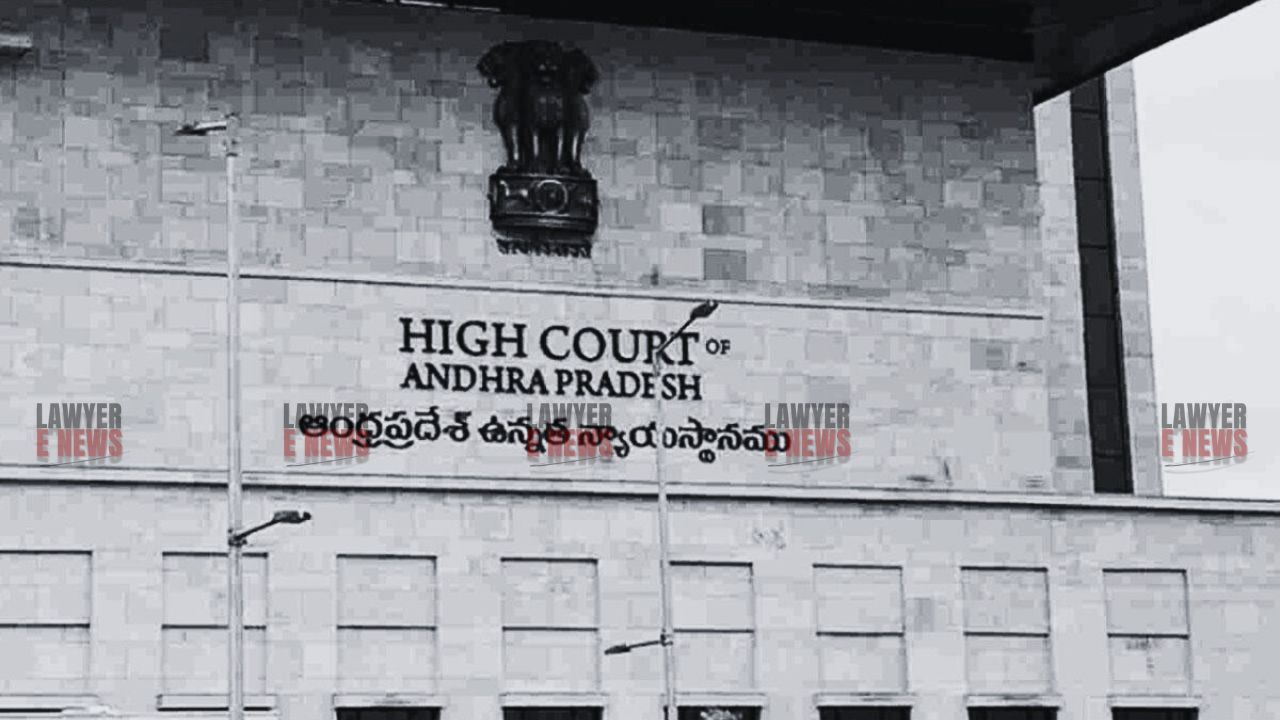
“Prosecution Failed to Prove Throttling—Manual Strangulation Ruled Out”, Andhra Pradesh High Court at Amaravati, comprising Justice K. Suresh Reddy and Justice Subba Reddy Satti, acquitted a man previously convicted of murdering his wife, holding that the prosecution had failed to prove the case beyond reasonable doubt, especially in light of contradictory medical evidence and unreliable confession.
AP High Court allowed Criminal Appeal, setting aside the conviction and life sentence imposed by the IV Additional Sessions Judge, Kadapa, under Sections 302, 498A and 201 of the Indian Penal Code.
“When Medical Evidence Rules Out Manual Throttling, The Entire Case Built on That Basis Must Collapse”
The appellant was accused of murdering his wife Pallavi on 30th December 2015 after an alleged quarrel over his illicit affair and demand for additional dowry. The prosecution alleged that he throttled her with his hands, then hung the body with a saree and rope to simulate suicide.
However, the High Court placed considerable reliance on the evidence of Dr. L. Ananda Kumar (P.W.9), who conducted the post-mortem and categorically ruled out manual throttling, stating:
“In throttling, we find finger prints on the front part of the neck and nail marks. In any violent asphyxia, petechial haemorrhage will be present. These features were absent in the present case. Hence, manual throttling is ruled out.”
“Extra-Judicial Confession to a Stranger Cannot Be the Sole Basis for Conviction”
Another vital pillar of the prosecution's case was an alleged extra-judicial confession (Ex.P3) made by the appellant to the VRO (Village Revenue Officer), P.W.7. The High Court rejected this, citing serious procedural and evidentiary lapses:
“It is wholly unlikely that the accused would make an extra-judicial confession to a person he never knew. His statements do not inspire confidence.”
Citing the Supreme Court in Sunny Kapoor v. State (U.T. of Chandigarh), the Bench held that confessions to strangers lack credibility, especially when no acquaintance or context is established.
“Motive Was Weak, Chain of Circumstances Incomplete—Acquittal Is Inevitable in a Circumstantial Evidence Case”
The entire prosecution case rested on circumstantial evidence, as there was no direct eyewitness to the alleged murder. The Court emphasized that in such cases, the motive and chain of circumstances must be proved beyond doubt. However, it found:
No strong motive was established. The alleged affair with a Muslim woman was not corroborated.
The name of the alleged woman was never revealed in the investigation.
The father of the deceased (P.W.1) made inconsistent statements and failed to establish the dowry harassment.
Medical evidence and post-mortem findings did not support the prosecution’s narrative.
The Court reiterated the five cardinal principles laid down in Sharad Birdhichand Sarda v. State of Maharashtra [(1984) 4 SCC 116] regarding circumstantial evidence, stating:
“There must be a chain of evidence so complete as not to leave any reasonable ground for the conclusion consistent with the innocence of the accused.”
That standard, the Court held, was not met in this case.
“Conduct of Accused Post-Incident Suggests Innocence, Not Guilt—He Took the Victim to Multiple Hospitals”
Another major factor considered was the post-incident conduct of the accused. After discovering the deceased, he:
Took her to Tirumala Hospital
Then to Gajjala Ramakrishna Reddy Hospital
Finally to RIMS Hospital, Kadapa
P.W.2, a close relative, confirmed that the accused was present the entire day, attempting to revive the deceased and informing the family. The Bench noted:
“The accused had taken all steps as a dutiful husband by shifting the deceased to two hospitals. This conduct does not align with that of a murderer trying to conceal a crime.”
“No Charge Under Section 304-B—Conviction Without Proper Framing Is Illegal”
Though the death occurred within seven years of marriage, no charge under Section 304-B IPC (dowry death) was framed. The Court held:
“Unless a charge is framed, convicting the accused of the said charge without affording a fair trial is impermissible and improper.”
Acquittal, Refund of Fine, and Closure of Proceedings
The Court declared: “The prosecution has failed to prove the guilt of the appellant beyond reasonable doubt. Accordingly, the conviction and sentence imposed in S.C.No.158 of 2016 dated 22.12.2017 are set aside. The appellant is acquitted of all charges.”
The fine paid by the appellant was ordered to be refunded, and as he had already been enlarged on bail during the pendency of the appeal, he was directed to complete formalities under Batchu Ranga Rao v. State of A.P..
Date of Decision: 1st September 2025