-
by sayum
27 August 2026 3:32 PM







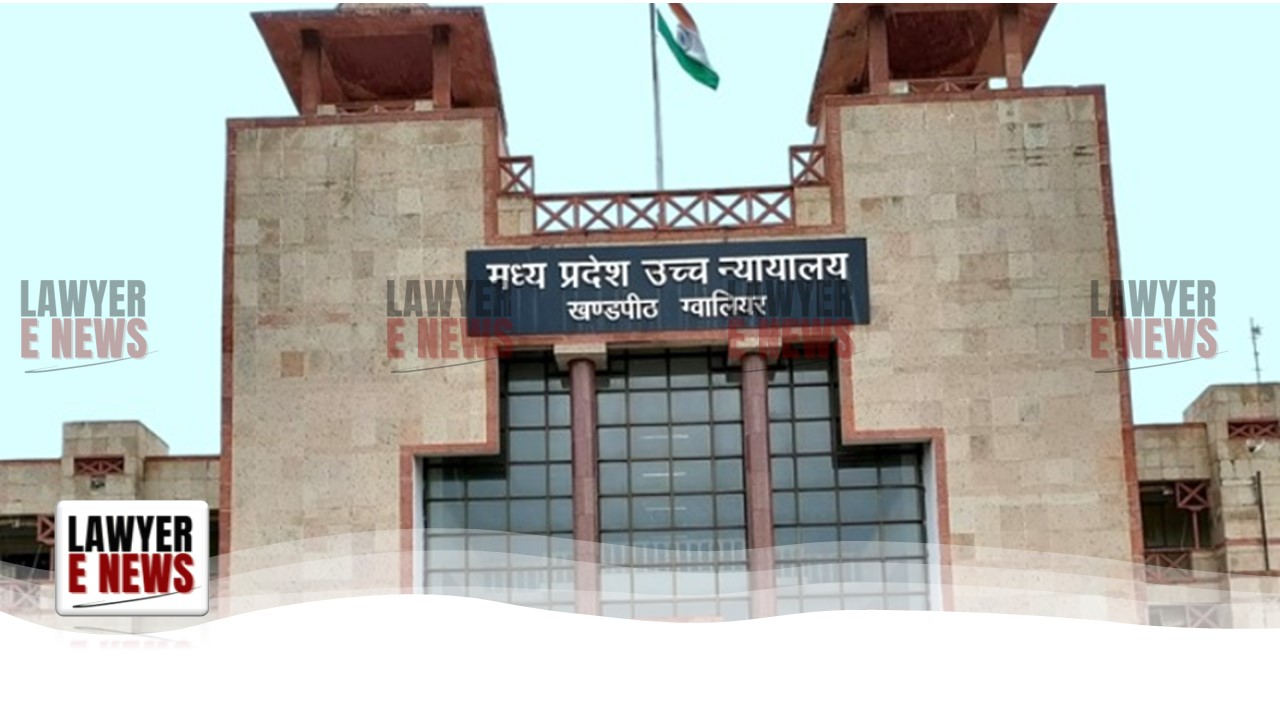
"Petitioner’s position cannot be altered now when he has materially changed his position based upon his selection by the Institute unless the illegality is attributed to the petitioner himself" , Gwalior Bench of the Madhya Pradesh High Court, in a significant ruling, held that an educational institute is estopped from re-examining the validity of a selection process after the candidate has materially altered their position by leaving a previous secure employment.
A single-judge bench of Justice Ashish Shroti observed that "if his appointment is cancelled by respondents by taking shelter of certain insignificant factors, the petitioner would be nowhere as his earlier job is also not with him."
The petitioner, previously a Manager at the State Bank of India (SBI), was appointed as an Assistant Registrar at the Atal Bihari Vajpayee-Indian Institute of Information Technology and Management (ABV-IIITM), Gwalior, in 2019. After the regular Director demitted office, an in-charge Director constituted successive committees to probe the petitioner’s selection and the grant of pay protection. Based on committee recommendations that questioned the selection process and the petitioner’s "low" marks in the written test, his pay protection was withheld and his probation was extended indefinitely, prompting him to approach the High Court.
The primary question before the court was whether there was any inherent defect in the petitioner’s selection warranting its cancellation years later. The court was also called upon to determine whether the Board of Governors' ratification cured any alleged procedural irregularities in the selection committee’s constitution and if the Institute could unilaterally withhold pay protection and extend probation without a speaking order.
Written Test Only A Qualifying Benchmark
The Court examined the recruitment scheme as per the 2018 advertisement, which specified that a written test would be conducted and only qualifying candidates would be called for an interview. Justice Shroti noted that a "qualifying test" refers to a benchmark that makes a candidate eligible for appointment rather than determining inter-se merit. The Court clarified that the purpose is to judge suitability for the post, and once the minimum benchmark is secured, final selection rests on interview performance.
The bench rejected the committee’s observation that the petitioner’s selection was suspect because candidates with higher written marks were left out. The Court observed that "it is not always necessary that a candidate who secured very good marks in written test would also perform well in interview." Since the petitioner cleared the 60% cut-off and was selected by the interview committee, his appointment could not be termed illegal merely based on his written test scores.
Irregularities Cured By Subsequent Ratification
Addressing the alleged defect in the selection committee's constitution, where the Director delegated the chairmanship to an in-charge Director, the Court held this was at best a procedural irregularity. The Court placed heavy reliance on the Ratio Decidendi in National Institute of Technology & Another vs. Pannalal Choudhury & Another (2015), which established the law on "ratification."
The Court noted that the Board of Governors (BoG), being the competent appointing authority under the Indian Institutes of Information Technology Act, 2014, had duly ratified the petitioner's appointment in its 43rd meeting. Justice Shroti emphasized that "ratification would always relate back to the date of the act ratified," thereby curing any prior defect in authority or committee constitution with retrospective effect.
Doctrine Of Estoppel In Service Jurisprudence
A pivotal aspect of the judgment focused on the fact that the petitioner had resigned from a secure position at SBI to join the Institute. The Court applied the principles laid down by a Division Bench in Sanjeev Yadav & Ors. vs. Lakshmibai National Institute of Physical Education, noting that management cannot challenge a selection after a significant lapse of time when the candidate has materially changed his status.
Management Barred From Challenging Selection After Delay
The Court observed that no unsuccessful candidate had challenged the selection, and no allegations of favoritism or fraud were attributed to the petitioner himself. The bench held that the respondents are "estopped and restrained" from enquiring into the validity of the selection. It noted that the Institute's attempt to throw the petitioner out of a job based on "insignificant factors" after he altered his position was legally unsustainable.
Final Directions On Pay Protection And Probation
Regarding the withholding of pay protection, the Court found that no conscious institutional decision had been taken by the BoG, which is the competent authority under the First Statutes of the Institute. The Court granted the petitioner liberty to reply to the show-cause notice dated March 17, 2026, and directed the competent authority to pass a speaking order.
On the issue of probation, the Court directed the respondents to consider the petitioner's confirmation based on a fair appraisal of his performance on the post. The bench explicitly cautioned the Institute that it "shall not be influenced by the finding and recommendations made by committees" that sought to question the selection, and must impartially judge the petitioner’s suitability for confirmation.
The High Court disposed of the petitions by providing protection to the petitioner’s appointment against arbitrary re-evaluation. The ruling reinforces the principle that subsequent administrative changes or "in-house" probes cannot be used to unsettle the settled career of an employee who joined in good faith after a competitive process, especially when procedural defects are cured by the competent governing body.
Date of Decision: 20 April 2026