-
by sayum
20 August 2026 10:29 AM







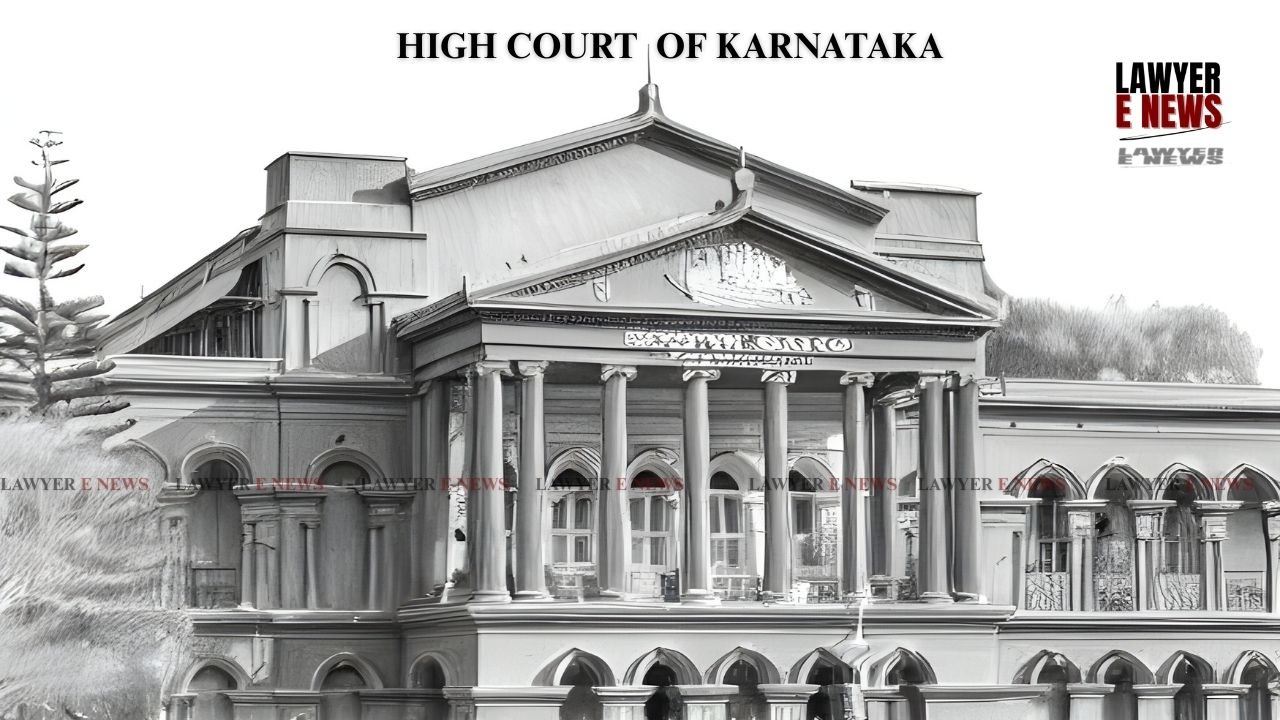
"It is trite law that a person who was living along with a woman according her the status of wife in public, is more than sufficient to hold that she is the wife of said person, even in the absence of any customs and other documents to that effect." Karnataka High Court, in a significant ruling, held that prolonged cohabitation and public recognition of a second wife, coupled with statutory nominations and documentary evidence, are sufficient to establish a valid marriage and entitlement to a share in ancestral and self-acquired properties.
A division bench comprising Justice D.K. Singh and Justice T.M. Nadaf observed that a legal heir cannot defeat such legitimate rights by setting up suspicious and unproven testamentary documents.
The dispute arose from multiple interconnected suits filed concerning the estate of late T.A. Reddy, a prominent advocate and former Member of the Legislative Council (MLC) who passed away in September 2009. Smt. A.R.S. Chitra Reddy filed a suit for partition claiming to be the legally wedded second wife of T.A. Reddy, seeking a one-third share in the estate. Meanwhile, T. Lokprakash Reddy, the son from the first marriage, contested her status and claimed absolute ownership over the properties on the basis of alleged Wills executed by the deceased, subsequently filing a separate suit seeking injunctions against the disbursement of dues and benefits.
The primary questions before the court were whether the plaintiff successfully established her status as the legally recognized second wife of the deceased, and whether the defendant successfully proved the execution of the disputed Wills under Section 63 of the Indian Succession Act, 1925, read with Section 68 of the Indian Evidence Act.
Court Rejects Denial Of Marriage
The bench emphasized that a woman accorded the status of a wife in public view and through continuous cohabitation for over two decades acquires the legal presumption of a valid marriage. The court noted that late T.A. Reddy had explicitly acknowledged Smt. Chitra Reddy as his wife in official records, including bank FDRs, Advocate Welfare Fund certificates, and communications addressed to the Karnataka Legislative Council for family pension entitlements.
"Public Recognition Outweighs Formal Customary Proof"
The bench observed that the oral testimony of independent witnesses, coupled with admissions made by co-defendants who recognized the plaintiff's marital status and her 24-year cohabitation with the deceased, satisfied the evidentiary thresholds under Sections 50 and 114 of the Indian Evidence Act.
Strict Scrutiny Of Wills And The "Panchapadi" Test
Addressing the validity of the purported Wills set up by the late advocate's son, the court applied the five-step judicial framework, or "Panchapadi," laid down in J.T. Surappa v. Satchidhanandeendra Saraswathi Swamiji Public Charitable Trust. The bench noted that the propounder failed to remove grave suspicious circumstances surrounding the documents, given the strained relations and police complaints between the testator and his son during his lifetime, alongside the inexplicable total exclusion of dependent family members.
"Testator Of High Stature Would Not Execute Wills Through Unreliable Witnesses"
The court highlighted that the deceased was a seasoned lawyer and a former legislator, making the reliance on rustic and untrustworthy attesting witnesses highly improbable. Furthermore, the failure to produce a third alleged Will pleaded in the written statement severely undermined the credibility of the defense.
Finding no perversity or legal infirmity in the appreciation of evidence by the trial court and the first appellate court, the High Court dismissed both the regular first appeal and the regular second appeal. The common judgment and decree granting a one-third share each to the second wife, the surviving son, and the joint share of the predeceased son's legal heirs was affirmed in entirety.
Date of Decision: 18 August 2026