-
by sayum
20 August 2026 5:46 AM








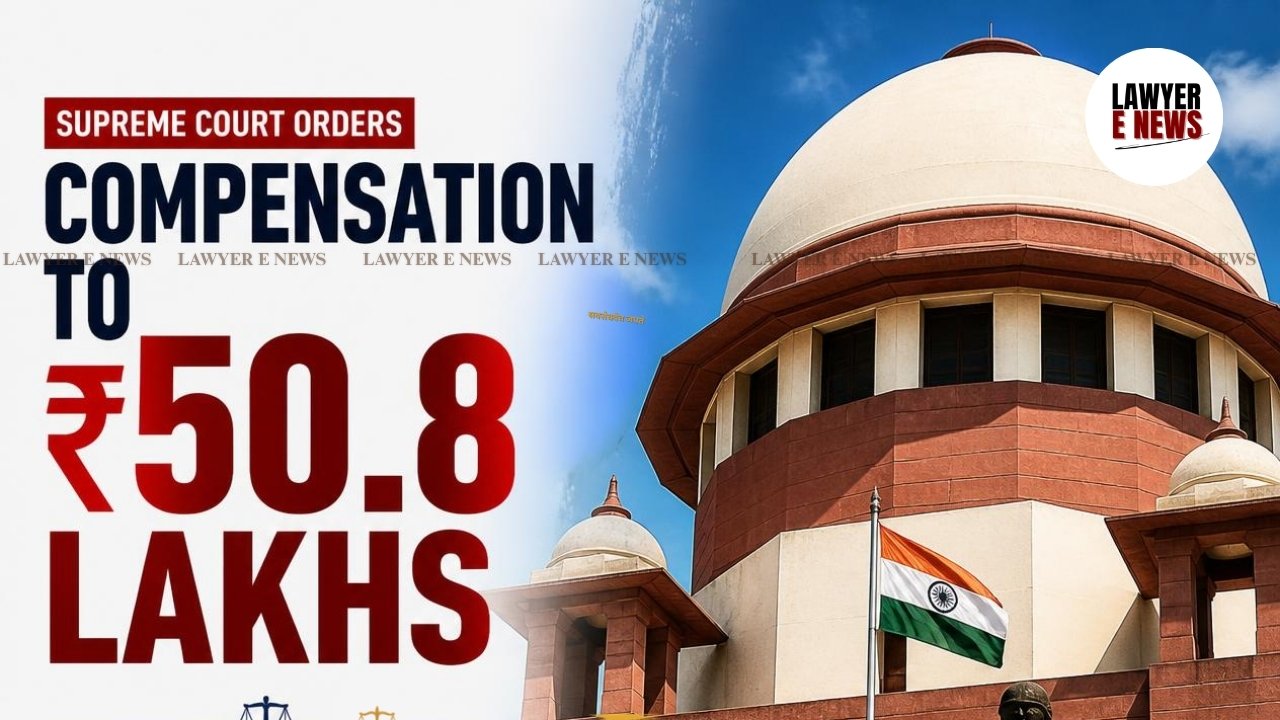
"An enjoyment survey captures nothing more than the fact of physical occupation on the land at the time it is conducted. It does not purport to examine the legal title, right, or interest by virtue of which such occupation is held. In such circumstances, the findings of such survey cannot be treated as conclusive of entitlement to compensation." Supreme Court, in a significant ruling delivered on August 19, 2026, held that a Lok Adalat has no jurisdiction to adjudicate disputed questions of title or apportion compensation without the explicit consent and signatures of all rival claimants.
A bench comprising Justice J.B. Pardiwala and Justice Manoj Misra categorically ruled that public funds disbursed during land acquisition cannot be distributed based on mere "enjoyment surveys" recording physical possession, nor can representative suit principles under Order I Rule 8 of the Code of Civil Procedure, 1908 (CPC) be imported into Lok Adalat proceedings to bind non-consenting disputants.
The dispute arose from the acquisition of 489.04 guntas of land in Khammam district for mining operations by Singareni Collieries Company Ltd. under the Land Acquisition Act, 1894. Following rival title claims, the Land Acquisition Officer referred the matter to the Principal District Judge under Sections 30 and 31, who subsequently referred the dispute to the Lok Adalat. The Lok Adalat passed 16 awards based on an administrative "enjoyment survey" rather than a mutual settlement between the competing title holders, which was erroneously affirmed by the Telangana High Court.
The primary question before the Court was whether the Lok Adalat could lawfully resolve title and apportionment disputes under Section 30 of the Land Acquisition Act, 1894 on the strength of an enjoyment survey without the consent of all rival claimants. The Court also examined whether the principles of representative suits under Order I Rule 8 of the CPC can be applied to proceedings before a Lok Adalat to bind non-signatory disputants.
Only Two Statutory Modes Exist For Apportionment Under Land Acquisition Act
Delivering the judgment, Justice J.B. Pardiwala traced the statutory scheme of the Land Acquisition Act, 1894, observing that there are only two permissible modes for resolving apportionment disputes among interested persons. The first is under Section 29, where all interested parties arrive at a mutual agreement, and the second is under Section 30, where the absence of an agreement mandates judicial adjudication by the competent reference court.
The bench emphasized that an agreement under Section 29 necessarily demands the concurrence of all interested parties without exception. A partial or truncated consensus involving only some claimants cannot operate as a binding agreement in the eyes of law because those excluded continue to remain in active dispute.
Collector Cannot Adjudicate Title Once Reference Is Made
Relying on the Constitution Bench judgment in Dr. G.H. Grant v. State of Bihar (1965), the bench reiterated that the Collector has no authority to adjudicate conflicting rights of interested persons. The act of making a reference under Section 30 is an explicit statutory acknowledgment that a dispute exists which the Collector lacks jurisdiction to decide.
"After an award is passed by the Collector and the dispute between the claimants is the focus in a reference under Section 30 of the Act, 1894, the acquiring body leaves the pitch, and the match thereafter is between the rival claimants/persons interested."
Enjoyment Surveys Cannot Form Basis For Disbursing Public Compensation
The Court severely criticized the practice adopted by authorities in relying upon "enjoyment surveys" to distribute compensation. The bench noted that physical occupation is legally distinct from title, as possession can be held under multiple capacities such as an encroacher, tenant, or licensee.
Referencing the Telangana High Court decisions in Gudala Pentamma v. State of Telangana and Kottamula Mallaiah v. State of Telangana, the Supreme Court held that the concept of an enjoyment survey is entirely alien to the statutory framework governing land acquisition.
"When the Government acquires property, public funds are disbursed as compensation. It must be paid to the person entitled and determined as per law, and not merely to any claimant who cares to appear at the first instance, or who is the most vocal or visible before the authorities."
Order I Rule 8 CPC Inapplicable To Adversarial Inter-Se Claimant Disputes
The bench emphatically rejected the High Court’s rationale that the Lok Adalat awards could be upheld as a class action settlement under Order I Rule 8 of the CPC. The Court observed that Order I Rule 8 presupposes a community of interest and a shared common grievance among all persons represented.
Applying class action principles to rival claimants who are contesting each other’s title is fundamentally flawed. In an apportionment reference, the claimants do not share a common interest against the acquiring authority; rather, their interests are adverse and hostile to one another.
"To treat such rival claims as a single class is to elide the very dispute that the reference under Section 30 of the Act, 1894, was intended to resolve."
Lok Adalat Awards Void Without Signatures Of All Disputing Parties
Examining the National Legal Services Authority (Lok Adalat) Regulations, 2009, the Court pointed out that Regulation 13(6) expressly bars adjudication of disputed questions, while Regulation 17(2) strictly mandates that every award must bear the signatures of all parties to the settlement.
Reiterating the ratio in State of Punjab v. Jalour Singh (2008) and Vasant Nanaji Patre v. Vidarbha Irrigation Development Corporation, the bench held that a Lok Adalat cannot step into the shoes of an adjudicatory court. An award passed without the signatures and genuine compromise of all rival disputants is non-binding and invalid in law.
Allowing the appeal, the Supreme Court set aside the impugned judgment of the Telangana High Court along with the underlying Lok Adalat awards. The matter has been remitted to the Court of the Principal District Judge, Khammam, for de novo adjudication of the Section 30 reference in accordance with law within six months.
Date of Decision: August 19, 2026