-
by sayum
20 August 2026 5:45 AM







"Spot where a lighter vehicle is found lying on a site map post-accident cannot be assumed to be the spot where the collision occurred, nor that it was being driven on the wrong side, as a collision with a heavy, speeding vehicle naturally pushes or drags the smaller vehicle forward." Supreme Court, in a significant ruling delivered on August 19, 2026, held that a rough sketch or site map showing the post-impact resting position of vehicles cannot alone form the basis to fasten contributory negligence against a smaller vehicle in motor accident claims.
A bench comprising Justice S.V.N. Bhatti and Justice N.V. Anjaria observed that criminal court acquittals operate on distinct legal standards and cannot displace the prima facie civil liability established by a police charge sheet under the Motor Vehicles Act, 1988.
Tragic Collision Claims Three Lives
The case arose out of a fatal road collision on October 14, 2005, on NH-48 in Kunigal Town, Karnataka, where a Hyundai Santro car collided with a heavy passenger bus owned by the Karnataka State Road Transport Corporation. The crash claimed the lives of the car driver Nandan Shet, his mother Geetha Shet, and a family friend, while leaving the driver's newly wedded wife critically injured. Aggrieved by the Karnataka High Court's reduction of compensation by attributing 50 percent contributory negligence to her deceased husband, the surviving widow approached the Supreme Court seeking enhancement and full liability on the state transport corporation.
The primary question before the court was whether an accident site sketch and a subsequent criminal acquittal of a heavy vehicle driver can be used to infer contributory negligence against a deceased driver in motor accident claim proceedings. The court was also called upon to determine whether appellate courts should liberally admit additional documentary evidence under Order XLI Rule 27 of the Code of Civil Procedure to assess "just compensation" under Section 168 of the Motor Vehicles Act for an IT entrepreneur.
Criminal Acquittal Does Not Displace Tortious Civil Liability - High Court Erred In Overturning Negligence Findings
The Supreme Court set aside the High Court's finding of 50 percent contributory negligence, reaffirming that police investigation records, including the FIR and final charge sheet, constitute reliable prima facie evidence of rash and negligent driving in proceedings before the Motor Accident Claims Tribunal. The bench emphasized that the bus driver was merely given the benefit of the doubt in the criminal trial, which does not amount to an honourable acquittal capable of eroding civil tortious liability.
Distinct Proof Standards In Criminal And Tort Law
Citing Mathew Alexander v. Mohd. Shafi and ICICI Lombard General Insurance Co. Ltd. v. Rajani Sahoo, the bench underscored that criminal proceedings under Section 304-A of the Indian Penal Code demand a higher degree of culpable rashness beyond reasonable doubt, whereas motor accident claims under Section 166 of the MV Act are adjudicated strictly on the touchstone of preponderance of probability.
"Criminal proceedings and civil MACT Claim Petitions operate in entirely distinct legal realms, as the degree of 'culpable rashness' required under Section 304-A of the Indian Penal Code, 1860 is significantly higher than civil negligence under the law of torts."
Post-Impact Drag Marks Misconstrued By High Court - Contact Point Determinative Over Final Vehicle Position
The Court pulled up the High Court for exclusively relying on the topographical sketch to apportion blame onto the lighter Santro car. Relying on Mangla Ram v. Oriental Insurance Co. Ltd., the bench clarified that a collision with a heavy passenger vehicle naturally drags or pushes a smaller vehicle across the roadway, rendering the final resting spot misleading. The court observed that the contact point of impact is determinative, rather than the drag marks which pushed the car onto the road shoulder.
Additional Evidence Must Be Entertained In Beneficial Legislation - Procedural Flexibility Under Motor Vehicles Act
Addressing the rejection of additional evidence by the High Court, the bench ruled that appellate powers under Order XLI Rule 27(1)(b) of the CPC must be exercised in aid of justice, especially in welfare-oriented statutes where summary procedure is contemplated under Section 169 of the MV Act. Taking note that the claimant lost her husband barely three months into the marriage and suffered prolonged trauma, the bench received additional bank records and software invoices to determine just compensation without prolonging two decades of litigation.
"The MV Act is a beneficial, welfare-oriented legislation designed to protect accident victims and their families. Section 169 of the MV Act states that Tribunals may follow a summary procedure as they may deem fit."
Income Enhanced For Software Entrepreneur - Realistic Assessment Of Deceased's Professional Earning Capacity
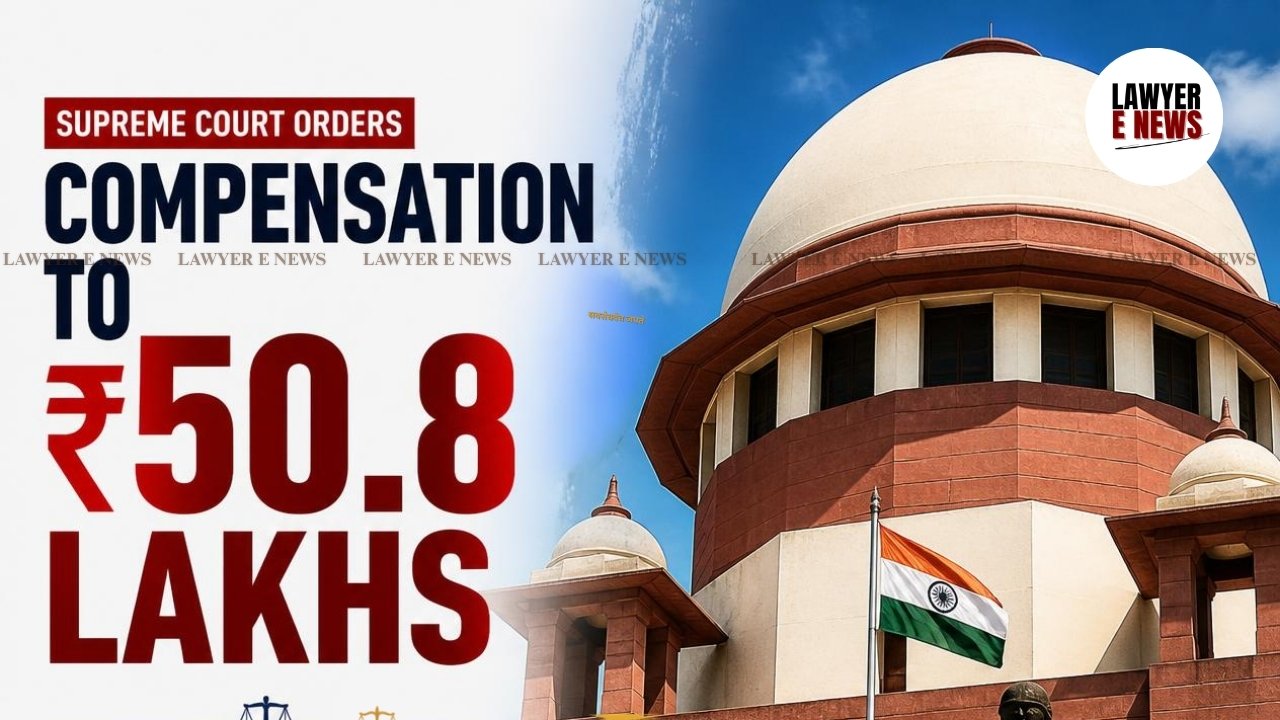
Revising the deceased's monthly notional earnings from ₹20,000 to ₹70,000 in view of his qualifications as an engineer and entrepreneur running Geetha Technologies, the Court computed the substantive loss to estate at ₹50,10,376 after factoring in 40 percent future prospects, statutory income tax deductions, and a multiplier of 17. Together with conventional heads of ₹52,000 for loss of consortium and ₹19,500 for funeral and transportation expenses, the total compensation was quantified at ₹50,81,876.
Restoring the Tribunal's finding of exclusive negligence on the KSRTC bus driver, the Supreme Court directed the Karnataka State Road Transport Corporation to satisfy the entire enhanced compensation of ₹50,81,876 along with 6 percent interest per annum from the date of the claim petition till realization.
Date of Decision: August 19, 2026