Appellate Court Can Allow Additional Evidence To Ensure Fair Adjudication Even If Not Produced In Trial: Madhya Pradesh High Court Police Can Freeze Bank Accounts Under Section 106 BNSS Upon Suspicion Of 'Proceeds Of Crime': Punjab & Haryana High Court 'No Penalty For Monthly MGQ Shortfall If Annual Target Met': Supreme Court Upholds Quashing Of Excise Department Demands For Liquor Licensees 'Murder Went Unavenged, But Courts Cannot Convict On Mere Assumptions': Supreme Court Acquits Accused In 1988 Murder Case, Quashes High Court's Remit Order 'NCSC Cannot Pass Mandatory Adjudicatory Orders Directing Payment Of Arrears': Supreme Court Clarifies Commission's Powers Under Article 338 "'Cannot Present Fait Accompli': Supreme Court Upholds Denial Of NOC To Airman For Skipping Prior Permission To Apply For Civil Post" Supreme Court Upholds 2017 Notification For Ex Post Facto Environmental Clearances, Quashes 2021 Office Memorandum As Impermissible Executive Overreach Workman Fails To Prove 240 Days Continuous Work; Punjab & Haryana High Court Upholds Denial Of Reinstatement For "Abandonment Of Service" Party Cannot Take Contradictory Stands In Same Case, Admissions In Pleadings Bind Them Under Order XII Rule 6 CPC: Telangana High Court Delayed Recovery Of Weapon From Open Space Casts Serious Doubt On Prosecution Story: Madhya Pradesh High Court Acquits Murder Convicts Procedural Irregularities By Public Servants Serve As Circumstantial Evidence Of Conspiracy In Corruption Cases: Kerala High Court Blaming Previous Counsel For Omission Does Not Satisfy 'Due Diligence' Test To Amend Plaint After Trial Commences: Punjab & Haryana High Court Muslim Man's Second Marriage Under Special Marriage Act Void Despite Personal Law Permitting Bigamy: Karnataka High Court Suppression Of Material Facts Regarding Criminal Antecedents Disentitles Accused To Discretionary Relief Of Bail: Orissa High Court Section 311 CrPC | Delay Or Absence Of Examination-In-Chief No Bar To Summon Material Witnesses: Allahabad High Court Revenue Authorities Lack Jurisdiction To Declare Genuineness Of Wills Or Validity Of Settlement Deeds; Parties Must Approach Civil Court: Andhra Pradesh High Court Demand Of Bribe Is Sine Qua Non For Conviction Under PC Act, Mere Recovery Of Tainted Money Not Enough: Bombay High Court Title And Ownership Irrelevant In Suit Under Section 6 Specific Relief Act; Plaint Liable To Be Rejected If Filed Beyond Six Months: Delhi High Court Receipt Of Pension By Widow Can Be Considered To Determine 'Just Compensation' But Not To Deprive Claimants Of Award: Calcutta High Court FSL Report Lacking Scientific Criteria And Data Is Inadmissible In Evidence: Allahabad High Court Issues Directives For Testing Viscera Standard Of Proof In Railway Accident Claims Is Preponderance Of Probabilities, Not Beyond Reasonable Doubt: Gujarat High Court No Second Statutory Appeal Lies Against Conviction By Appellate Court Reversing Acquittal; Revision Is Sole Remedy: Supreme Court Wives' Property Is Their Own, Not Husband's: Supreme Court REJECTS High Court's Succession Formula; Restores Clarity For Christian Inheritance

Liability in Cheque Bounce Cases – Drawer Alone Liable: Delhi High Court

07 May 2024 8:19 AM

By: Admin


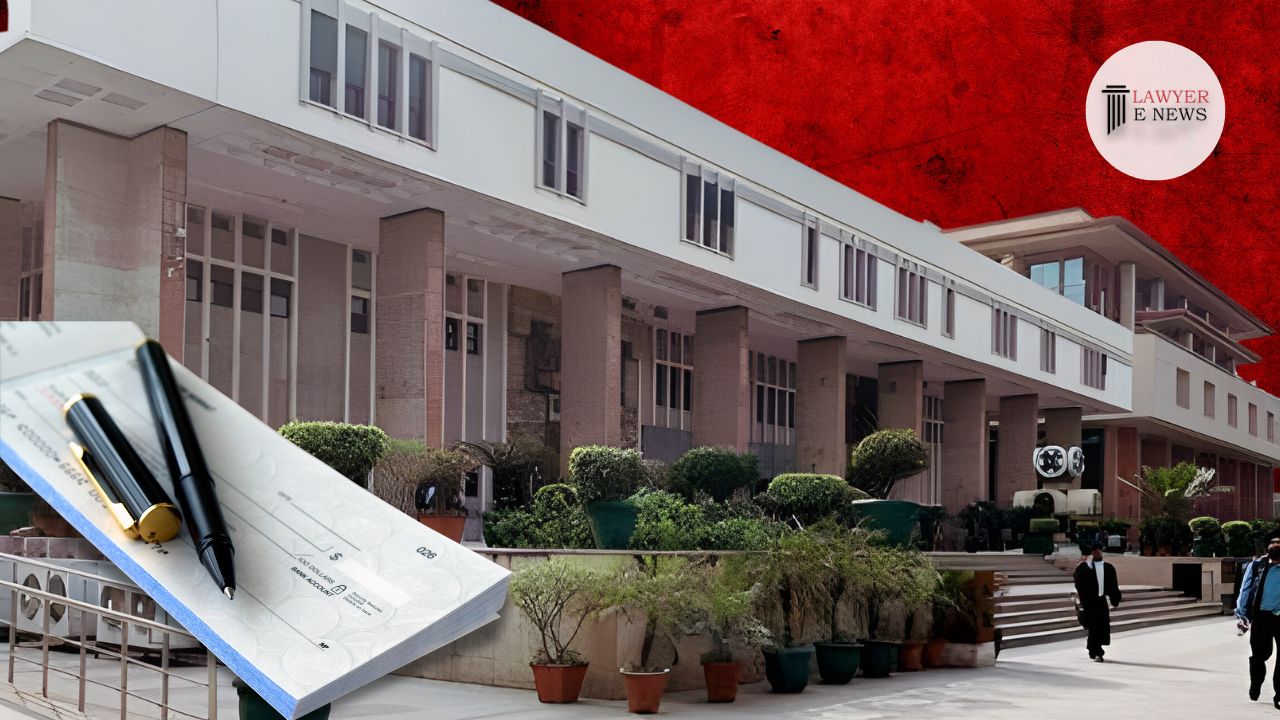
In a significant legal development, the Delhi High Court delivered a judgment on December 6, 2023, that has clarified the liability of individuals in cases of dishonored cheques. The court emphasized that only the drawer of a dishonored cheque can be held criminally liable under Section 138 of the Negotiable Instruments Act, 1881.

The judgment came in response to a petition filed by Arushi Gupta seeking the quashing of Complaint Case No. 4061/2020, which was based on a dishonored cheque allegedly issued by her. The court examined the legal provisions and relevant case law to arrive at its conclusion.

Justice Saurabh Banerjee, presiding over the case, stated in the judgment, “If the cheque in question is returned unpaid on account of the conditions mentioned under Section 138 of the Act, such person alone is liable to be prosecuted for the offence under Section 138 of the Act.”

The court’s decision reaffirmed the principle that the liability for a dishonored cheque falls squarely on the drawer of the cheque. The judgment also highlighted that even in cases of joint liability, individuals other than the drawer cannot be prosecuted unless they are signatories to the cheque and have drawn it on their account.                                                  

Date of Decision: December 6, 2023

ARUSHI GUPTA VS AJAY CHANANA

Latest Legal News