-
by sayum
11 August 2026 2:00 PM







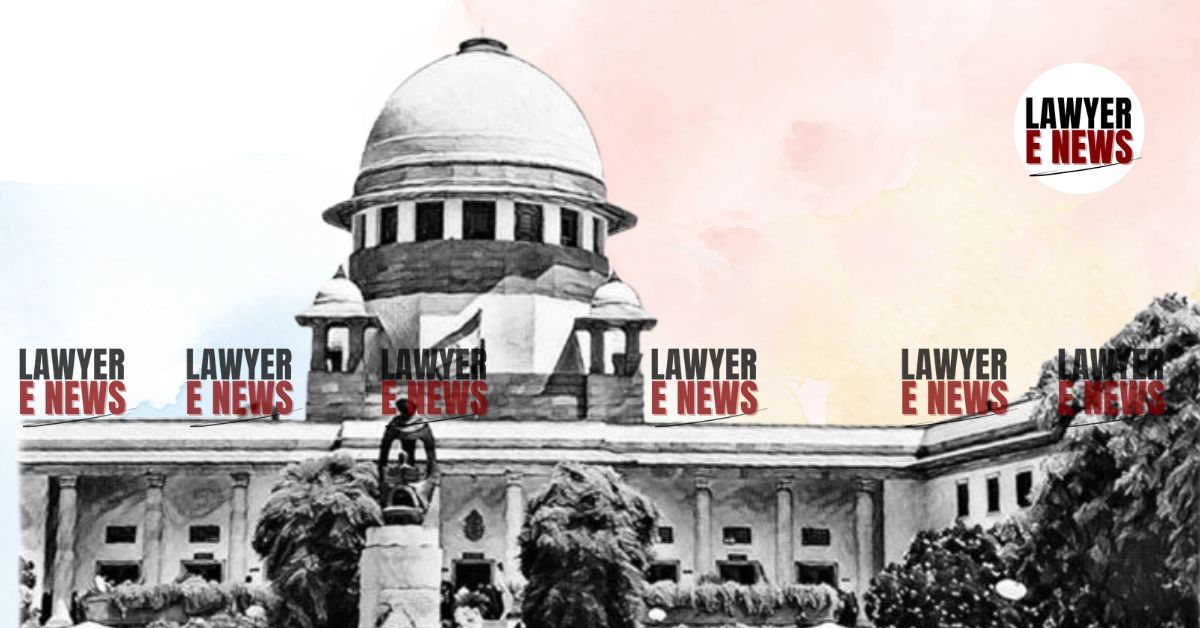
“Marriage That Exists Only on Paper Cannot Be Forced Upon Estranged Spouses” – In a compassionate and constitutionally significant judgment, the Supreme Court of India on April 22, 2025, in Ramanuj Kumar v. Priyanka, Civil Appeal No. 14276 of 2024, exercised its extraordinary powers under Article 142 of the Constitution to dissolve a dead marriage on the ground of irretrievable breakdown. Overruling concurrent findings of the Family Court and the Jharkhand High Court, the Court observed that the parties had lived apart for more than eleven years and there was no scope for reconciliation.
The Court declared, “Continuing such a marriage would only perpetuate hardship and serve no useful purpose. This is a fit case for exercise of this Court’s jurisdiction under Article 142 of the Constitution to do complete justice.”
The marriage between the parties was solemnized on November 24, 2012. The couple had two children—a daughter born in August 2013 and a second child born in November 2014, diagnosed with cerebral palsy and later deceased. Shortly before the birth of the second child, the husband filed for divorce in March 2014 under Sections 13(1)(ia) and (iii) of the Hindu Marriage Act, citing cruelty and unsoundness of mind.
The wife, in turn, filed a criminal complaint under Section 498A IPC and the Dowry Prohibition Act. The Family Court dismissed the divorce petition in 2019, and the High Court upheld the dismissal in 2023, noting that cohabitation continued until 2014 and that the claims of cruelty were not legally sustainable.
The husband then approached the Supreme Court, not merely pressing the original grounds but invoking the doctrine of irretrievable breakdown of marriage, a ground judicially evolved but not yet codified in Indian matrimonial law.
Supreme Court’s Rationale for Divorce under Article 142
The Supreme Court noted that despite the failure of statutory grounds under Sections 13(1)(ia) and (iii), the broader facts justified relief under Article 142:
“The marriage has completely and irrevocably broken down. Multiple attempts at reconciliation through mediation have failed. Neither party has shown any willingness or inclination to restore the marital bond.”
The Court observed that the parties had lived separately for over a decade and were embroiled in persistent hostility, grave allegations, and mutual emotional detachment.
It held, “The relationship has been irreparably damaged by prolonged hostility, deep-seated bitterness, and mutual allegations of a grave and serious nature. The marriage has reached a point of no return.”
On Custody and Visitation of Children
The Court took a humane view on the issue of children. The daughter, now aged 12, had been in the father’s exclusive care since infancy. The mother never sought custody or visitation, explaining that she was preoccupied with caring for their medically challenged second child, who later passed away, and was also engaged in government service as an Agricultural Coordinator.
Despite this, the Court expressed that maternal affection must not be extinguished by procedural omissions:
“Depriving the mother of all contact would not only cause emotional harm to her but may also adversely impact the child. In the interest of justice, equity, and the welfare of the child, we deem it appropriate to grant visitation rights.”
Accordingly, the Court directed that the mother be allowed to visit her daughter two days every month at the father's residence, with the father bearing all reasonable expenses of such visitation. The Court clarified that this was not a final determination of custody, which could still be pursued before an appropriate forum.
In dissolving the marriage under Article 142, the Court emphasized the evolving recognition of irretrievable breakdown of marriage as a valid ground in cases where statutory bars prevent relief, but the reality of matrimonial collapse is self-evident.
“A marriage that exists only in name and legal form but not in emotional substance cannot be forced to continue through judicial inertia,” the bench observed.
This decision reaffirms the Supreme Court’s role as a court of complete justice, capable of bridging legislative gaps in family law while upholding constitutional values of dignity, autonomy, and compassion.
Date of Decision: April 22, 2025