-
by sayum
10 October 2026 6:25 AM







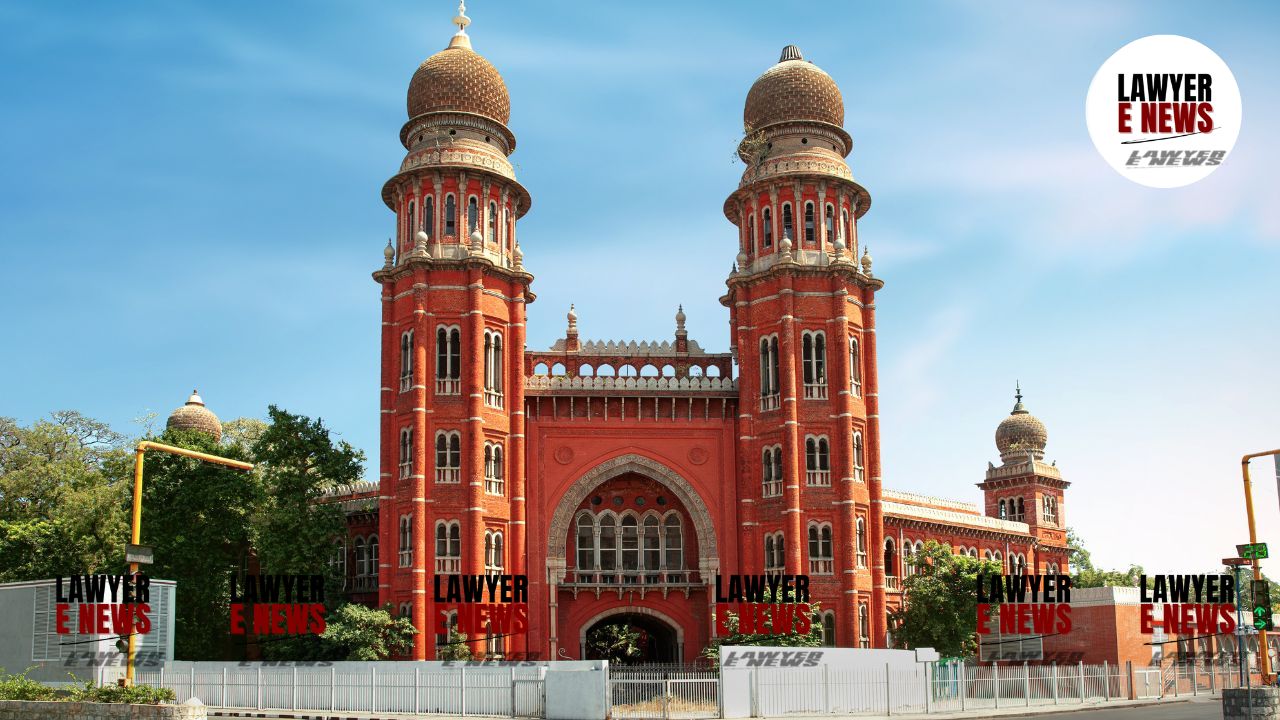
"In the garb of exercising supervisory jurisdiction under Article 227 of the Constitution, the High Court is not expected to engulf the specific statutory remedy or provision in law and, thus, become a supervisor over the court below." Madras High Court, in a recent ruling, held that the High Court cannot exercise its supervisory jurisdiction under Article 227 of the Constitution of India to strike off a plaint when a specific statutory remedy for the rejection of a plaint is available under Order VII Rule 11 of the Code of Civil Procedure (CPC).
A bench of Mr. Justice K. Rajasekar observed that courts must adhere to "self-imposed discipline" by insisting that aggrieved parties exhaust available statutory remedies before approaching the High Court.
The dispute arose from a civil suit filed in 2022, challenging a property sale deed executed in 1951 on the grounds that the suit property was joint Hindu family property. The petitioner, who was the third defendant in the suit, sought to strike off the plaint directly before the High Court under Article 227, contending that the suit was filed after 71 years and lacked a valid cause of action. The petitioner bypassed the trial court process, seeking direct intervention from the High Court to terminate the proceedings.
The primary question before the court was whether the High Court is justified in exercising its supervisory jurisdiction under Article 227 of the Constitution to strike off a plaint, notwithstanding the availability of the remedy of rejection of plaint under Order VII Rule 11 CPC. The court was further called upon to determine the extent of self-imposed limitations on High Courts regarding the entertainment of such petitions in property disputes.
High Court Rejects Circumvention of CPC
The Court noted that while the petitioner had raised substantial arguments regarding the lack of cause of action, the procedural route adopted was legally impermissible. Relying on the recent Supreme Court judgment in P. Suresh v. D. Kalaivani and Others [2026 INSC 121], the bench held that parties are mandated to approach the trial court first for the rejection of a plaint under the established provisions of the CPC.
Disapproval of Routine Article 227 Usage
The Court emphasized that the supervisory power under Article 227 should not be exercised in a routine manner, particularly in civil suits involving disputed questions of fact that require adjudication through the leading of evidence. The bench remarked that the "embargo" on bypassing specific statutory provisions is "near total" when a corresponding remedy exists within the Code of Civil Procedure.
"It is held, therefore, that once the specific provision under Order VII Rule 11 of the CPC, is available, the High Court cannot exercise powers under Article 227 to reject or strike off the plaint."
Maintaining Trial Court Primacy
The Court further observed that the High Court is not intended to act as a supervisor over every order of the trial court, as this would undermine the statutory framework designed for civil litigation. By insisting on the exhaustion of remedies under Order VII Rule 11, the Court aims to prevent the "engulfing" of statutory provisions by the extraordinary jurisdiction of the High Court.
Consequentially, the High Court disposed of the Civil Revision Petition, granting the petitioner the liberty to file an appropriate application for rejection of the plaint before the trial court. The trial court was directed to consider such a petition, if filed, and dispose of the same in accordance with the law as expeditiously as possible.
Date of Decision: 02 September 2026