-
by sayum
27 August 2026 3:32 PM







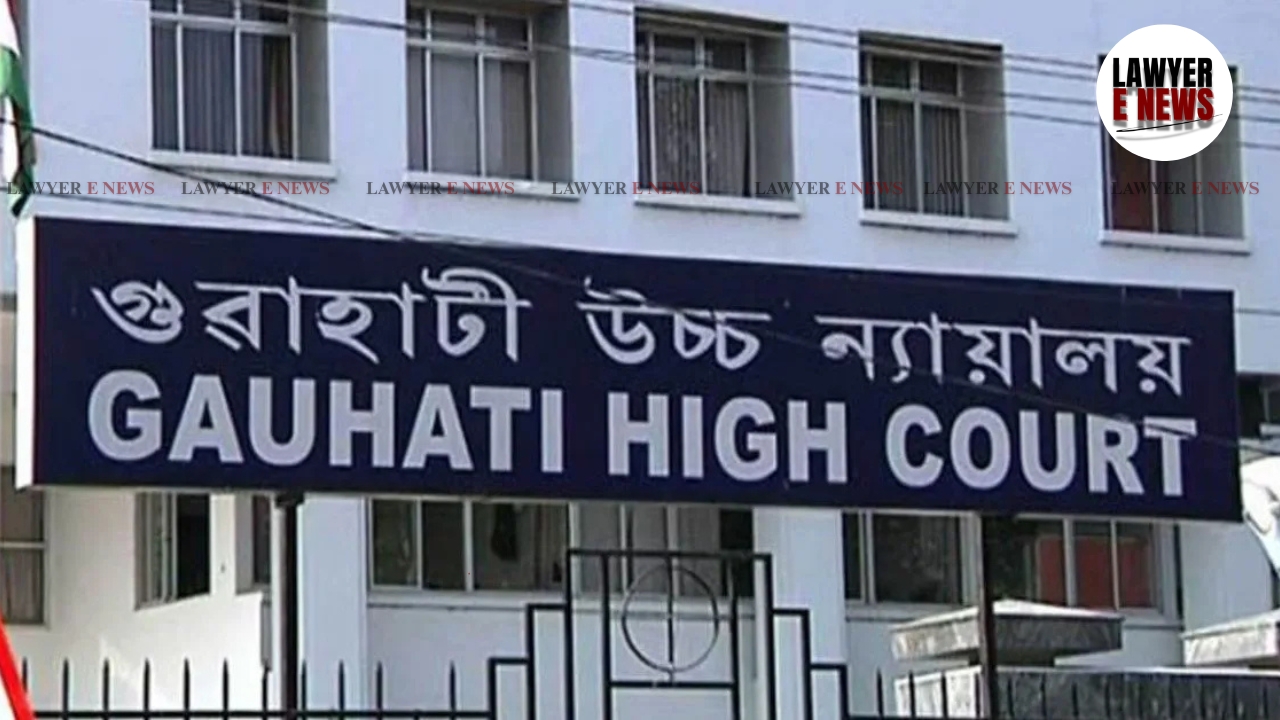
"Criminal court decides criminal liability independently — there is no statutory rule that a finding in one proceeding is final and binding in the other," Gauhati High Court has dismissed a criminal revision petition filed by a former Member of the Assam Legislative Assembly, who had alleged that political opponents forged his B.Com. educational qualification certificates on the eve of Assembly Elections to damage his reputation.
Justice Robin Phukan upheld the order of the Chief Judicial Magistrate, Jorhat, accepting the Final Report of the Investigating Officer — a Final Report that had not only closed the case but simultaneously initiated counter-prosecution against the petitioner himself for filing a false case.
The Court held that the investigation was not perfunctory, that an Investigating Officer is not bound to seize every document produced by the complainant, that non-examination of the college principal caused no infirmity given that the University is the final authority on examination results, and that the pendency of a civil title suit had no binding effect on the criminal court's independent assessment.
The Court was required to examine whether the CJM's acceptance of the Final Report suffered from any illegality or impropriety on account of: non-seizure of documents produced by the petitioner with the FIR; non-examination of the Principal of J.B. College; non-recording of the petitioner's statement during investigation; failure to consider the pending civil title suit; and whether the CJM had accepted the Final Report without notice to the petitioner.
Notice Was Issued, Petitioner's Statement Was Recorded — Both Allegations Found Factually False
At the outset, the Court repudiated two of the petitioner's grounds as contradicted by the record itself. The claim that the CJM had accepted the Final Report without issuing notice to the petitioner was rejected after the Court examined the scanned case record, which clearly showed that notice had been issued on November 18, 2017, and that the petitioner had obtained time, filed objections on February 1, 2018, and was represented by counsel when the order was passed on February 17, 2018.
Similarly, the argument that the petitioner's statement was never recorded by the I.O. was rejected after the Court examined the original Case Diary, which showed that the I.O. had recorded the petitioner's statement on the very day the FIR was registered — April 1, 2016.
Investigating Officer Not Bound To Seize Every Document Produced By Complainant
The Court addressed the argument that the I.O. had failed to seize the documents enclosed by the petitioner with the FIR — including his mark sheet, pass certificate, and result sheet. The Court held that this caused no infirmity whatsoever.
"It is well settled that an investigating officer is not bound to seize every document produced by the complainant during the investigation. He has the discretion to decide which document is relevant and necessary for the investigation. He is also not a receptacle for every paper the complainant produces; he may accept copies or merely note the said document in the case diary."
The Court examined the documents individually and found that the High School mark sheet and the admit card were wholly irrelevant to the core allegation of B.Com. certificate fabrication. As for the relevant documents — the B.Com. mark sheet, pass certificate, and result sheet — the Court found that the I.O. had, in fact, physically taken these documents to Dibrugarh University and verified them with the University authorities, who found the mark sheet to be incorrect. The I.O. then seized the Photo Copy of the Original Tabulation Sheet from the Controller of Examinations. "This being the position, omission to seize the document Nos. 3, 4 and 5 by the I.O. caused no dent to the investigation."
University Is Final Authority On Examinations — Non-Examination of College Principal Irrelevant
The petitioner argued strenuously that the I.O. had failed to examine the Principal of J.B. College, who had issued the provisional pass certificate. The Court rejected this contention by applying a straightforward principle.
The Court noted that it is the University, and not the affiliated college, that is the final authority to declare whether a student has passed or failed and to issue mark sheets and certificates. Since the I.O. had already examined the Controller of Examinations at Dibrugarh University and recorded his statement — and since the University's Tabulation Sheet revealed discrepancies — the non-examination of the college Principal had no bearing on the outcome of the investigation.
Civil Court Finding Cannot Bind Criminal Court — Pendency Of Title Suit No Ground To Reject Final Report
The petitioner's most legally interesting argument was that the CJM had ignored a pending title suit, T.S. No. 49/2017, filed by the petitioner before the Civil Judge, Jorhat, seeking a declaration that his B.Com. result was correct, that the University's RTI-based response was wrong, and a direction to the University to correct its tabulation sheet and issue a regular degree certificate. The petitioner contended that the findings of the Civil Court on these very issues would be binding on the criminal court.
The Court firmly rejected this position. Relying on the Supreme Court's decision in K.G. Premshanker v. Inspector of Police and Another, (2002) 8 SCC 87, the Court reiterated the established principle that "the criminal court decides criminal liability independently and may convict or acquit based on the evidence before it, while the civil court finding only controls the civil consequences."
"There is no statutory rule that a finding in one proceeding is final and binding in the other, though a civil court decision may be relevant evidence if it satisfies conditions in Sections 40–43 of the Evidence Act. It cannot be said that the same would be conclusive, except as provided in Section 41."
The Court found that while the FIR allegations and the Title Suit reliefs appeared interrelated, they were not interdependent. The criminal case required the prosecution to prove fabrication of documents and conspiracy beyond reasonable doubt, while the civil suit operated on a preponderance of evidence standard. The pending civil suit could not, therefore, be a ground to interfere with the acceptance of the Final Report. The Supreme Court decision in Shanti Kumar Panda, relied upon by the petitioner, was distinguished on the ground that it arose under Section 145 CrPC, which deals with disputes over possession of land where title is always to be adjudicated by Civil Courts — a factual situation entirely different from the present case.
Petition Dismissed — No Infirmity In CJM's Order
Having examined each ground raised by the petitioner and finding all of them to be either factually incorrect or legally unsustainable, the Court concluded that the petitioner had failed to demonstrate any infirmity or illegality in the CJM's order dated February 17, 2018. The criminal revision petition was accordingly dismissed, with the parties directed to bear their own costs.
Date of Decision: April 23, 2026