-
by sayum
18 November 2026 6:45 AM







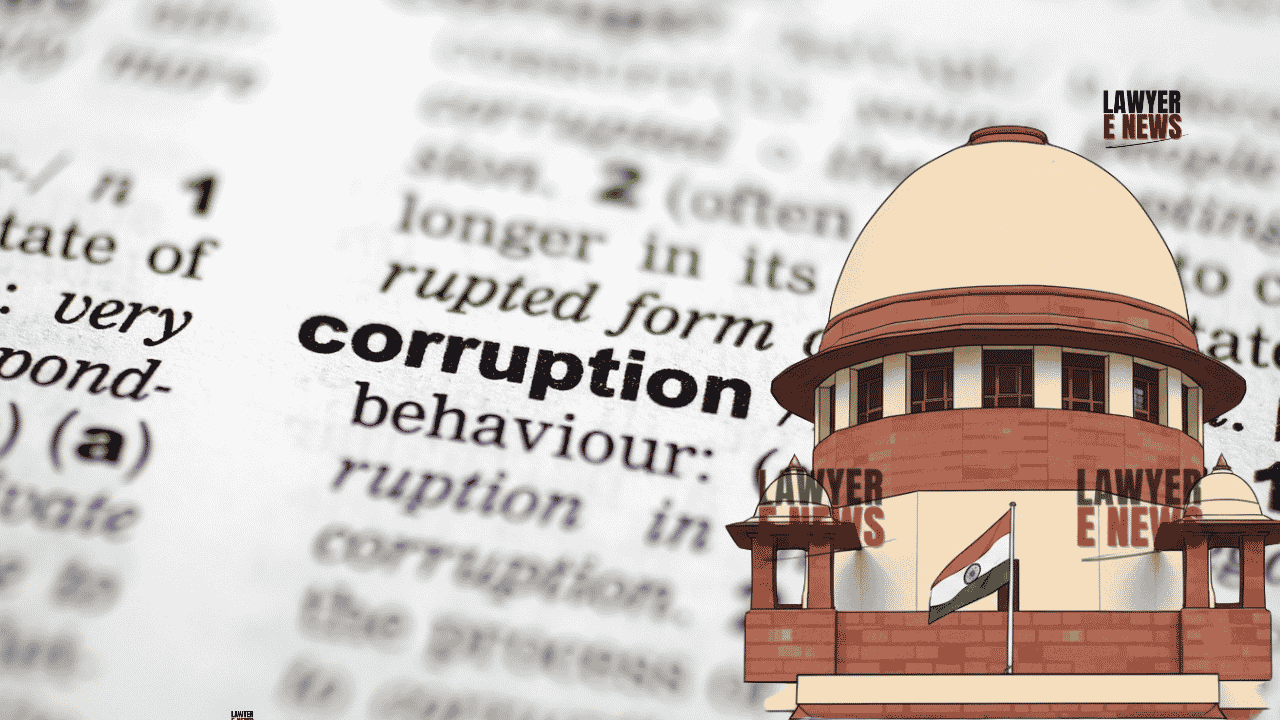
"Thus, it is evident that neither the demand for bribe by the appellant nor the conscious acceptance of the bribe by the appellant can be said to have been proved. In the absence of such proof, drawing of presumption under Section 20 of the PC Act was impermissible." Reaffirming that proof of demand and voluntary acceptance of illegal gratification constitutes an indispensable foundation for sustaining corruption charges, the Supreme Court bench comprising Justice Ujjal Bhuyan and Justice Atul S. Chandurkar, on November 17, 2026, held that the statutory presumption under Section 20 of the Prevention of Corruption Act, 1988 cannot be invoked merely on the basis of recovery of tainted currency notes or positive chemical wash tests.
The prosecution arose from an execution proceeding for recovery of unpaid wages forwarded to the appellant, who was serving as Tehsildar, Kotwali. The complainant alleged that the appellant demanded illegal gratification of Rs. 1,000 to forward the recovered cheques to the Labour Commissioner, resulting in an Anti-Corruption Bureau trap where marked currency notes were recovered from the appellant’s coat pocket. Following the death of both the complainant and the shadow witness prior to trial, the Special Judge and subsequently the Delhi High Court relied upon Section 20 of the PC Act to convict the appellant under Sections 7 and 13(1)(d) read with Section 13(2) of the PC Act.
Whether the statutory presumption under Section 20 of the Prevention of Corruption Act, 1988 can be invoked solely upon the recovery of tainted currency and positive phenolphthalein tests when both the complainant and shadow witness died prior to trial?
Whether the testimony of the trap officer relaying communications made to him by a deceased shadow witness regarding the demand and acceptance of bribe constitutes inadmissible hearsay?
Whether a public servant can be convicted under Sections 7 and 13(1)(d) of the PC Act when contemporaneous official records prove that the official act was already executed prior to the date of the alleged demand?
Foundational facts of demand and acceptance must be established beyond reasonable doubt
The Court meticulously analyzed Section 7, Section 13(1)(d), and Section 20 of the PC Act alongside established Constitution Bench jurisprudence. It underscored that proof of demand and acceptance of illegal gratification by a public servant as a fact in issue is a sine qua non to establish guilt under Sections 7 and 13(1)(d)(i) and (ii) of the PC Act. The bench stressed that mere receipt or recovery of money, absent proof of demand, cannot bring home a conviction.
The bench recalled that while inferential deductions of guilt are permissible when primary evidence of the complainant is unavailable, such deductions require other reliable evidence to establish foundational facts. Referring to the Constitution Bench ruling in Neeraj Dutta, the Court reiterated that Section 20 mandates the raising of a legal presumption only after the prosecution proves the underlying facts in issue. Furthermore, the bench observed that Section 20 applies strictly to Section 7 and has no application to Section 13(1)(d) offenses.
Trap officer's testimony relaying shadow witness's narration constitutes inadmissible hearsay
Noting that neither the complainant nor the shadow panch witness entered the witness box due to their demise before trial, the bench highlighted the total absence of direct oral evidence regarding any prior or spot demand. The prosecution case rested entirely on the testimony of the trap laying officer.
Addressing the trap officer's statement regarding the exchange between the accused and the complainant, the bench held that such narration was wholly derivative. The Court observed, "Notwithstanding the right hand left hand discrepancy, it is evident that the above statement of PW-10 regarding what was narrated to him by the panch witness is nothing but hearsay evidence. PW-10 himself had not seen or heard any demand for illegal bribe being made by the appellant or acceptance of the same." In the absence of the shadow witness affirming the event, the trap officer's relayed testimony remained inadmissible to prove demand or voluntary acceptance.
Official records showing prior completion of work rebuts prosecution motive and supports defence
The Court scrutinized the contemporaneous official records, which revealed that the appellant’s office had already dispatched the recovery cheques to the Deputy Labour Commissioner on December 28, 2002, and were received there on January 1, 2003. Consequently, no official work or proceeding remained pending before the appellant on the alleged trap date of January 6, 2003.
This unimpeachable official record completely belied the prosecution’s theory that the appellant demanded a bribe under threat of withholding the cheques. The Court determined that the explanation offered by the appellant under Section 313 CrPC—that the complainant attempted to thrust money into his pocket under the pretense of shaking hands to convey gratitude—satisfied the test of preponderance of probabilities.
Mere recovery without proof of conscious acceptance cannot justify statutory presumption
Emphasizing that the burden on an accused to rebut a statutory presumption is merely that of preponderance of probabilities, the Supreme Court held that the courts below gravely erred in drawing an adverse presumption under Section 20 of the PC Act. The bench reaffirmed that mere recovery of marked money and positive chemical wash tests cannot substitute the essential element of conscious, voluntary acceptance pursuant to an illegal demand.
The Supreme Court allowed the criminal appeal, set aside the judgment of the Delhi High Court as well as the conviction order of the Special Judge, and acquitted the appellant of all charges under Sections 7 and 13(1)(d) read with Section 13(2) of the PC Act while discharging his bail bonds.
Date of Decision: November 17, 2026