-
by sayum
19 August 2026 12:01 PM







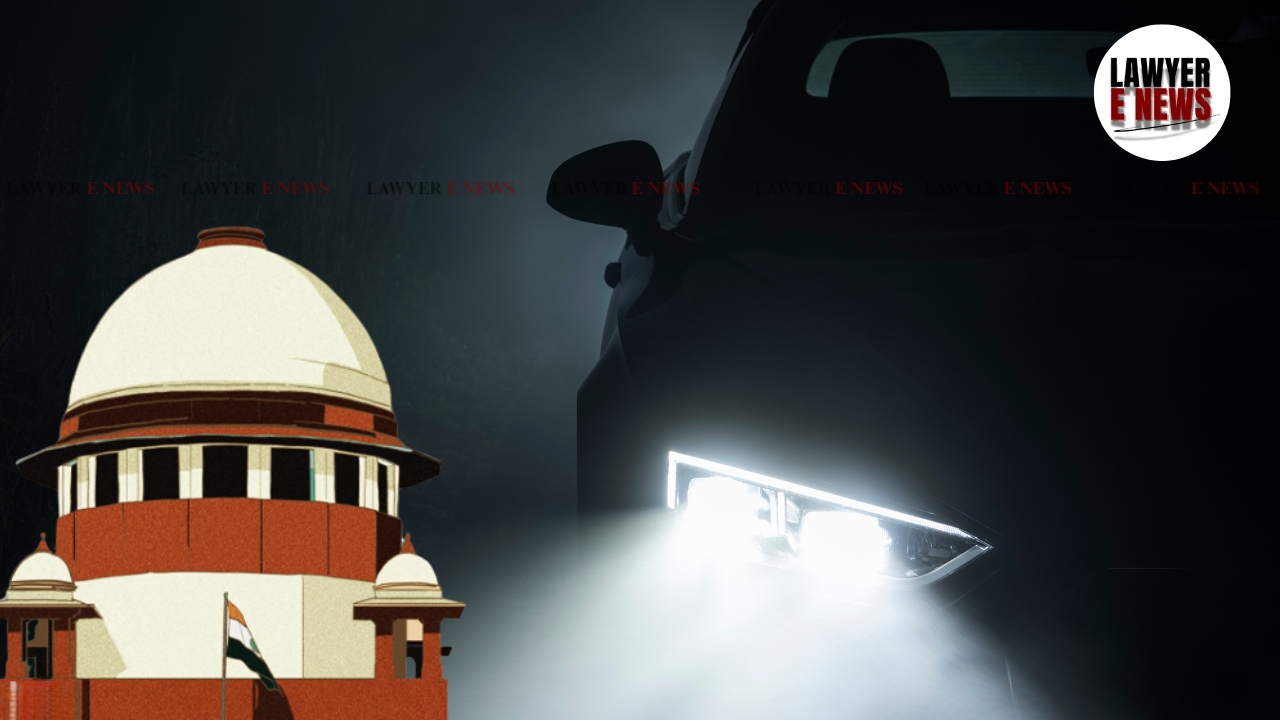
In a strongly worded and precedent-setting observation, the Supreme Court of India, in its October 7, 2025 decision, declared that the unchecked use of high-intensity LED headlights, red-blue strobe lights, and illegal emergency hooters poses a serious threat to public safety and violates the right to life and mobility under Article 21 of the Constitution.
Calling for immediate corrective measures, the Court said, “High-intensity headlights, including those fitted in two-wheelers, cause temporary visual disorientation and glare for oncoming drivers, as well as pedestrians.” The Bench of Justices J.B. Pardiwala and K.V. Viswanathan did not mince words in holding that such dazzling lights were not merely technical violations but active contributors to road trauma and fatalities.
The ruling came as part of a broader judgment on road safety infrastructure and enforcement, delivered in a long-pending PIL filed under Article 32 by Dr. S. Rajaseekaran, a noted orthopedic surgeon and public health advocate. The Court was also assisted by Amicus Curiae Mr. Gaurav Agrawal, whose submissions drew the Court’s attention to the dangers posed by indiscriminate installation of LED lights and hooters, especially by private vehicles impersonating emergency services.
“Visual Chaos on Indian Roads Must End”: Apex Court Orders MoRTH and States to Set Luminance Standards and Enforce Headlight Regulations
The Court directed the Ministry of Road Transport and Highways (MoRTH) and all State and Union Territory transport departments to formulate and enforce maximum permissible luminance and beam-angle standards for headlights, stating:
“Visual chaos on Indian roads has gone unregulated far too long. These devices not only disorient other drivers and pedestrians but compromise reaction time and increase the likelihood of accidents, particularly on narrow roads, undivided carriageways, and at night.”
It further ordered that compliance be ensured through Pollution Under Control (PUC) and vehicle fitness checks, warning that “modified or non-compliant headlights must be penalised through seizure and cancellation of fitness certificates.”
In a crucial step, the Court instructed the authorities to launch targeted enforcement drives against vehicles with unauthorized lighting modifications. These directions are to be executed by transport authorities, traffic police, and testing agencies, with immediate effect.
“Emergency Hooters and Strobe Lights Are Not Symbols of Status but Abuse of Power”: Supreme Court Orders Total Ban on Unauthorized Use
The Bench expressed concern at the widespread misuse of red–blue strobe lights and emergency sirens by private individuals, noting that such devices are meant exclusively for authorised emergency vehicles such as ambulances, police, and fire services. It said:
“These gadgets create a false sense of authority, panic among road users, and contribute to erratic driver behaviour. Pedestrians may freeze, retreat, or make unsafe evasive actions, increasing their exposure to injury.”
The Court ordered a complete ban on the sale, installation, and use of unauthorized red–blue strobe lights and emergency hooters, and directed that market crackdowns and seizure operations be carried out across cities. It clarified that:
“Such misuse also undermines respect for genuine emergency responders and dilutes their authority in critical situations. It must be curbed through strict enforcement and public education.”
“Glare-Induced Blindness Is a Reality, Not Hyperbole”: SC Calls for Nationwide Public Awareness Campaigns
The Court emphasized that legal enforcement must be accompanied by public awareness. Directing MoRTH, State Governments, and Traffic Police departments to launch nationwide sensitisation campaigns, the Court observed:
“There is a shocking lack of awareness among both vehicle owners and enforcement agencies about the impact of blinding LED headlights and illegal hooters. This is not a mere inconvenience—it is a safety hazard with lethal consequences.”
The awareness campaigns are to cover the dangers of glare-induced pedestrian disorientation, disorientation of oncoming drivers, delayed reaction times, and increased likelihood of road crashes. The Court also suggested that education about headlight usage norms be incorporated into driver training modules and licence renewal exams.
“Unsafe Illumination Is a Form of Road Violence”: SC Links Lighting Violations to Constitutional Duty and Penal Accountability
Importantly, the Court linked lighting violations to public authority accountability. It clarified that enforcement officers, testing centres, and RTOs who fail to detect and penalise such modifications may themselves be liable under Section 198A of the Motor Vehicles Act, 1988, which punishes failure to comply with prescribed safety standards in road design and regulation.
“When a person dies or is injured due to visual impairment caused by dazzling lights or illegal sirens, the liability is not just moral—it is legal.”
This recognition effectively brings lighting safety within the scope of statutory and criminal accountability, a significant expansion of the jurisprudence surrounding road safety.
Supreme Court to Monitor Implementation; Non-Compliance Will Invite Judicial Scrutiny
While issuing the above directions, the Court also made it clear that this is not a one-time intervention. The matter has been ordered to be listed after seven months for a compliance review, during which MoRTH, States, and NHAI are to file affidavits indicating the steps taken for enforcement, rule framing, seizures, and public sensitisation.
“We will not allow these directions to become paper orders. Road safety is not negotiable,” the Court affirmed.
The judgment, in its depth, clarity, and legal innovation, stands as a strong rebuke to the culture of vehicular privilege and regulatory apathy. It is also a constitutional recognition that lighting design, when misused, can become an instrument of harm, and must therefore be regulated with precision and purpose.
Date of Decision: 7th October, 2025