-
by sayum
29 August 2026 9:28 AM







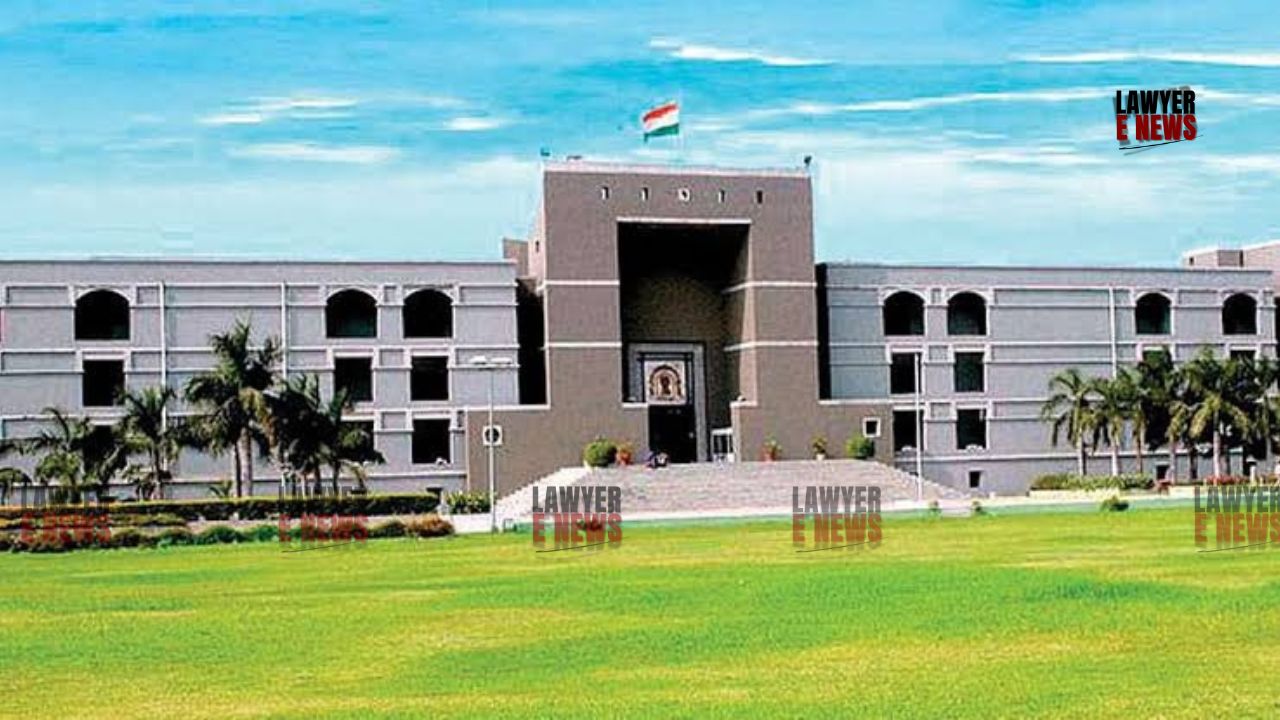
"Discovery panchnama must be proved in accordance with law – When both panch witnesses turn hostile and Investigating Officer fails to narrate material facts, conviction based on such evidence is impermissible": In a detailed and significant verdict Gujarat High Court delivered a split ruling on two criminal appeals arising from a conviction under Section 302 of the Indian Penal Code and Section 135(1) of the Gujarat Police Act. The Division Bench of Justices Ilesh J. Vora and P. M. Raval confirmed the conviction of Accused No. 4 (Rajesh @ Rajio) for murder, while acquitting Accused No. 2 (Ravi @ Pagli), holding that his conviction was legally unsustainable due to the prosecution’s failure to prove discovery evidence in accordance with law and the absence of direct attribution by any eyewitnesses.
The judgment reinforces long-established principles that convictions must rest on cogent, admissible evidence, not assumptions or procedural shortcuts.
“Four Eyewitnesses Depose with Clarity; Minor Inconsistencies Do Not Shake Core of Prosecution Case”
The central issue before the Court was the credibility of four eyewitnesses – Bharatbhai (PW-2), Govindbhai (PW-3), Dineshbhai (PW-4), and Kallubhai (PW-5) – whose testimony consistently identified Rajesh @ Rajio (Accused No. 4) as the person who chased the deceased Girishsinh and inflicted sword blows, leading to his death.
Rejecting defence contentions that the witnesses were “interested,” “chance,” or unreliable due to their friendship with the deceased, the Court categorically observed:
“When the oral evidence of PW-2 at Exh. 17, PW-3 at Exh. 18, PW-4 at Exh. 19 and PW-5 at Exh. 20 is taken together, their version corroborates each other, and when all of them are eyewitnesses, this Court has to see that their stand is consistent with regard to the role played by Accused No. 4 and the fatal sword blow inflicted by him.”
The Court emphasized that eyewitness testimony must be appreciated holistically, and trivial inconsistencies cannot derail a prosecution case that otherwise bears the “ring of truth”.
"Failure to Inform Police Not Fatal: Witness Conduct Must Be Judged in Context, Not by Ideal Reactions"
The defence sought to undermine the prosecution by arguing that none of the eyewitnesses informed the police at the scene, despite possessing mobile phones and witnessing the crime.
Citing the Supreme Court’s landmark ruling in Appabhai v. State of Gujarat, AIR 1988 SC 696, the High Court rejected this line of argument as unrealistic and outdated:
“To discard the evidence of a witness on the ground that he did not react in any particular manner is to appreciate evidence in a wholly unrealistic and unimaginative way.”
The Court acknowledged that human behaviour under stress is unpredictable, noting that witnesses may not react “ideally” in traumatic events, and their conduct cannot be held against them unless it fatally contradicts the core prosecution narrative – which it did not in this case.
“Discovery Must Be Legally Proven – Hostile Panchas and Vague I.O. Deposition Render Recovery Inadmissible”
Crucially, the Court overturned the conviction of Accused No. 2, Ravi @ Pagli, observing that the prosecution relied solely on the discovery of a knife under Section 27 of the Indian Evidence Act.
However, both panch witnesses to the recovery panchnama (Exh. 47) turned hostile, and the Investigating Officer (PW-21) failed to narrate the essential stages of discovery – the accused’s willingness to disclose, the subsequent recovery, and its connection to the crime.
The Court declared: “Despite the panch witnesses turning hostile, the officer did not state the contents of the panchnama in his deposition. He only stated that Ravi had said he was ready to show the knives used by Chotadon. However, the weapon allegedly used by another accused cannot be used to convict this appellant.”
It further held that the recovery did not pertain to the weapon used by Ravi @ Pagli, but to a knife allegedly used by another absconding accused – making the discovery wholly irrelevant against him.
The Court concluded: “There is no legal evidence against Accused No. 2. The conviction cannot be sustained when neither his presence at the crime scene nor his role is established by any witness or circumstance.”
“Conviction Under Gujarat Police Act Unsustainable in Absence of Proper Notification Proof”
The Court also set aside the conviction under Section 135(1) of the Gujarat Police Act, which penalises possession of weapons in notified areas.
Although the prosecution produced a notification (Exh. 63) prohibiting the carrying of deadly weapons at the time of the offence, the Court held that it was not proved as per Section 78 of the Indian Evidence Act, which mandates either:
A certified copy by the head of the concerned department, or
A publication in the official gazette
The Court observed: “Exh. 63 is neither certified by the head of the department nor published in the official gazette. The proclamation restricting carrying of deadly weapons was not proved. In such circumstances, conviction under Section 135(1) cannot be sustained.”
This aligns with the principle that procedural safeguards for proving public documents are not optional, especially when the conviction hinges on them.
“Faulty Investigation Cannot Override Clear Eyewitness Testimony”
On the broader issue of defective investigation, including flawed TIP procedures and delayed arrests, the Court was categorical in holding that investigative lapses do not per se justify acquittal.
Drawing from the Supreme Court’s rulings in Ram Bihari Yadav v. State of Bihar and Karnel Singh v. State of M.P., the Bench reiterated:
“If primacy is given to negligent investigation or omission by a perfunctory investigating agency, it would shake the faith and confidence of the people not only in the law enforcement agency but also in the administration of justice.”
Thus, Accused No. 4's conviction was sustained despite investigative lapses, since the eyewitness accounts were found to be consistent, specific, and credible.
Conviction of Rajesh @ Rajio for Murder Upheld, Ravi @ Pagli Acquitted
Summing up, the High Court ruled: “The role of Accused No. 2 has not clearly emerged from the evidence. His presence at the scene of offence is not proved. In contrast, the deposition of four eyewitnesses has remained unshaken regarding the role played by Accused No. 4.”
Accordingly:
Criminal Appeal No. 1149 of 2018 (filed by Rajesh @ Rajio) was partly allowed – conviction under Section 302 IPC upheld, but Section 135(1) Gujarat Police Act set aside
Criminal Appeal No. 1004 of 2017 (filed by Ravi @ Pagli) was fully allowed – he was acquitted of all charges
The Court also noted that three other accused remain absconding, and the State has not filed appeals against the acquittal of other accused or against findings on unlawful assembly, hence it refrained from commenting further on those aspects.
Date of Decision: 3 September 2025