-
by sayum
28 August 2026 2:11 PM







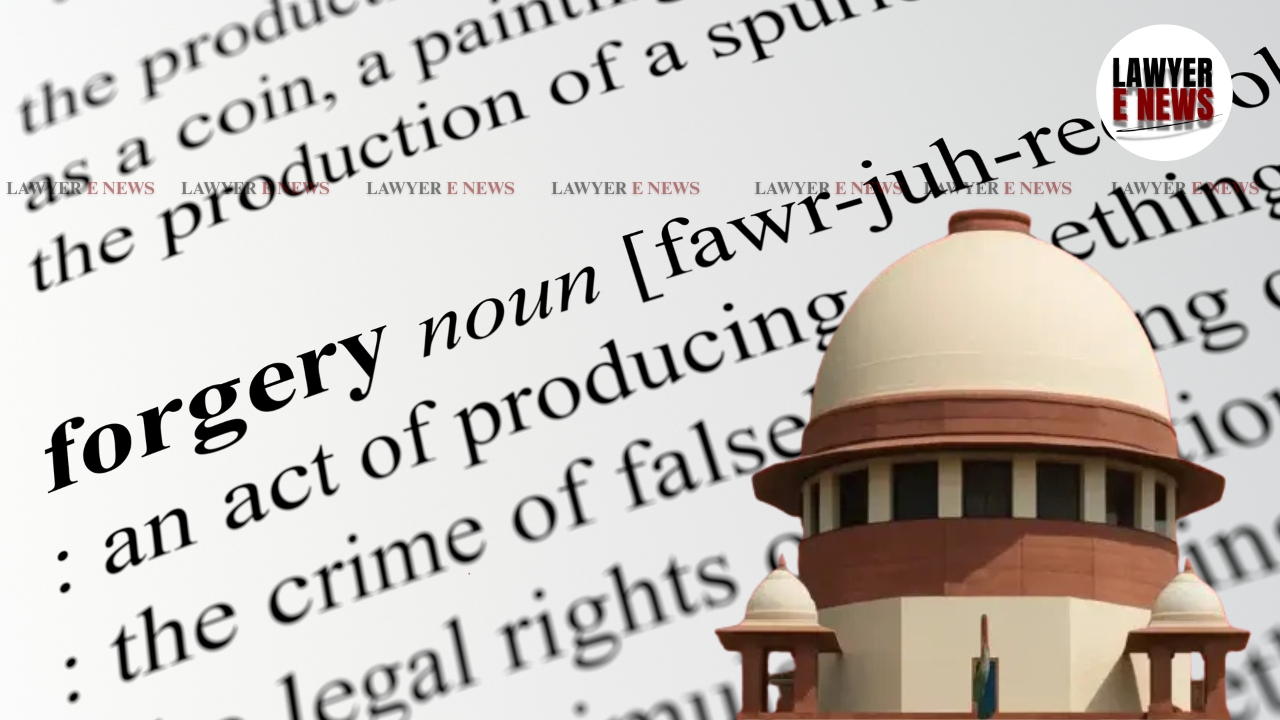
In a scathing indictment of the misuse of criminal law for settling civil scores, the Supreme Court of India on 24 September 2025 quashed a 22-year-old criminal case arising from a money-lending dispute, calling it a textbook example of malicious prosecution and abuse of process. The Court held that when a commercial or contractual disagreement is “dressed up as a criminal offence without foundational allegations of mens rea”, the criminal justice system must not become a weapon of coercion.
Bench of Justice B.V. Nagarathna and Justice R. Mahadevan allowed the appeal against the Allahabad High Court’s 2019 order and quashed FIR No. 47 of 2003 and chargesheet dated 16.04.2003 under Sections 420, 467 and 468 IPC. The Court observed that “the allegations even if accepted at face value, do not disclose any criminal offence and constitute a purely civil dispute regarding a loan and cheque transaction.”
The case marks another emphatic application of the Bhajan Lal principles and a firm judicial stance against the increasing trend of filing criminal cases in retaliation to legitimate civil or quasi-criminal proceedings.
"When the Dispute is Manifestly Civil and the Criminal Process is Invoked to Wreak Vengeance, It Must Be Quashed"
The genesis of the case lay in a property dispute that spiralled into multiple criminal allegations. According to the appellant Anukul Singh, his father had lawfully purchased agricultural land through a registered sale deed in 2000. Their opposition to the use of the land for religious animal sacrifice (Qurbani) allegedly triggered hostility from local religious authorities and political interference.
What followed, according to the appellant, was a campaign of harassment resulting in eight FIRs lodged against him within a single week, including the present FIR No. 47 of 2003. The impugned FIR, filed on 05.02.2003, accused the appellant of coercing the complainant into executing a sale agreement and issuing cheques in connection with a ₹2 lakh loan—three of which bounced and led to prior N.I. Act proceedings.
The appellant had already initiated proceedings under Section 138 of the Negotiable Instruments Act against the complainant in 2002 and 2003, in which the complainant was convicted in 2025. The appellant contended that the present FIR was nothing but a “retaliatory counterblast” filed maliciously to sabotage the ongoing proceedings and coerce a settlement.
Despite these facts, the Allahabad High Court refused to quash the proceedings under Section 482 Cr.P.C., holding that no grave injustice had occurred and that the dispute required trial. The Supreme Court, however, found this approach to be legally unsustainable.
“Abuse of Criminal Process Is Not a Matter of Trial — It Must Be Stopped at the Threshold”
Reaffirming the scope of powers under Section 482 Cr.P.C., the Court referred extensively to State of Haryana v. Bhajan Lal, where it was held that courts must intervene where criminal proceedings are manifestly malicious or initiated with ulterior motives. The Court observed:
“The High Court misdirected itself by failing to apply the Bhajan Lal principles and by permitting criminal proceedings to continue in a matter that is civil in essence.”
Referring to the gravamen of the complaint—alleging that only ₹1.40 lakh was paid on a ₹2 lakh loan and that the complainant was compelled to sign an agreement and issue cheques—the Court held:
“Even if all these allegations are accepted in their entirety, they do not disclose the essential ingredients of cheating or forgery. There is no material to establish fraudulent intent at the inception of the transaction.”
The Court further noted that the appellant was not even a signatory to the agreement to sell in question, and that the prosecution was clearly initiated to settle scores.
"Criminal Law Cannot Be Used as a Pressure Tactic in Loan Recovery": Court Warns Against Weaponising IPC in Civil Disputes
The Court drew from its jurisprudence in Indian Oil Corporation v. NEPC India Ltd. and Shailesh Kumar Singh v. State of U.P., where it had observed that:
“There is a growing tendency to convert purely civil disputes into criminal cases... Such misuse of criminal law must be deprecated and discouraged.”
Criticising the trend of bypassing civil courts and using FIRs to pressurise adversaries, the Court categorically held:
“The machinery of criminal law is not meant to serve as a debt recovery mechanism. Where there is no element of deception or dishonest inducement at the inception, the offence of cheating cannot be said to arise.”
The Supreme Court underscored that the prosecution was instituted only after the complainant had been arrested in an earlier case initiated by the appellant. The timing, multiplicity of FIRs, and pendency of civil-like disputes reinforced the inference of “malice and ulterior motives.”
“Where Prosecution Is Launched as a Counterblast to Civil Action, Courts Must Act with Vigilance”
The Court found the sequence of events telling: the complainant was arrested in FIR No. 120/2002 filed by the appellant; N.I. Act complaints were also filed prior to the present FIR; and the present complaint came only after those proceedings were underway. In fact, the complainant was convicted in the N.I. Act case by order dated 15.01.2025.
Referring to this timeline, the Court held:
“The present FIR was lodged nearly three months after the Section 138 complaint and seven months after the appellant’s FIR. It bears all the hallmarks of a retaliatory counterblast aimed at frustrating legitimate legal action.”Concluding that the prosecution was manifestly attended with mala fide, the Court invoked categories (1) and (7) of Bhajan Lal, where allegations do not disclose an offence and proceedings are launched with malicious intent. It ruled:
“The dispute, concerning repayment of loan money and the alleged coercion in execution of documents, is purely civil in character. The essential ingredients of cheating or forgery are not prima facie made out.”
The Court accordingly set aside the Allahabad High Court’s order dated 22.10.2019 and quashed FIR No. 47 of 2003 and chargesheet dated 16.04.2003. It clarified that the parties remain free to pursue civil remedies as available under law.
“The Criminal Justice System Cannot Be Used to Circumvent Civil Process”
This ruling is a reiteration of judicial reluctance to allow civil disputes to be criminalised, particularly in commercial transactions. In a system already burdened by pendency, the Court sent a clear message: “Where allegations do not meet the threshold of criminality, the process must be halted at inception—not after years of prosecution.”
Date of Decision: 24 September 2025