-
by sayum
25 August 2026 4:32 AM







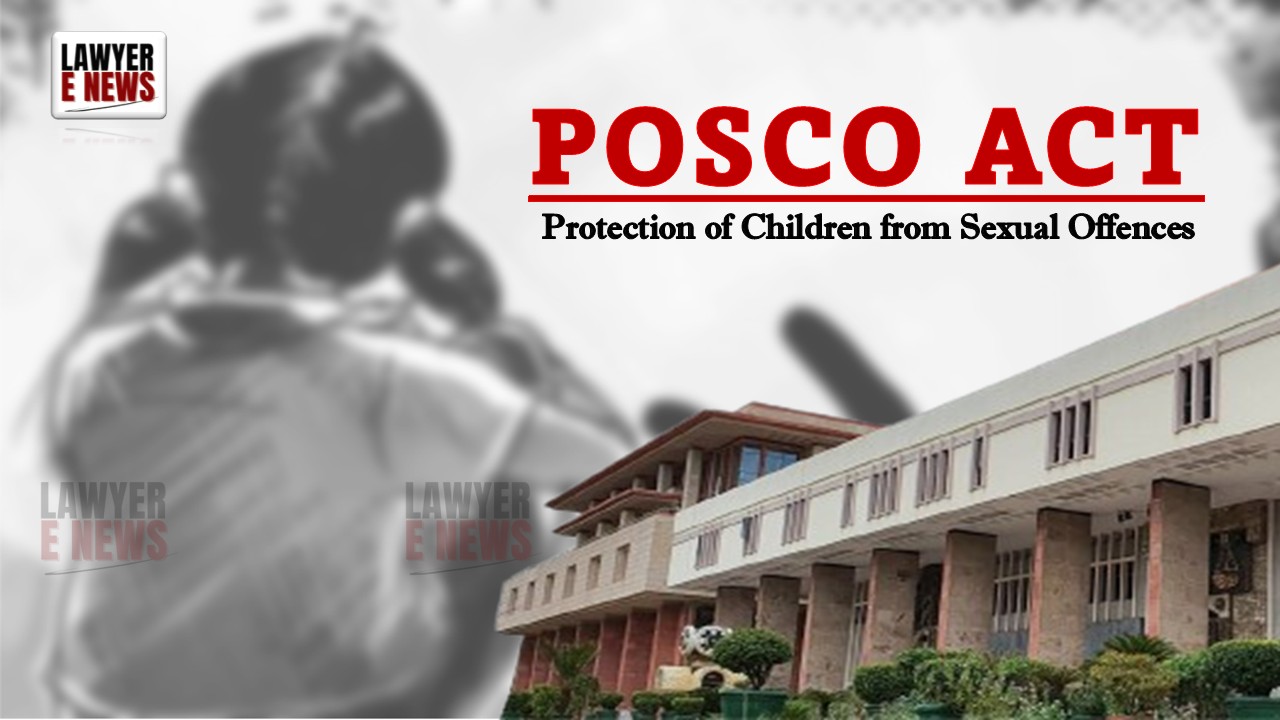
“Even A Five-Year-Old's Truth Can Shake the Court’s Conscience, If It Is Consistent, Coherent and Unshaken by Cross-Examination”, Delhi High Court delivered a critical judgment rejecting an appeal filed by one Jagat, who had been convicted for sexually assaulting a five-year-old girl. The Court reaffirmed that under the Protection of Children from Sexual Offences Act (POCSO), the testimony of a child victim, if found credible, can be the sole basis for conviction, even in the absence of corroborative forensic evidence.
Justice Manoj Kumar Ohri, while upholding the conviction and 10-year sentence awarded by the Special POCSO Court, held that the child’s account was “consistent and categorical” and that “the testimony of the child victim, having been found to be credible and reliable and duly supported by the MLC, inspires confidence.”
“Section 29 POCSO Raises Presumption Once Foundational Facts Are Proved — The Burden Then Shifts To The Accused”
The High Court clarified the procedural significance of Section 29 of the POCSO Act, which allows the court to presume guilt once certain basic facts are established. The judgment quotes the Supreme Court’s latest pronouncement in Sambhubhai Raisangbhai Padhiyar v. State of Gujarat (2025) 2 SCC 399, stating:
“Section 29 comes into play once the foundational facts of the case stand established… the presumption is not absolute, but rebuttable, through cogent defence or cross-examination.”
In this case, the Court found that the foundational facts were clearly established through the immediate disclosure by the child to her parents, the medical evidence of hymenal injury and bleeding, and the consistent narrative in her deposition under Section 164 CrPC.
“An Unshaken Voice of a Child Victim Can Resound Louder Than Doubt” — Court Rejects Defence Theory of Tutoring and Enmity
The appellant argued that the child had been tutored to falsely implicate him due to a prior neighbourhood quarrel regarding water supply during Holi. However, the Court found these allegations entirely unsubstantiated, observing:
“The allegation of tutoring is also unsubstantiated; the bare suggestions during cross-examination were denied by both the child and her parents.”
Justice Ohri relied on State of Madhya Pradesh v. Balveer Singh (2025 SCC OnLine SC 390), where the Supreme Court had summarised the legal framework for assessing child witness testimony:
“There is no requirement or condition that the evidence of a child witness must be corroborated… if the child’s testimony is coherent, rational, and inspires confidence, it is sufficient to convict.”
The Court found no material discrepancies, no evidence of coaching, and no plausible motive for false implication.
“Medical Evidence Need Not Be Conclusive — It Only Needs To Corroborate the Victim’s Consistent Statement”
The defence had sought to undermine the prosecution by highlighting that the FSL report was inconclusive due to degraded DNA samples. But the Court emphasized that medical and forensic evidence is not mandatory for conviction under POCSO, where the testimony itself is convincing.
Here, the MLC (Medical Legal Certificate) revealed a fresh hymenal tear and bloodstain near the child’s ankle, consistent with the narrative of assault. The Court noted:
“The MLC thus corroborates the victim’s account of having bled after the assault… the inconclusive FSL report cannot be read to the advantage of the appellant.”
“The Innocence of a Victim Cannot Be Doubted Simply Because the Accused Was Once a Neighbour”
The accused was arrested on the same day of the incident from a public park after the father of the child identified him. The prosecution’s case was built on:
the immediate reaction and statement of the child to her father
the statement recorded under Section 164 CrPC
and the victim’s in-court identification of the accused
The Court dismissed the theory of false implication based on prior animosity, noting:
“The defence of false implication on account of a quarrel over water during Holi remains unsubstantiated… no material was led in support of the said contention.”
“No Infirmity In Trial Court’s Competence Assessment of the Child Witness”
The High Court also upheld the manner in which the Trial Court assessed the child’s capacity to testify. It recorded satisfaction about the child's understanding of the oath and ability to answer questions rationally. The judgment, citing Balveer Singh, noted:
“The questions put to the child, her demeanour, and her ability to respond to questions coherently and rationally must be recorded… and this was duly followed by the Trial Court.”
The victim not only described the act in detail but also identified the accused face-to-face in court. Her responses in cross-examination remained consistent, as she denied suggestions of false implication or the presence of the accused’s wife during the incident.
“Presumption of Innocence is No Shield Against a Child’s Credible Cry for Justice”
Summing up, the Court declared: “These factors, taken together, establish the foundational facts of the prosecution case, thereby attracting the presumption under Section 29 POCSO… This Court, therefore, finds no merit in the appeal.”
Accordingly, the conviction and the sentence awarded — 10 years RI under Section 376(2) IPC, and 4 years under Section 366A IPC, both to run concurrently — were upheld.
Date of Decision: 27 August 2025