-
by sayum
27 July 2026 3:39 PM







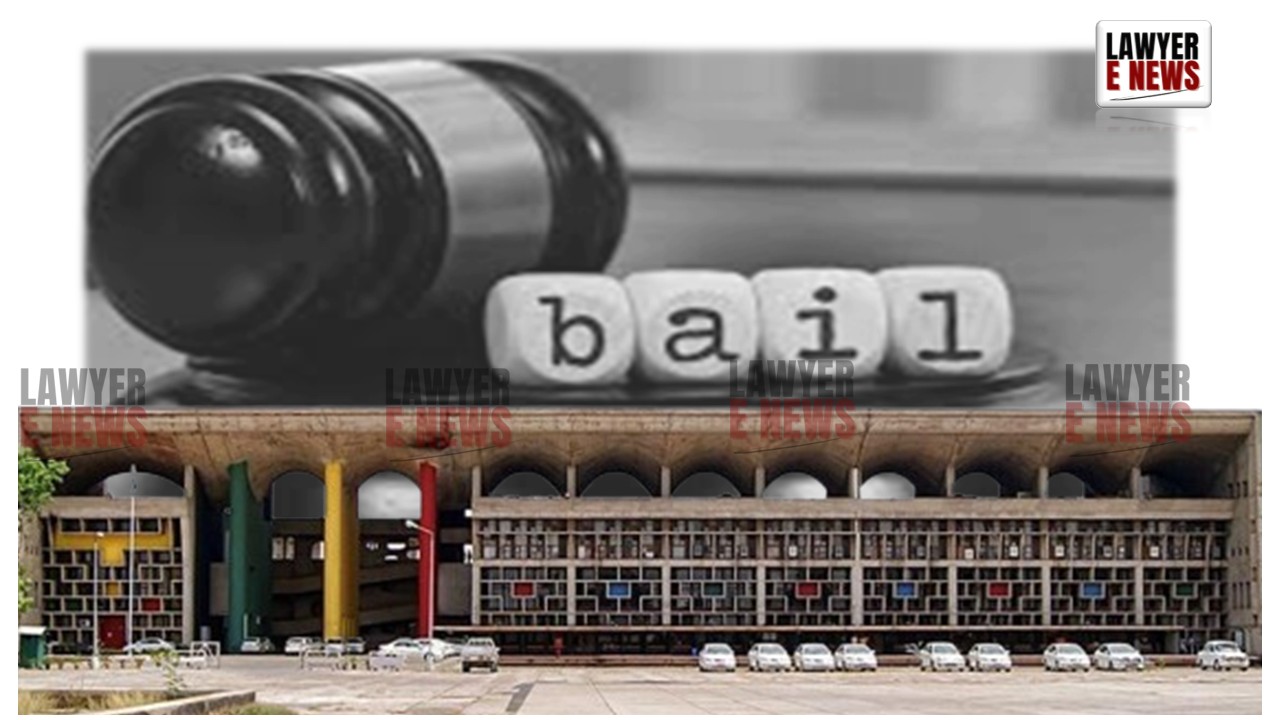
"Clock of liberty begins the moment an individual’s volition is subsumed by the arresting authority’s coercive power and he/she is no longer free to depart, regardless of when a formal declaration is made." Punjab and Haryana High Court, in a significant ruling, held that the mandatory 24-hour period for producing an arrested person before a Magistrate begins from the exact moment of physical deprivation of liberty, rather than the time recorded in the formal arrest memo.
A bench of Justice Sumeet Goel observed that any restraint on a person's liberty, regardless of the nomenclature used by the investigating agency, constitutes an arrest for the purpose of constitutional and statutory safeguards.
The petitioner, a partner in a pharmaceutical firm, was accused of involvement in the illegal inter-state diversion of psychotropic medicines under the NDPS Act. On October 31, 2025, at approximately 10:45 P.M., the Narcotics Control Bureau (NCB) searched his premises in Dehradun and he subsequently traveled to Chandigarh in an NCB vehicle. While his formal arrest was recorded only at 9:00 P.M. on November 01, 2025, he was produced before a Magistrate at 2:00 P.M. on November 02, 2025.
The primary question before the court was whether the 24-hour period under Section 58 of the BNSS (formerly Section 57 CrPC) and Article 22(2) of the Constitution of India commences from the time of de facto apprehension or the time of formal arrest. The court also examined whether the petitioner was in coercive custody from the moment he left his premises with the NCB officials.
Personal Liberty As The Bedrock Of Democracy
Justice Sumeet Goel began the judgment by emphasizing that personal liberty is an inherent attribute of humanity that the law merely seeks to recognize and fortify. The Court noted that the protection of personhood from unlawful restraint is a duty so sacred that it transcends the ordinary business of courts. Quoting Lord Denning, the bench observed that whenever a cause concerning personal freedom is espoused, the judge must cast aside all other matters to afford it an immediate hearing.
Nomenclature Of 'Detention' vs 'Arrest' Is Irrelevant
The Court delved into the legal definition of 'arrest', noting that the term is not defined in the BNSS or the Constitution. It held that arrest is a "term of art" representing a state where an individual's autonomy is subsumed under the control of an authority. The bench clarified that whether a person is arrested depends on the factual deprivation of personal liberty to move where they please, rather than the label assigned by the agency.
"The record is merely a post facto declaration; it is the de facto restraint that triggers the clock of liberty."
Formal Arrest Memo Not Conclusive Proof Of Time
The bench observed that the time recorded in the arrest memo is a mere procedural formality and cannot be treated as an infallible index of the actual time of arrest. It warned that treating such records as absolute verity would allow investigating agencies to act as the sole auditors of their own compliance. The Court relied on the Supreme Court’s ruling in Niranjan Singh v. Prabhakar Rajaram Kharote to dismiss "informal custody" as a "shady facet" and "unfair evasion" of the law.
"Entry(s) contained in police records or arrest memos are merely declaratory and do not constitute infallible or conclusive proof of the time of arrest."
Magistrates Must Pierce The Documentary Veil
In a strong directive to the lower judiciary, the High Court held that the duty of a Magistrate is not a ministerial act of recording presence but a solemn judicial interrogation. The Court observed that Magistrates must act as the "sentinel on the qui vive" and proactively look past self-serving entries in police records. They are duty-bound to inquire into the "where, when, and how" of the capture to ensure illegal detentions are not regularized through sanitized paperwork.
Distinction Between Summons And Coercive Detention
The Court offered a caveat, distinguishing between coercive subsumption of volition and genuine investigative functions. It noted that if an individual is summoned for questioning but remains free to depart, has access to their mobile phone, and can communicate with the world, the 24-hour clock does not commence. However, if a person is detained overnight or compelled to stay in an agency office, such restraint is "in reality an arrest."
Subsequent Remand Cannot Cure Illegal Arrest
Addressing the legal consequences of such violations, the Court held that the mandate of Section 58 BNSS and Article 22(2) is a peremptory command. Referring to the Supreme Court’s decision in Directorate of Enforcement v. Subhash Sharma, the bench noted that a violation of these constitutional rights cannot be cured by the subsequent passing of a remand order. Once the arrest is found to be vitiated by illegal detention beyond 24 hours, the individual deserves to be enlarged on bail.
"The twenty-four-hour mandate is not a reflexive trap for a diligent investigating officer, but a shield against an overbearing captor."
Petitioner Was In Continuous Coercive Custody
Applying these principles to the facts, the Court found it "highly unbelievable" that the petitioner chose to accompany the NCB team through the night in their vehicle of his own volition. The bench noted that the petitioner remained with the NCB from 10:45 P.M. on October 31 until his production on November 02. The total period of detention was approximately 39 hours, far exceeding the 24-hour limit, rendering the arrest and subsequent custody illegal.
The Court allowed the petition, declaring the arrest of Anuj Kumar Singh illegal due to the violation of the 24-hour production mandate. It ordered the petitioner’s immediate release upon furnishing requisite bonds, while clarifying that these observations would not affect the merits of the ongoing trial.
Date of Decision: 16 April 2026