
-
by sayum
26 August 2026 1:49 PM







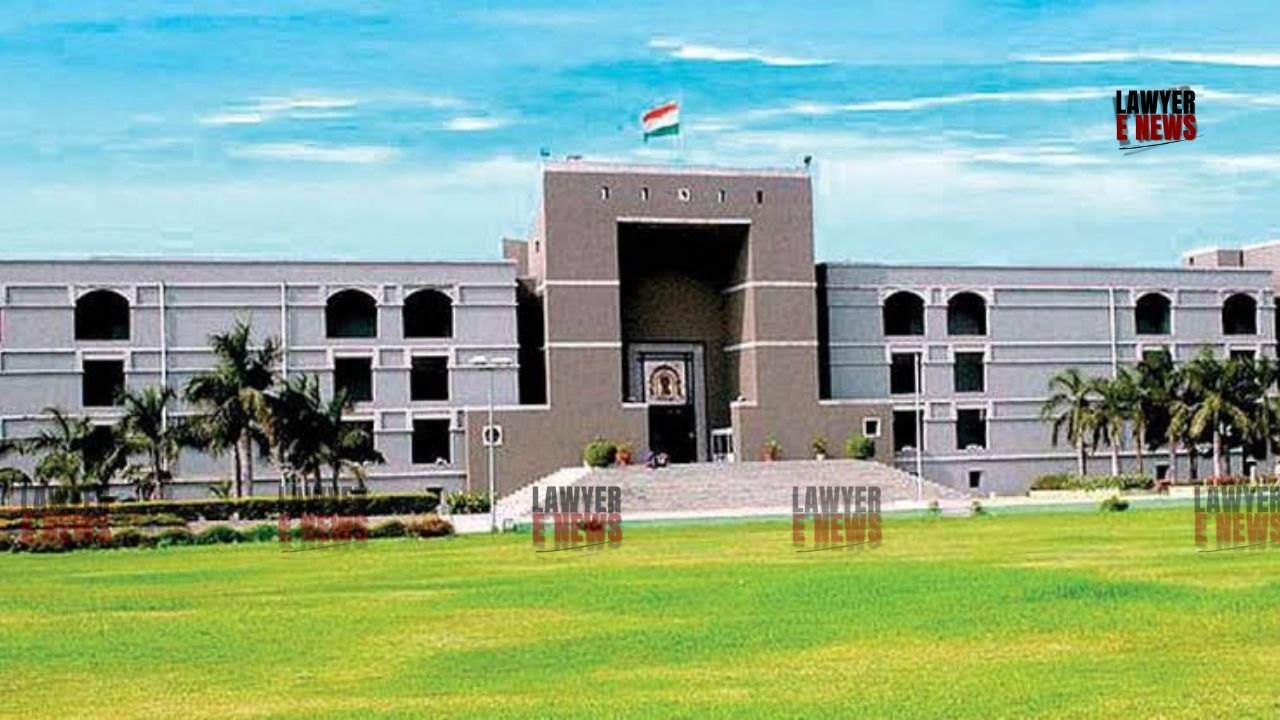
“If More Than One Promotional Post Exists, Higher Grade Pay Must Correspond To The Lowest Promotional Post”, Gujarat High Court recently held that where a government employee has more than one promotional avenue carrying different pay scales, the benefit of higher grade pay must correspond to the lowest promotional post.
Justice Maulik J. Shelat delivered a reportable judgment in Anil Babubhai Vaja v. Gujarat Maritime Board, dismissing a batch of writ petitions filed by Class-IV employees seeking the first higher grade pay scale of ₹4000–6000 applicable to the post of Tradesman instead of ₹2610–3540 applicable to Khalasi.
The Court ruled that since promotions from the post of Mazdoor were granted both to Khalasi and Tradesman, two promotional avenues existed, and therefore, under Clause 3(3) of the Government Resolution dated 16.08.1994 read with Clause 2 of G.R. dated 14.08.1998, the higher grade scale must correspond to the lowest promotional post, i.e., Khalasi.
Background of the Case
The petitioners were working with the Gujarat Maritime Board as Mazdoors (Class-IV employees) since around 1994. One petitioner had initially joined as an apprentice in 1993 and later continued in service.
After completing nine years of service, the Board granted them the first higher grade pay scale of ₹2610–3540, which corresponds to the promotional post of Khalasi.
However, the petitioners contended that the next promotional post from Mazdoor was Tradesman, which carried a higher pay scale of ₹4000–6000. On that basis, they demanded that their higher grade pay should be fixed at the Tradesman scale.
The petitioners relied on earlier instances where Mazdoors had been promoted to Tradesman and also pointed out that certain litigations relating to Khalasi and Tradesman pay scales had previously been decided by the High Court and affirmed up to the Supreme Court.
After their representation was rejected by the Board through a communication dated 24.04.2013, the petitioners approached the High Court under Articles 14, 16 and 226 of the Constitution of India.
Legal Issues Before the Court
The Court examined several key questions arising in the petitions:
“Whether the petitioners were entitled to the higher grade pay scale of ₹4000–6000 applicable to the post of Tradesman?”
“Whether the existence of multiple promotional avenues would affect entitlement to higher grade pay scale under the Government Resolutions of 1994 and 1998?”
“Whether the writ petitions were liable to be rejected on the ground of delay and laches?”
“Whether non-clearing of trade test or CCC examination could justify denial of higher pay scale?”
Court’s Observations on Delay and Continuing Wrong
The respondent Board argued that the petitions were barred by delay, as the pay scale had been granted years earlier.
However, the Court rejected this objection and held that incorrect pay fixation constitutes a continuing wrong, giving rise to a recurring cause of action every month.
Referring to Supreme Court precedents including Union of India v. Tarsem Singh and Sanjay Kumar Upadhyay v. State of Jharkhand, the Court observed:
“Benefit of higher pay scale, if not granted as per law, amounts to a continuing wrong as it has direct bearing on the monthly salary received by the employee.”
Thus, the Court held that delay alone could not defeat a claim relating to pay fixation, though monetary relief could be restricted to three years prior to the filing of the petition.
Draft Recruitment Rules Cannot Govern Service Conditions
Another contention raised by the Board relied on draft recruitment rules to establish the promotional hierarchy.
The Court rejected this reliance and clarified that draft rules not sanctioned or notified by the State cannot govern the service conditions of employees.
The Court noted that similar arguments had earlier been rejected by the Division Bench in Haresh H. Bhatt v. Gujarat Maritime Board, observing that unapproved draft rules have no legal force.
CCC Examination and Trade Test Not Applicable
The Board also argued that the petitioners had not cleared departmental tests or the CCC computer examination, and therefore could not claim the higher pay scale.
The Court rejected this reasoning.
It observed that Government Resolution dated 01.10.2007 clearly exempts Class-IV employees from the CCC examination. Moreover, the Board failed to produce any rule mandating trade tests for grant of higher pay scale.
Justice Shelat remarked that such arguments were “nothing but a feeble attempt to deny the legitimate claim”, as the employer could not establish any mandatory requirement.
Existence of Two Promotional Avenues from Mazdoor
The central issue before the Court was whether Mazdoor had only one promotional avenue (Khalasi) or two avenues (Khalasi and Tradesman).
From the record, the Court found:
Thus, the Court concluded that two promotional avenues existed.
Justice Shelat noted:
“It has come on record that the promotion was granted to Mazdoor on the post of Khalasi and Tradesman, as the case may be. Thus, it is discernible that… there are two promotional avenues available to Mazdoor.”
Interpretation of Higher Grade Pay Scheme
The Court then interpreted the Higher Grade Pay Scale Scheme under Government Resolution dated 16.08.1994 and its clarification under G.R. dated 14.08.1998.
Clause 3(3) of the 1994 Resolution provides that:
“For employees on posts having more than one promotional post in different scales of pay, their Higher Grade Scale shall be considered the pay scale of the lowest of the promotional posts.”
Similarly, Clause 2 of the 1998 Resolution clarifies that where multiple promotional posts exist, the higher pay scale must correspond to the lowest promotional post.
Applying this principle, the Court held that since Mazdoor could be promoted either to Khalasi or Tradesman, the higher grade benefit must correspond to the lowest promotional post, which was Khalasi with pay scale ₹2610–3540.
Court’s Final Decision
After examining the factual record and applicable government resolutions, the Court concluded that the Gujarat Maritime Board had correctly granted the higher pay scale corresponding to Khalasi.
Justice Shelat held:
“In view of two promotional avenues available from the post of Mazdoor to the post of Khalasi and Tradesman… the higher pay scale shall be the scale of the lowest promotional post.”
Accordingly, the Court dismissed the petitions, observing that the petitioners were not entitled to the higher pay scale of ₹4000–6000 applicable to Tradesman.
The Gujarat High Court ultimately held that when a post has more than one promotional avenue with different pay scales, the higher grade benefit must correspond to the lowest promotional post.
Since Mazdoor could be promoted either to Khalasi or Tradesman, the applicable higher grade scale was ₹2610–3540 (Khalasi scale) and not ₹4000–6000 (Tradesman scale).
Accordingly, the batch of writ petitions was dismissed, and the rule was discharged with no order as to costs.
Date of Decision: 06 March 2026





