-
by sayum
28 August 2026 7:56 AM







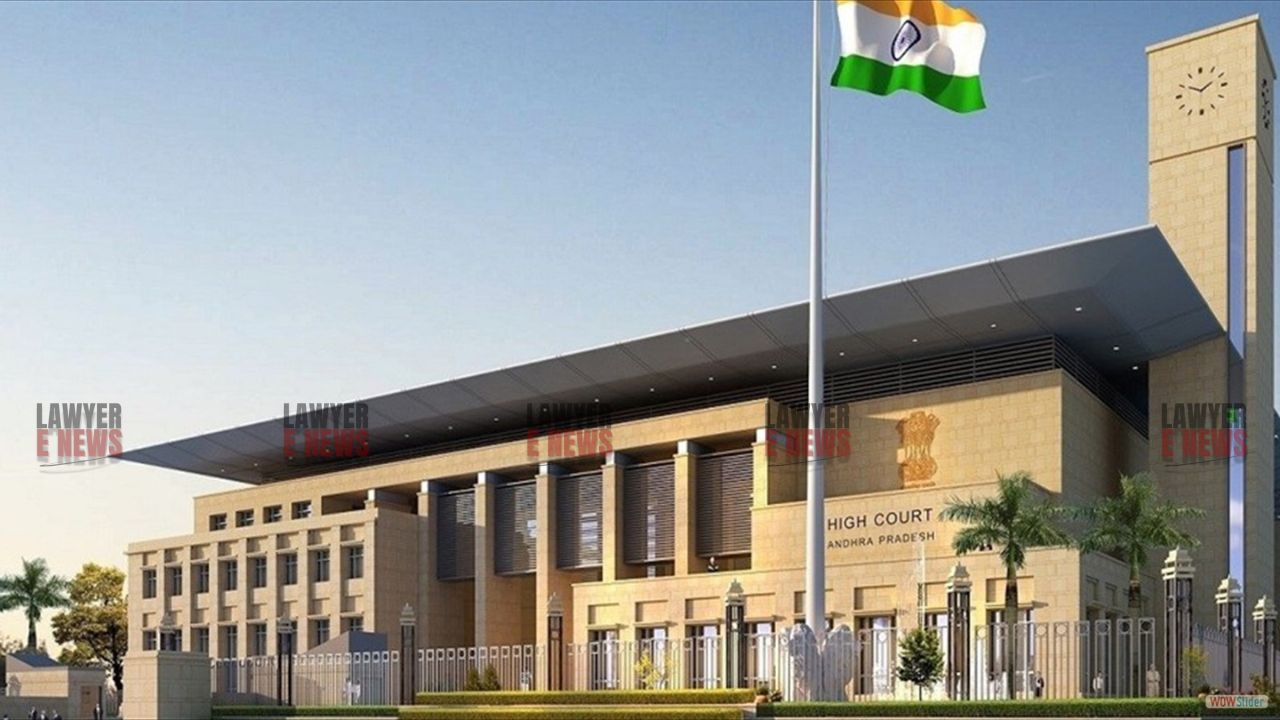
"Statute itself has amended the ‘Specified Value’ as ‘not less than three lakh rupees’... no separate notification by the Central Government is required to bring the amendment into force and to make it operative," High Court of Andhra Pradesh, in a landmark Full Bench ruling, held that the 2018 amendment to the Commercial Courts Act, 2015, which reduced the "Specified Value" of commercial disputes from ₹1 Crore to ₹3 Lakhs, is self-operative and effective from May 3, 2018.
A bench comprising Justice Cheekati Manavendranath Roy, Justice Ravi Nath Tilhari, and Justice Battu Devanand clarified that no separate notification from the Central or State Government is mandatory to trigger this revised valuation for the jurisdiction of Commercial Courts. The Court observed that the legislative intent was to provide an independent mechanism for the early resolution of commercial disputes of even lesser value to create a positive image for the Indian legal system.
The matter reached the Full Bench following a reference by a Division Bench in a civil revision petition challenging an execution order passed by the XI Additional District Judge, Tadepalligudem. The petitioner contended that as the dispute was commercial in nature and valued at approximately ₹78 Lakhs, only a Commercial Court had the inherent jurisdiction to execute the award under the amended Act. Conflicting previous judgments of the High Court in Bellam Balakrishna v. Greenmount Developers and U.V. Satyanarayana v. M/s. Shriram City Union Finance Ltd. necessitated a definitive ruling on whether the ₹3 Lakh threshold required a specific government notification to become functional.
The primary question before the Full Bench was whether the Amendment Act 28 of 2018, by itself, amended the ‘Specified Value’ to ₹3 Lakhs or if it merely enabled the government to do so via notification. The Court also sought to determine the effective date of this amendment and resolve the conflict between coordinate Division Bench judgments regarding the necessity of a State Government notification under Section 3(1A) of the Act.
Distinction Between Specified Value And Pecuniary Jurisdiction
The Full Bench noted that the previous Division Benches had failed to distinguish between "Specified Value" defined under Section 2(1)(i) and "pecuniary value" contemplated under Section 3(1A). The Court clarified that these are two distinct legal terms operating in separate fields. While Specified Value refers to the value of the subject matter that qualifies a dispute as "commercial," pecuniary value relates to the competence of a specific court to receive such a suit.
The Court observed that Section 2(1)(i) of the Act, as amended in 2018, explicitly substituted the words "one crore rupees" with "three lakh rupees." The Bench held that the phrase "as may be notified by the Central Government" in the section applies only if the government intends to fix a value higher than the ₹3 Lakh floor.
Amendment Is Self-Operative From May 2018
No Central Notification Needed For Base Limit
The Bench held that legislative power is the exclusive function of the Parliament, and since the Parliament itself amended the statute to reduce the threshold, no executive notification is required to give it life. The Court remarked that it was "beyond comprehension" why a separate notification would be needed to bring a parliamentary amendment into force unless the executive intended to deviate upward from the statutory base limit.
"The Statute itself has amended the ‘Specified Value’ as ‘not less than three lakh rupees’... no separate notification by the Central Government is required to bring the amendment into force," the Bench held. It emphasized that the disjunctive word "or" in Section 2(1)(i) separates the statutory base limit from the discretionary power of the Central Government to notify a higher value.
Jurisdiction Of Existing Commercial Courts
Special Courts Prevail Over General Civil Courts
Addressing the contention that existing Commercial Courts lacked jurisdiction for disputes below ₹50 Lakhs due to the A.P. Civil Courts Act, the Full Bench ruled that the Commercial Courts Act is a special central enactment. The Court held that when a special court is constituted under a special law, the jurisdiction of ordinary civil courts is impliedly barred. Consequently, Commercial Courts presided over by District Judges are competent to try commercial disputes above ₹3 Lakhs regardless of state-level pecuniary limits.
The Bench observed: "Jurisdiction conferred on Commercial Courts is a special jurisdiction under the special enactment." The Court noted that the lack of a State notification under Section 3(1A) does not denude existing Commercial Courts of their power, as that section is primarily intended to enable the creation of Commercial Courts at levels below a District Judge.
Analysis Of Conflicting Precedents
Bellam Balakrishna Declared Incorrect Law
The Full Bench explicitly overruled the logic in Bellam Balakrishna, which had held that the ₹3 Lakh limit would not operate without a State notification. The Court found this interpretation erroneous as it conflated Specified Value with Pecuniary Value. Regarding U.V. Satyanarayana, the Court noted that while the result was largely consistent with the current ruling, that Bench had failed to notice that the amendment is prospective and does not apply to transactions filed before May 3, 2018.
"The judgment of the Division Bench in the case of Bellam Balakrishna that till the notification is issued by the State Government... the value fixed in Section 2(1)(i) will not come into operation is not the correct proposition of law," the Full Bench declared.
Justice Tilhari’s Partial Dissent On Workability
Concerns Over Overburdening Existing Courts
Justice Ravi Nath Tilhari, in a partly concurring and supplementing opinion, expressed a different view on the implementation of the ₹3 Lakh to ₹1 Crore bracket. He argued that while the Specified Value is fixed by law, the "pecuniary jurisdiction" must be specifically conferred by the State under Section 3(1A) to make the Act "workable." He cautioned that an automatic transfer of all cases above ₹3 Lakhs to the only two existing Commercial Courts in the state would lead to "cadaveric consequences" and an unworkable scenario.
Justice Tilhari observed that "pecuniary value fixes the competence-parameters of the Court for receiving a commercial suit." He maintained that until the State Government notifies the pecuniary jurisdiction for the lower bracket, such disputes should technically remain with regular civil courts to avoid a total collapse of the specialized commercial court system.
Final Directions and Conclusion
The Full Bench concluded that the ₹3 Lakh threshold is legally effective from 2018. It issued a strong recommendation to the State Government and the High Court to functionalize the 13 recently converted Fast Track Courts as Commercial Courts at the Senior Civil Judge level. The High Court was directed to pursue the implementation of G.O.Rt.No.609 to ensure that the legislative intent of the 2018 amendment is realized in spirit and letter.
The reference was answered by clarifying that the amended "Specified Value" is ₹3 Lakhs by operation of the Statute itself since May 3, 2018. The Registry was directed to place the individual revision petitions before the respective benches for disposal in light of these findings.
Date of Decision: 18 May 2026