-
by sayum
18 August 2026 8:28 AM







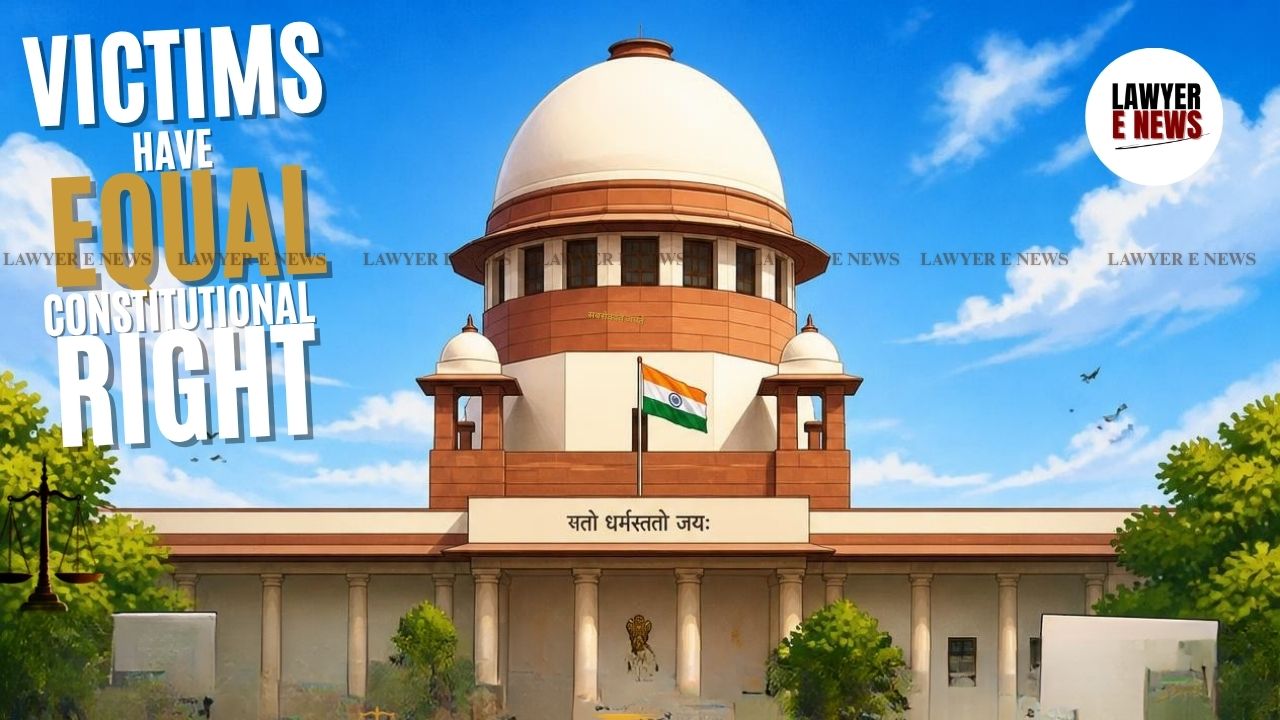
"The right to speedy trial is not only the prerogative of the accused but is also a valuable right of the victim and any inordinate delay in the conclusion of the trial, could have a deleterious effect on the society in general." Supreme Court, in a significant ruling dated August 17, 2026, held that Section 12 of the Uttar Pradesh Gangsters Act does not mandate staying or freezing other criminal trials pending against an accused, emphasizing that the provision is only intended to resolve scheduling conflicts in the event of a clash of dates.
A bench of Justices K.V. Viswanathan and Arun Palli observed that interpreting Section 12 to automatically stall a murder trial until a separate gangster proceeding concludes would violate Article 21 of the Constitution and render the right to a speedy trial illusory for victims.
The appellant, who is the brother of the deceased victim, lodged an FIR in September 2023 under Sections 147, 323, 504, 506, 302, and 427 of the IPC at Police Station Talbehat, District Lalitpur, alleging a brutal murder committed with lathis, stones, and metal rods. Following a detailed investigation, charge sheets were filed, cognizance was taken, and the case was committed to the Sessions Court as Session Trial No. 934 of 2023. Meanwhile, authorities prepared a gang chart and subsequently lodged an FIR in January 2024 under Section 2(b)(i) of the Uttar Pradesh Gangsters and Anti-Social Activities (Prevention) Act, 1986.
Application To Stay Trial Rejected
When the murder trial had advanced to the stage of recording statements under Section 313 of the CrPC, the accused filed an application to keep the sessions trial in abeyance, claiming precedence under Section 12 of the Gangsters Act. The Additional District and Sessions Judge dismissed this application on March 3, 2025, holding that the legislature never intended to stall mature trials where prosecution evidence was already complete. However, upon a criminal revision filed by the accused, the Allahabad High Court reversed the trial court's order and directed that the murder trial be stayed, prompting the de facto complainant to approach the Supreme Court.
The primary question before the court was whether Section 12 of the Gangsters Act compels a trial court to keep all other pending criminal proceedings against an accused in abeyance until the conclusion of the trial under the Gangsters Act. The court was also called upon to determine whether the statutory precedence granted to Special Courts under the Gangsters Act operates as a blanket freeze on other ongoing criminal prosecutions.
Section 12 Only Resolves Date Clashes
Analyzing the statutory framework, the court underscored that Section 12 of the Gangsters Act dictates that trials by Special Courts shall have precedence over trials in any other court not being a Special Court. However, the bench clarified that this provision does not require freezing or halting independent proceedings. Citing the precedent in Dharmendra Kirthal v. State of U.P., the court reiterated that the emphasis is on securing a speedy trial without denying justice, ensuring that an accused does not face simultaneous conflicting commitments.
"Dates Should Not Clash Together"
The bench noted that the true legislative intent is to prevent trial delays caused by scheduling conflicts between ordinary courts and Special Courts. The statutory design ensures that dates fixed in separate trials do not clash, thereby allowing the Gangsters Act proceedings to reach a logical conclusion without obstruction. It was never the design of the legislature to stall heinous crime trials like murder or dacoity merely because a subsequent gangster case had been registered.
Harmonizing With Statutory Mandates - "Harmonious Construction With Section 346 BNSS"
The court observed that Section 12 must be read harmoniously with procedural mandates requiring day-to-day trial continuity, such as Section 346 of the Bharatiya Nagarik Suraksha Sanhita, 2023, which succeeded Section 309 of the Code of Criminal Procedure. When read together, the provisions confirm that ordinary criminal trials must proceed expeditiously, and a stay is warranted only when simultaneous appearance of the accused or counsel in conflicting schedules physically impedes the progress of the Special Court.
"Absurdity Of Freezing Earlier Criminal Trials"
Rejecting the expansive interpretation advanced by the accused, the bench reasoned that staying other criminal prosecutions until the conclusion of a gangster trial would produce absurd results. It would mean that an accused charged under multiple substantive penal laws could indefinitely stall substantive convictions by manipulating trial timelines, effectively frustrating the administration of criminal justice.
Victim Rights And Constitutional Mandates - "Speedy Trial Is Not Exclusive To Accused"
Expanding on the constitutional dimensions, the bench declared that the right to a speedy trial under Article 21 of the Constitution is not an exclusive prerogative of the accused but a valuable, enforceable right of the victim. Citing the observations in Rattiram v. State of M.P., the court stressed that inordinate trial delays cause acute suffering and anguish to victims, sometimes exceeding the anxieties faced by the accused.
"Prejudice To Preservation Of Evidence"
The court cautioned that accepting the expansive interpretation of Section 12 would encourage accused persons to stall substantive trials under the pretext of pending gangster proceedings. Such a practice leads to fading human memories, hostile witnesses, and insurmountable challenges in preserving vital evidence, ultimately making a mockery of the judicial process.
The Supreme Court held that the Allahabad High Court committed a manifest error by issuing a contradictory final direction to stay the murder trial despite correctly acknowledging the limited scope of Section 12. Noting that the sessions trial had already concluded and resulted in a conviction pursuant to interim orders passed by the apex court, the appeal was allowed, and the impugned High Court order dated August 25, 2025, was set aside.
Date of Decision: 17 August 2026