-
by sayum
18 August 2026 8:28 AM







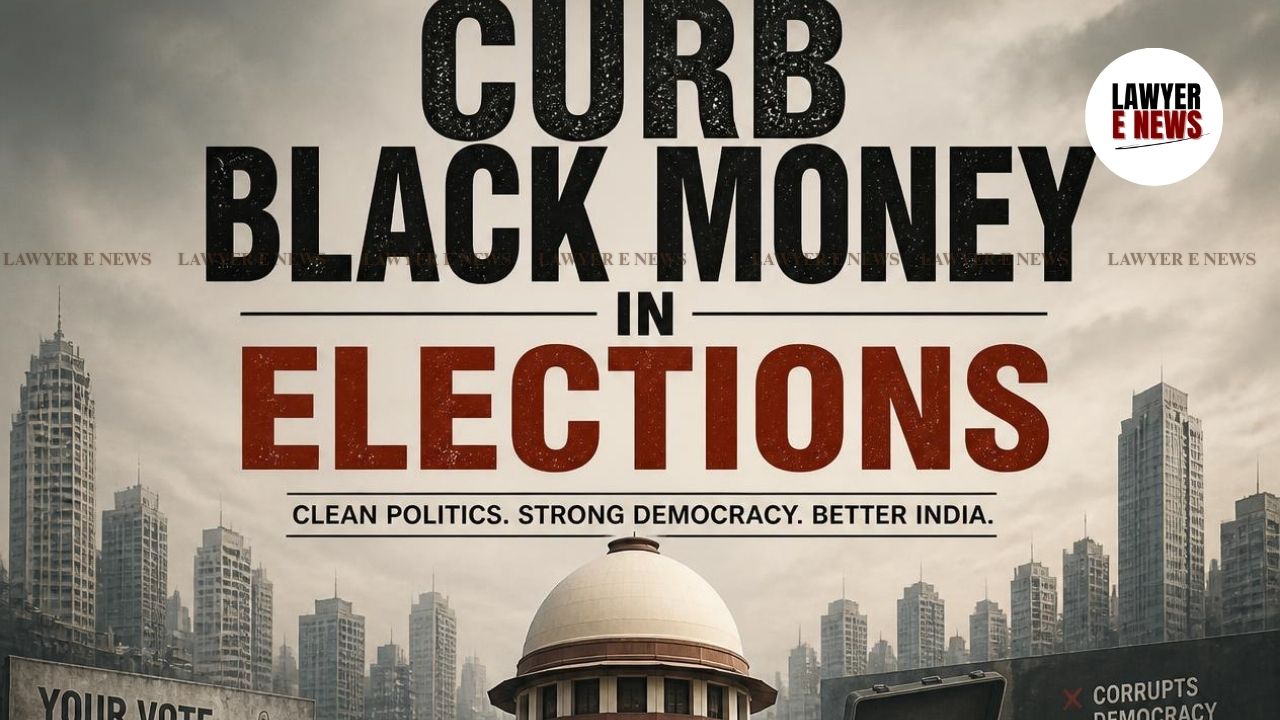
"The right to vote freely for the candidate of one's choice is of the essence of a democratic society, and any restrictions on that right strike at the heart of representative government." Supreme Court, in a significant ruling dated August 17, 2026, held that the unbridled use of black money and electoral inducements severely compromises the constitutional purity of elections, while issuing comprehensive guidelines to curb illicit funding and mandating fast-track disposal of criminal cases against politicians.
A bench comprising Justice Sanjay Karol and Justice Nongmeikapam Kotiswar Singh observed that democracy and free and fair elections are inseparable twins, and that the electoral process is vitiated when money power virtually controls the field and turns the common voter into a purchasable commodity.
The case arose from a special leave petition filed by the State of Karnataka against a High Court order quashing an FIR registered during the 2014 Lok Sabha bye-elections in the Bellary constituency. Police had raided the respondent's premises on an anonymous tip regarding counterfeit currency and cash meant for voter bribery, seizing over twenty lakhs in cash, laptops, and cheque books. The Karnataka High Court had quashed the FIR on the ground that the complaint lacked specific averments regarding intended recipients and modes of bribery, prompting the State to move the apex court.
The primary question before the court was whether criminal proceedings involving electoral offences and cash seizures can be short-circuited or quashed at the threshold without proper investigation. The court was also called upon to determine the parameters for executing search and seizure operations by election machinery and the legal safeguards against unilateral withdrawal of election-related prosecution by state governments.
Court Reaffirms Indissoluble Link Between Democracy and Electoral Purity
The court commenced its analysis by tracing the evolution of democracy from ancient Athens to modern constitutional republics, emphasizing that the rule of law and free elections are the twin hallmarks of any legitimate governance structure. Citing foundational precedents including Indira Nehru Gandhi v. Raj Narain and Anoop Baranwal v. Union of India, the bench underscored that the ballot is more potent than any weapon, serving as a peaceful instrument for citizens to unseat unresponsive governing parties.
"Democracy And Free And Fair Elections Are Inseparable Twins"
Quoting extensively from past Constitution Bench observations, the court reiterated that a voter's right to cast a ballot includes the fundamental right to be informed about the antecedents and criminal past of contesting candidates. When elections are fought with black money, the electoral level playing field is severely distorted, enabling unscrupulous elements to capture legislative bodies and defeat the socialist and democratic goals enshrined in the Preamble of the Constitution of India.
"In a democracy the little man—voter has overwhelming importance and cannot be hijacked from the course of free and fair elections. His freedom to elect a candidate of his choice is the foundation of a free and fair election."
Judicial Recognition of Black Money As a Chronic Threat
The judgment comprehensively documented decades of judicial and legislative concern over the pernicious influence of black money, referencing landmark rulings such as Kanwar Lal Gupta v. Amar Nath Chawla, the Goswami Committee Report, the Vohra Committee Report, and the 255th Law Commission Report. The bench observed that the proliferation of undeclared funds creates a vicious parallel economy that corrupts government machinery and makes the task of investigating agencies exceptionally difficult.
"Unaccounted Money Destroys Level Playing Field"
The court noted that large funds tend to disproportionately increase a candidate's reach, denying less affluent individuals and parties an equal chance to present their programs to the electorate. Such structural inequality reduces participatory democracy to a sham, effectively denying ordinary citizens an equal and effective voice in the governance of the nation.
Analysis of Election Commission Powers and Standard Operating Procedures
Examining the constitutional contours of Article 324 of the Constitution of India, the bench observed that the Election Commission possesses wide residuary powers to fill legislative vacuums for ensuring free and fair elections, as established in Mohinder Singh Gill and Union of India v. Assn. for Democratic Reforms. The court reviewed the Standard Operating Procedures governing Flying Squads and Static Surveillance Teams, noting that cash seizures exceeding fifty thousand rupees require recorded reasons and a prima facie nexus to electoral malpractices.
"Statutory Safeguards Balance Enforcement With Citizen Rights"
The court observed that video-graphing search proceedings, preparing Panchnamas in strict compliance with the CrPC, and filing complaints within twenty-four hours provide adequate structural safeguards against arbitrary harassment of common citizens while maintaining rigorous surveillance against the flow of illicit cash.
Strict Controls Mandated on Withdrawal of Criminal Prosecutions
Addressing a core concern highlighted by the Election Commission regarding the unilateral withdrawal of election-related criminal cases following shifts in political power, the court invoked its rulings in State of Kerala v. K. Ajith and Ashwini Kumar Upadhyay v. Union of India. The bench reaffirmed that Section 321 of the CrPC does not grant absolute power to public prosecutors or state governments, and that judicial consent must be supervisory and rigorous to prevent the subversion of justice.
"Political Dispensation Changes Cannot Oust Prosecution"
The court strongly deprecated the practice of withdrawing serious electoral offences, including bribery and defacement violations, merely due to changes in government. Such executive overreach undermines public trust and sends a dangerous signal that election law violators can act with complete impunity.
Comprehensive Directions Issued by the Supreme Court
Concluding its extensive analysis, the bench issued a series of binding directions to authorities across India to ensure systemic accountability. When cash or assets are seized, the seizing authority must report the same within twenty-four hours to the jurisdictional District Magistrate or court, disclosing written reasons establishing a prima facie nexus with a suspected electoral offence.
"Fast-Track Courts Designated For MP and MLA Trials"
Investigating officers must complete probes into election FIRs within one year, failing which recorded reasons must be communicated to the Election Commission alongside quarterly status reports routed through police nodal officers. Furthermore, when Static Surveillance Teams detect cash exceeding ten lakh rupees, information must immediately be forwarded to the Income Tax Department.
"High Courts Directed To Designate Special Courts"
To clear the massive backlog of pending cases from the 2024 Lok Sabha elections and recent assembly polls, High Courts were directed to designate fast-track special courts for the expeditious trial of cases involving candidates, sitting MPs, and MLAs. Crucially, the court mandated that the withdrawal of any criminal case against candidates in a particular election cycle shall require the prior approval of the concerned High Court, reinforcing the constitutional mandate of judicial oversight.
In summary, the Supreme Court's directives establish a robust institutional framework that bridges administrative enforcement with judicial oversight, ensuring that the integrity of India's democratic electoral process remains uncompromised by the corrosive influence of black money and political patronage.
Date of Decision: 17 August 2026