
-
by sayum
28 August 2026 2:11 PM







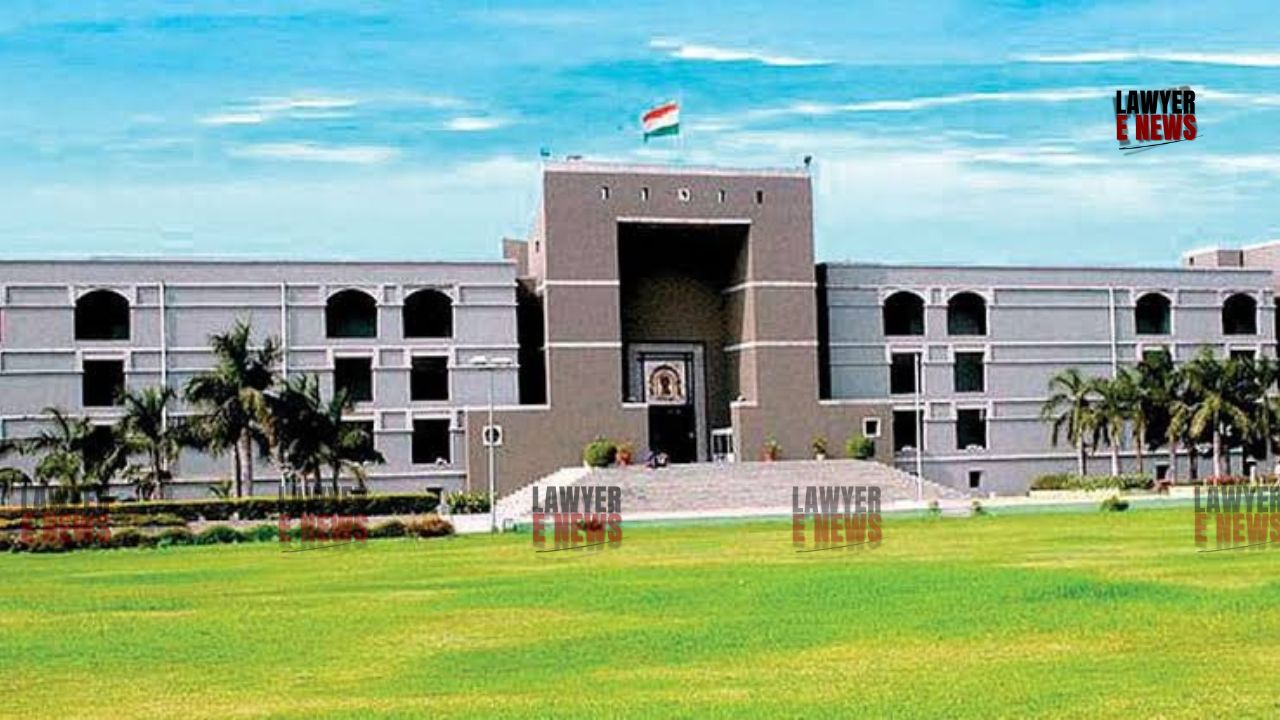
"A mere reference to the name of family members in a criminal case arising out of a matrimonial dispute, without specific allegations indicating their active involvement should be nipped in the bud," Gujarat High Court, in a significant ruling, held that criminal proceedings under the IPC and the Domestic Violence Act cannot be sustained when they are initiated as a "counterblast" to divorce proceedings and contain only general, omnibus allegations against the husband's parents.
A bench of Justice D.N. Ray observed that there is a growing trend of using matrimonial laws as a tool for personal vendetta, which overburden the judiciary and harass innocent family members.
The case arose from two petitions filed by the mother-in-law and father-in-law seeking the quashing of complaints filed under the Protection of Women from Domestic Violence Act, 2005, and various provisions of the Indian Penal Code, 1860. The complainant-wife had alleged an incident of assault and harassment on December 15, 2022, after her husband, who resides in the United States, had already obtained a decree of divorce from a Superior Court in New Jersey in February 2023.
The marriage between the respondent-complainant and the petitioners’ son was solemnized on June 24, 2021. Following marital discord and a brief stay, the husband returned to the USA and secured a divorce decree on February 15, 2023. Shortly after the divorce was granted, the wife filed an FIR on February 28, 2023, and a DV Act complaint in March 2023, alleging that she was assaulted and turned out of the house by her in-laws in December 2022.
The primary question before the court was whether the continuation of criminal proceedings against the in-laws constituted an abuse of the process of law when the allegations were nonspecific and filed after the dissolution of marriage. The court was also called upon to determine if the complaints were a retaliatory measure following the divorce decree obtained by the husband in a foreign jurisdiction.
Court’s Observations on Omnibus Allegations
The High Court noted that the accusations against the petitioners were "omnibus, general and utterly nonspecific." It observed that the complainant had barely resided with the petitioners for a period of two to three months, making the narrative of sustained harassment extremely improbable. The bench emphasized that for a criminal trial to proceed, there must be specific instances of criminal conduct attributed to each accused.
Court Warns Against 'Arm-Twisting' Tactics In Matrimonial Disputes
The court highlighted a "worrying trend" where parties involved in matrimonial relationships resort to filing frivolous and vexatious claims to settle personal scores. Relying on the Supreme Court’s decision in Ishwar Chand Sharma v. State of Uttar Pradesh, the bench noted that such litigation is often used as an "arm-twisting" method to reach a more favourable financial settlement or to simply harass the spouse’s family members.
The Phenomenon of the 'Matrimonial Bouquet' of Cases
Justice Ray referred to the concept of a "matrimonial bouquet" of litigation, where an estranged wife presents a set of cases including dowry demands, cruelty under Section 498A IPC, and domestic violence claims simultaneously. The court observed that this set of cases frequently includes bogus and empty allegations that contain little to no substance and are not backed by documentary evidence.
Duty Of Legal Fraternity to Weed Out Vexatious Proceedings
The judgment underscored the social responsibility of the Bar to ensure that the social fiber of family life is not ruined by exaggerated versions of small incidents. The court observed that lawyers must restrain parties from filing concocted complaints and should instead endeavor to help parties arrive at an amicable resolution of what is essentially a human problem.
Court Explains the Impact of Vexatious Litigation on the Judiciary
The bench lamented that the "docket explosion" caused by such false cases results in genuine complaints not being given the time and attention they deserve. The court held that it is the duty of the judiciary to separate the "wheat from the chaff" and protect innocent parties from being trampled by unscrupulous and baseless litigation initiated out of vengeance.
Final Directions and Quashing of Proceedings
Finding that the complaints were nothing but a counterblast to the divorce successfully initiated by the husband, the court held that allowing the proceedings to continue would be a gross abuse of the process of law. The bench noted that the petitioners were "unfortunately caught in the cross-hairs in the bitter matrimonial fight" between their son and the respondent.
The High Court allowed both the Special Criminal Applications and quashed the pending proceedings before the Chief Judicial Magistrate at Mirzapur, Ahmedabad, and the 11th Additional Metropolitan Magistrate, Ahmedabad. Rule was made absolute, setting aside the FIR, the charge-sheet, and the DV Act application qua the petitioners.
Date of Decision: 08 June 2026





