-
by sayum
07 August 2026 7:56 AM







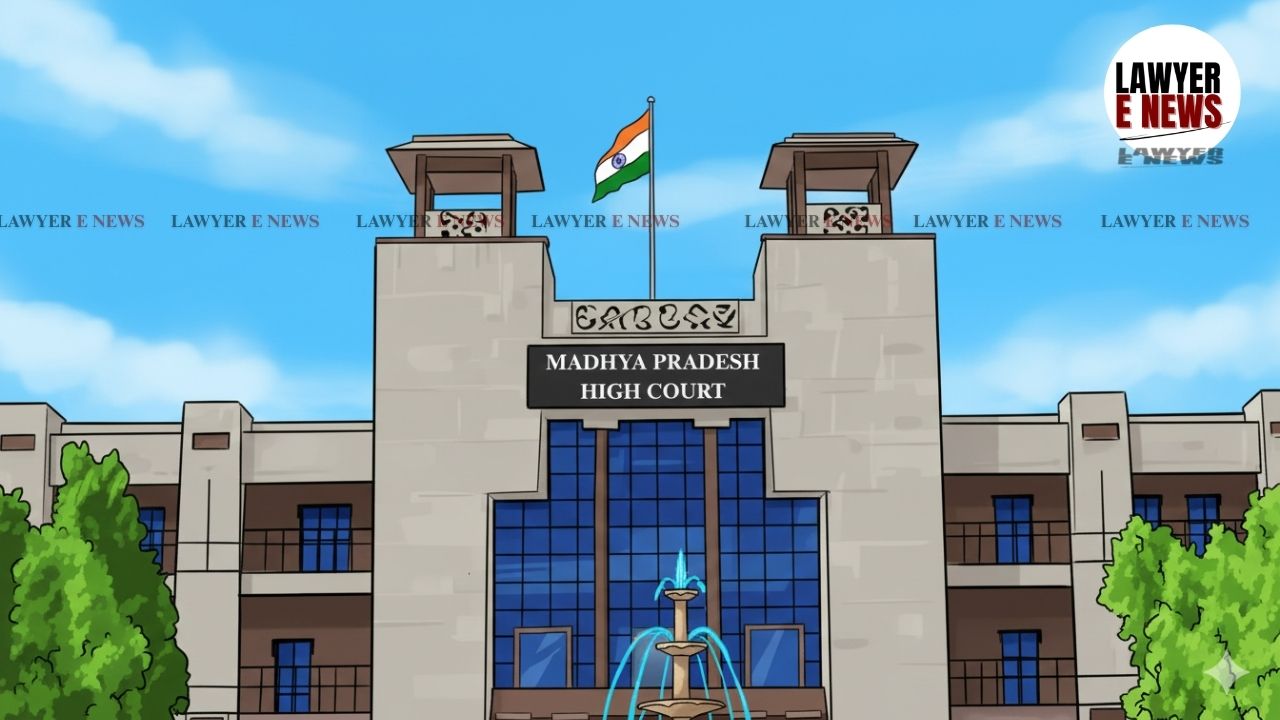
"when it is not proved by charge-sheet that there was an unlawful assembly consisting of five persons or more then specific role of each appellant has to be seen..." High Court of Madhya Pradesh at Jabalpur, in a crucial ruling, underscored the fundamental necessity of proving the existence of an 'unlawful assembly' of five or more persons for charges under Section 149 of the Indian Penal Code (IPC) to sustain.
A division bench of Justice Vivek Agarwal and Justice Avanindra Kumar Singh observed that without such specific proof, the individual role of each appellant must be independently established, leading to the acquittal of three men convicted for murder and other offenses.
The case originated from a petty dispute over Rs. 5 between the family of complainant Dinesh Yadav and appellant Satyendra Yadav on November 13, 2015. Later that evening, appellants Satyendra, Rajendra, Jitendra, along with three alleged "unknown persons," reportedly assaulted Dinesh's elder brother Parmanand, leading to his death, and also injured other family members. The trial court in Niwari had convicted the appellants under various sections, including Sections 302/149 and 323/149 of the IPC, alongside other charges.
The primary legal question before the High Court was whether the prosecution had sufficiently proven the existence of an unlawful assembly comprising five or more persons to invoke Section 149 IPC. Further, the court examined whether, in the absence of such proof, the individual culpability of each appellant for the alleged offenses was established beyond reasonable doubt.
Prosecution Fails To Establish Existence Of Unlawful Assembly
The High Court meticulously scrutinized the prosecution's foundational premise of an unlawful assembly. It highlighted that while the charge-sheet mentioned the involvement of "three unknown persons," it crucially failed to indicate any ongoing investigation against them under Section 173(8) of the Code of Criminal Procedure, 1973 (CrPC).
The bench emphasized that in such a scenario, where the existence of an unlawful assembly of five or more persons is not firmly established, the charges under Sections 147 (rioting), 148 (rioting, armed with deadly weapon), 302/149 (murder with common object of unlawful assembly), and 323/149 (voluntarily causing hurt with common object of unlawful assembly) of the IPC become unsustainable.
The Court noted, "when it is not proved by charge-sheet that there was an unlawful assembly consisting of five persons or more then specific role of each appellant has to be seen in which it is to be seen as to, if any, who had committed the individual offence and the person, who committed the specific offence and whether he committed the crime on his own or in the common intention of the co-accused." The Court added that while charges with the aid of Section 34 IPC (common intention) might have been applicable, the framing of charges under Section 149 IPC was legally flawed given the lack of proof regarding the minimum required members for an unlawful assembly.
Crucial Medical Evidence Withheld, Not Proved
The Court expressed surprise and suspicion over the prosecution's failure to exhibit and prove the medical reports of the injured witnesses, including Dinesh Yadav (P.W.1), Shobha Yadav (P.W.2), Malti Yadav (P.W.3), Rachna Yadav (P.W.4), and Brijesh Yadav (P.W.6). Despite the MLC reports for Brijesh, Rachna, and Dinesh, as well as reports from Jhansi Hospital, being attached to the file, the prosecution inexplicably did not present them as evidence during the trial. This significant omission raised serious doubts about the injuries claimed by the witnesses and their very presence at the scene, thereby weakening the prosecution's narrative considerably.
Witness Testimonies Riddled With Contradictions & Omissions
The High Court found numerous contradictions and omissions in the statements of the prosecution witnesses. P.W.1 Dinesh Yadav, who lodged the report, initially alleged Rajendra was armed with a gun but later admitted in cross-examination that Rajendra did not attack anyone with the gun or fire it. He also contradicted his own statement regarding Rajendra pulling Parmanand out of the house.
Several witnesses, including P.W.2 Shobha and P.W.3 Malti, also conceded that Rajendra did not use his gun. P.W.1 Dinesh Yadav further admitted that "three unknown persons," who were carrying weapons, did not assault anyone. Witnesses P.W.5 Narayan Yadav and P.W.7 Rakesh Yadav were declared hostile, with P.W.7 notably changing his version multiple times regarding seeing the assault. P.W.9 Tulsidas Yadav, an elderly witness with weak eyesight, also admitted not seeing the appellants assaulting anyone.
No Reliable Evidence on Rajendra's Gun Use
The bench specifically highlighted the lack of reliable evidence connecting appellant Rajendra to the use of his gun to cause injury, either by firing or using the butt. The contradictory statements of the alleged injured eyewitnesses, whose medical reports remained unproved, cast a shadow of doubt on this aspect of the prosecution's case.
Seized Weapons Not Linked To Injuries Or Produced In Court
The Court observed a critical lapse in the investigation regarding the seized weapons. The danda (Patiya) and sword were neither produced in court during the trial nor presented to Dr. R.C. Malaya (P.W.17), who conducted the post-mortem, for a query report on whether the injuries on the deceased could have been caused by these articles.
Dr. Malaya, in his cross-examination, explicitly stated that injuries No. 1, 2, and 3 (the fatal cut wounds) on the deceased's body could not have been caused by a danda. He further confirmed the absence of any gunshot injury. The only contusion (injury No. 4) was not deemed the cause of death. This disconnect between the alleged weapons and the nature of fatal injuries further undermined the prosecution's narrative.
Appellant Jitendra's Alibi Confirmed
The defence successfully established appellant Jitendra's plea of alibi. Medical records and testimony from D.W.2 Dr. D.S. Gupta and D.W.1 Dr. Balbir Krishna Gupta, along with the cross-examination of Court Witnesses Renu Samuel (C.W.1) and Harishchandra (C.W.2), confirmed Jitendra's admission and treatment at Government Hospital, Jhansi, on the relevant date and time. The prosecution failed to disprove this alibi. Appellant Satyendra's claim of sustaining injuries from Dinesh was also supported by D.W.4 Dr. Vinod Bajpayee's testimony, which the Government Advocate did not cross-examine.
Prosecution Fails To Prove Charges Beyond Reasonable Doubt
Considering the cumulative impact of these significant lapses – the failure to prove an unlawful assembly, the non-exhibition of crucial medical evidence, the contradictions in witness testimonies, the unproved link between weapons and injuries, and the established alibi for one appellant – the High Court concluded that the prosecution had failed to prove the charges against the appellants beyond a reasonable doubt.
"For the reasons mentioned above, we hold that the prosecution has failed to prove the charges against the appellants. Hence, the appeal is allowed."
In light of the substantial legal and evidentiary deficiencies, the High Court allowed the appeal, acquitting all appellants of the charges for which they had been convicted and sentenced. The Court directed the immediate release of appellant Jitendra from jail, provided he is not wanted in any other case, noting his prolonged custody of over ten years. This judgment reaffirms the stringent burden on the prosecution to prove every foundational element of an offense, particularly the existence of an unlawful assembly under the IPC.
Date of Decision: August 05, 2026