-
by sayum
07 August 2026 7:56 AM







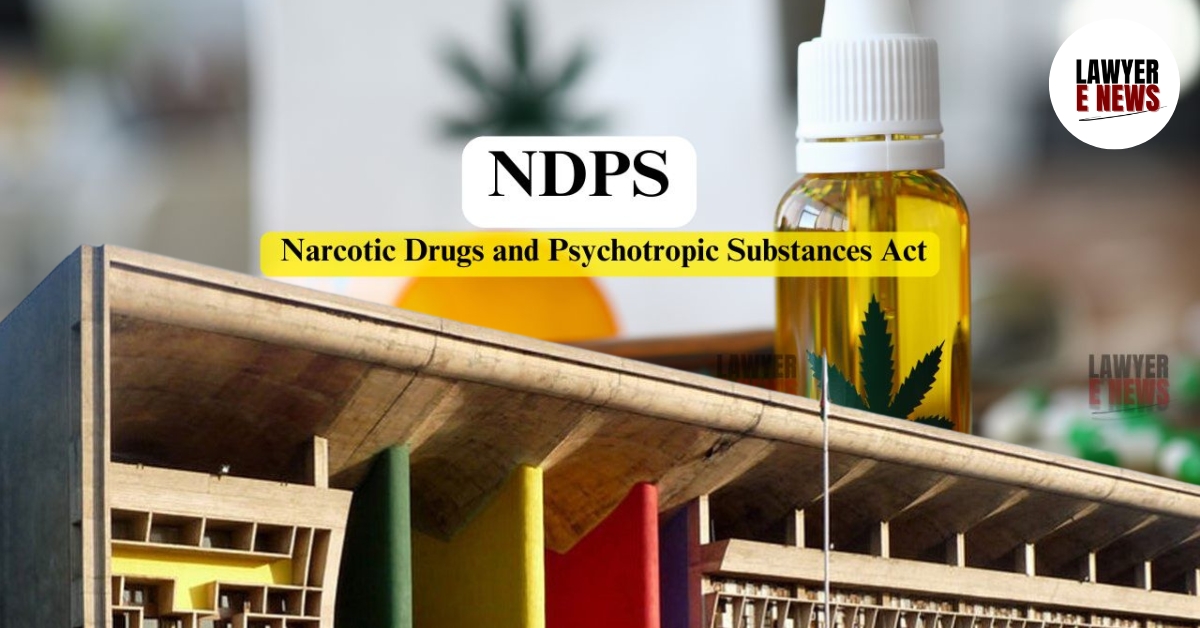
"Section 50 of the NDPS Act confers upon an accused a valuable right to have his personal search conducted before a Gazetted Officer or a Magistrate, if he so requires. Such right is sacrosanct and indefeasible which cannot be disregarded by the prosecution except at its own peril. The protection under Section 50 is confined to cases where the recovery is sought to be effected through the personal search of the accused. It has no application where the search is of an article, such as a bag, container, suitcase or any other object, which the accused may be carrying," Punjab and Haryana High Court.
Punjab and Haryana High Court, in a judgment, held that statutory safeguards under Section 50 of the Narcotic Drugs and Psychotropic Substances Act, 1985, are strictly confined to personal searches and do not extend to the search of bags, briefcases, or containers carried by an accused. A bench of Justice Rupinderjit Chahal observed that minor contradictions in the depositions of official witnesses, occurring after a lapse of years, cannot form the sole basis to discard an otherwise consistent prosecution case resting on the conscious possession of contraband.
The appellant was intercepted by a police party outside the Panipat bus stand on April 7, 1998, while carrying a blue bag on his left shoulder. Upon attempting to turn back, he was apprehended, and 1.5 kilograms of Charas was recovered from the bag during a search conducted in the presence of a Deputy Superintendent of Police. The Special Judge at Panipat convicted the appellant under Section 20 of the NDPS Act on July 8, 2004, sentencing him to ten years of rigorous imprisonment along with a fine of Rs. 1 lakh. Aggrieved by the conviction, the appellant approached the High Court, raising various legal challenges concerning procedural lapses and evidentiary inconsistencies.
The primary question before the court was whether the non-compliance of Section 50 of the NDPS Act vitiated a search conducted on a bag carried by an accused person. The court was also called upon to determine whether minor discrepancies in police testimonies and a delay in sending samples to the forensic laboratory warranted setting aside a conviction under the NDPS Act.
Court Rejects Arguments On Minor Discrepancies
Addressing the discrepancies pointed out by the defense concerning weights, seal numbers, and container types, the court noted that such minor variations are bound to occur when witnesses depose after a considerable lapse of time. The bench emphasized that the core substratum of the prosecution case regarding the apprehension and recovery of 1.5 kgs of Charas from the conscious possession of the appellant remained unshaken.
"Discrepancies Occur Due To Lapse Of Time"
The court observed that minor inconsistencies do not go to the root of the matter when the testimonies of official witnesses remain consistent on all material particulars of the crime.
Official Witnesses Inspire Confidence
Repelling the contention regarding the non-association of independent public witnesses, the court reiterated that the testimony of police personnel cannot be discarded merely because of their official status. The bench cited landmark rulings, including Karamjit Singh v. State and State of Punjab v. Balbir Singh, to underscore that police officials are presumed to act honestly unless clear animus or hostility is demonstrated by the defense.
"Testimony Of Police Personnel Treated Like Any Other Witness"
The court noted that general public hesitation in joining police investigations is a recognized reality, and the official witnesses in the present case remained thoroughly credible throughout their cross-examination.
Delay In FSL Transmission Not Fatal
On the eight-day delay in transmitting the sample parcel to the Forensic Science Laboratory, the court held that such delay is immaterial when safe custody and the intact nature of the seals are duly proved through ocular and documentary evidence. Citing Hardip Singh v. State of Punjab, the bench reiterated that in the absence of any evidence pointing toward tampering or prejudice caused to the accused, procedural delays in chemical analysis cannot invalidate a trial.
"Delay Of Days In Sending Sample Immaterial Without Tampering Proof"
Investigator As Complainant Validated
Addressing the validity of the investigation where the informant and the investigator were the same officer, the bench relied upon the Constitution Bench ruling of the Supreme Court in Mukesh Singh v. State. The court ruled that the dual role of an informant-investigator does not automatically vitiate the proceedings unless concrete bias or prejudice is established on the facts of the case.
Section 50 Safeguards Inapplicable To Articles
Ruling decisively on the applicability of Section 50 of the NDPS Act, the court affirmed that the provision is attracted exclusively during the personal search of an individual and does not govern the search of bags, containers, or luggage. The bench drew strength from precedents including Ajmer Singh v. State of Haryana and the recent ruling in Mehboob Shah v. State of Madhya Pradesh.
"Protection Under Section 50 Confined To Personal Search"
The court noted that even though Section 50 was strictly inapplicable since the contraband was recovered from a shoulder bag, the investigating agency had superfluously complied with the safeguard by serving a written notice and producing the appellant before a Gazetted Officer.
Final Directions And Order
Finding no illegality, perversity, or misreading of evidence in the judgment passed by the trial court, the High Court dismissed the appeal in its entirety. The conviction and sentence imposed under Section 20 of the NDPS Act were duly affirmed, and the appellant was directed to surrender forthwith if on bail to serve out the remainder of his sentence.
Date of Decision: 27 July 2026